


A risk-model for hospital mortality among patients with severe sepsis or septic shock based on German national administrative claims data
- PMID: 29558486
- PMCID: PMC5860764
- DOI: 10.1371/journal.pone.0194371
A risk-model for hospital mortality among patients with severe sepsis or septic shock based on German national administrative claims data
Abstract
Background: Sepsis is a major cause of preventable deaths in hospitals. Feasible and valid methods for comparing quality of sepsis care between hospitals are needed. The aim of this study was to develop a risk-adjustment model suitable for comparing sepsis-related mortality between German hospitals.
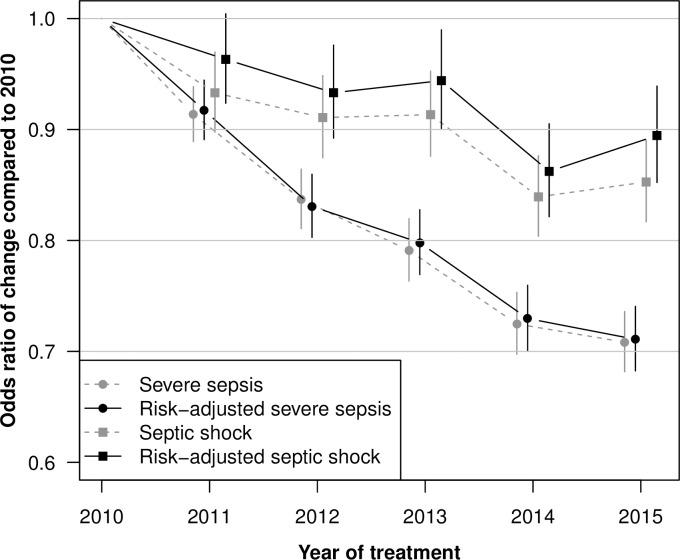
Methods: We developed a risk-model using national German claims data. Since these data are available with a time-lag of 1.5 years only, the stability of the model across time was investigated. The model was derived from inpatient cases with severe sepsis or septic shock treated in 2013 using logistic regression with backward selection and generalized estimating equations to correct for clustering. It was validated among cases treated in 2015. Finally, the model development was repeated in 2015. To investigate secular changes, the risk-adjusted trajectory of mortality across the years 2010-2015 was analyzed.
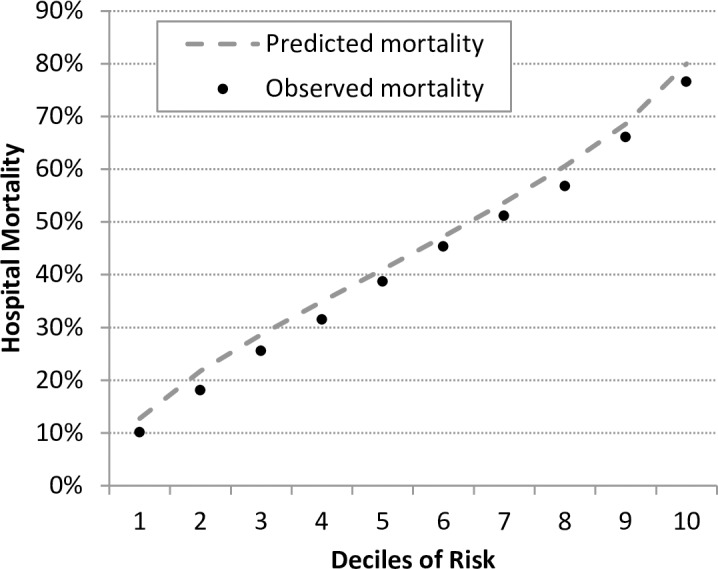
Results: The 2013 deviation sample consisted of 113,750 cases; the 2015 validation sample consisted of 134,851 cases. The model developed in 2013 showed good validity regarding discrimination (AUC = 0.74), calibration (observed mortality in 1st and 10th risk-decile: 11%-78%), and fit (R2 = 0.16). Validity remained stable when the model was applied to 2015 (AUC = 0.74, 1st and 10th risk-decile: 10%-77%, R2 = 0.17). There was no indication of overfitting of the model. The final model developed in year 2015 contained 40 risk-factors. Between 2010 and 2015 hospital mortality in sepsis decreased from 48% to 42%. Adjusted for risk-factors the trajectory of decrease was still significant.
Conclusions: The risk-model shows good predictive validity and stability across time. The model is suitable to be used as an external algorithm for comparing risk-adjusted sepsis mortality among German hospitals or regions based on administrative claims data, but secular changes need to be taken into account when interpreting risk-adjusted mortality.
Conflict of interest statement
Figures
References
-
- Singer M, Deutschman CS, Seymour CW, Shankar-Hari M, Annane D, Bauer M, et al. The Third International Consensus Definitions for Sepsis and Septic Shock (Sepsis-3). JAMA-J Am Med Assoc. 2016;315(8):801–10. doi: 10.1001/jama.2016.0287 WOS:000370700500015. - DOI - PMC - PubMed
-
- Goodwin APL, Srivastava V, Shotton H, Protopapa K, Butt A, Mason M. Just say sepsis! A review of the process of care received by patients with sepsis [PDF]. 2015 [cited 2017 15 January]. Available from: http://www.ncepod.org.uk/2015report2/downloads/JustSaySepsis_FullReport.pdf.
-
- Clinical Excellence Commission. Recognition and Management of Sepsis [PDF]. 2012 [cited 2017 January 15th]. Available from: http://www.cec.health.nsw.gov.au/__data/assets/pdf_file/0004/259375/pati....
-
- World Health Assembly Executive Board. EB140.R5 Improving the prevention, diagnosis and management of sepsis [PDF]. 2017 [cited 2017 October 26]. Available from: http://apps.who.int/gb/ebwha/pdf_files/EB140/B140_R5-en.pdf.
-
- Damiani E, Donati A, Serafini G, Rinaldi L, Adrario E, Pelaia P, et al. Effect of Performance Improvement Programs on Compliance with Sepsis Bundles and Mortality: A Systematic Review and Meta-Analysis of Observational Studies. PLOS ONE. 2015;10(5):e0125827 doi: 10.1371/journal.pone.0125827 - DOI - PMC - PubMed
Publication types
MeSH terms
LinkOut - more resources
Full Text Sources
Other Literature Sources
Medical
