


Myxoid liposarcoma: local relapse and metastatic pattern in 43 patients
- PMID: 29558901
- PMCID: PMC5859402
- DOI: 10.1186/s12885-018-4226-8
Myxoid liposarcoma: local relapse and metastatic pattern in 43 patients
Abstract
Background: Liposarcomas are the second most common type of soft tissue sarcomas, 30-50% of these are of myxoid subtype. The aim of this retrospective study was to analyze the local control rate, the metastatic pattern and survival of patients in a consecutive single-institution series.
Methods: From 1983 to 2015, 43 patients with myxoid liposarcoma of the extremities and trunk wall underwent resections. The margin was defined as R0 (wide) or R1 (marginal). Patients were followed for evidence of local recurrence or distant metastasis. Overall and recurrence-free survival was calculated.
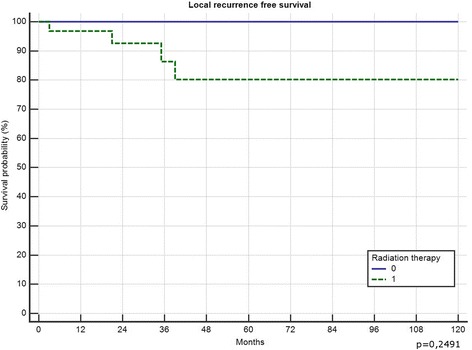
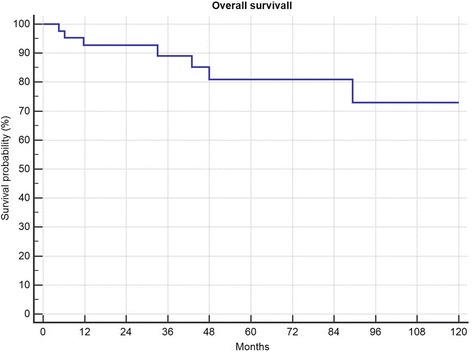
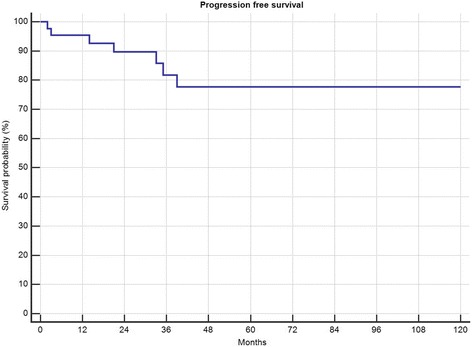
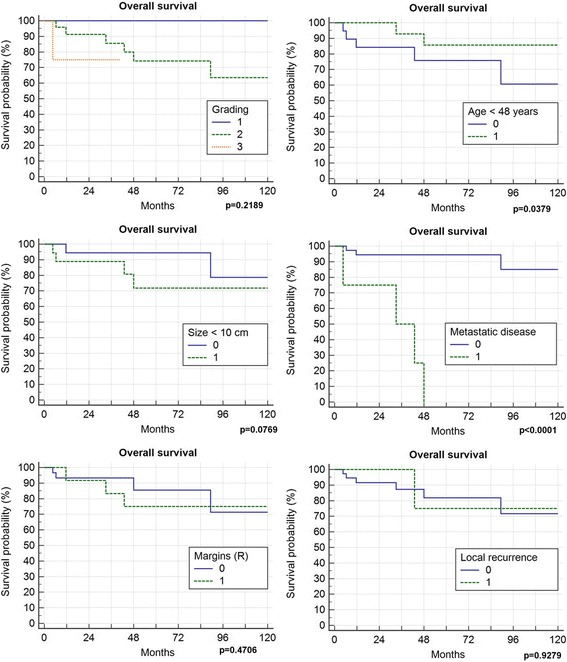
Results: The mean age was 48.6 years. The lower extremity was involved in 40 cases, the mean tumour size was 12 cm. In 31 cases a wide and in 12 cases a marginal resection was performed. Grading was G1 in 14, G2 in 25 and G3 in 4 cases. Nine patient died in follow-up, 4 of them with metastatic disease, all nonpulmonary. 5-year local recurrence (LR) free survival was 82%. 4 (9.3%) patients developed LR (all R1). Overall survival (OS) was 81% after 5 and 72% after 10 years. In multivariate analysis age and Grading proved to be significant on OS. According to univariate analysis, only age over 48 years and distant metastasis had a significant impact on overall survival.
Conclusions: Patients with myxoid liposarcomas have a good prognosis. Myxoid liposarcoma has a distinct pattern of nonpulmonary metastatic disease. Therefore, patients with high-risk extremity myxoid liposarcoma should undergo imaging studies of the chest, abdomen, spine and pelvis as part of their staging and follow-up examinations preferably with whole body MRI, or CT scans and MRI of the spine and pelvic region for detection of suspected metastatic disease.
Keywords: Myxoid liposarcoma; Prognosis; Recurrence; Sarcoma; Surgery; Survival.
Conflict of interest statement
Authors’ information
All authors are part of the SarKUM, the Bone and Soft Tissue Tumor Center of the University Hospital, Ludwig-Maximilians-University Munich.
Ethics approval and consent to participate
This study was approved by the ethics committee of the Medical Faculty, University of Munich. Written consent was obtained from all surviving patients included in this study. In accordance with the ethics committee, the data from non-surviving patients were irreversible anonymized for statistical evaluation.
Consent for publication
Not applicable.
Competing interests
The authors declare that they have no competing interests.
Publisher’s Note
Springer Nature remains neutral with regard to jurisdictional claims in published maps and institutional affiliations.
Figures

References
-
- Fletcher CDM, Gronchi A. Tumors of soft tissue. Introduction, epidemiology. In: Fletcher CDM, Bridge JA, Hogendoorn PCW, Mertens F, editors. WHO classification of tumours of soft tissue and bone. Lyon: International Agency for Research on Cancer (IARC); 2013. p. 14.
-
- Weiss SW, Goldblum JR. Liposarcoma. St. Louis: Mosby; 2001.
-
- Antonescu CR, Ladanyi M. Myxoid liposarcoma. In: Fletcher CDM, Bridge JA, Hogendoorn PCW, Mertens F, editors. WHO classification of tumours of soft tissue and bone. Lyon: International Agency for Research on Cancer (IARC); 2013. pp. 39–41.
MeSH terms
LinkOut - more resources
Full Text Sources
Other Literature Sources
