


Does heterogeneity matter in the estimation of tumour budding and tumour stroma ratio in colon cancer?
- PMID: 29558947
- PMCID: PMC5859415
- DOI: 10.1186/s13000-018-0697-9
Does heterogeneity matter in the estimation of tumour budding and tumour stroma ratio in colon cancer?
Abstract
Background: Tumour budding (TB) and Tumour Stroma Ratio (TSR) may be rewarding in the treatment stratification of patients with stage II colon cancer. However, lack of standardization may exclude these parameters from being used in a clinical setting. The purpose of this methodologic study was to compare stereology with semi-quantitative estimations of TSR, to investigate the intra-tumoural heterogeneity of TB and TSR, and to assess the intra- and inter-observer agreement.
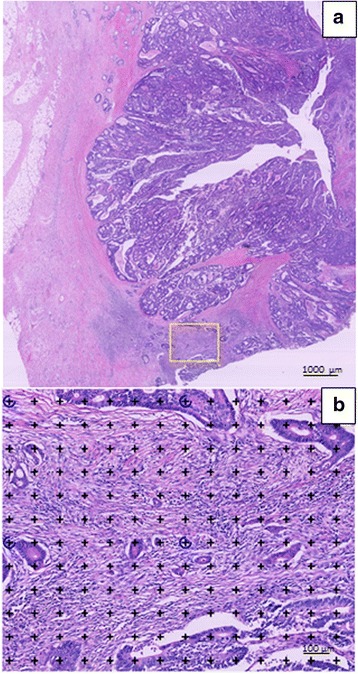
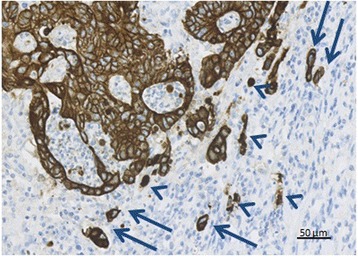
Methods: Three paraffin embedded tumour blocks, one of them representing the deepest invasive front, were selected from each of 43 patients treated for stage II colon cancer. TSR was estimated in H&E sections semi-quantitatively using conventional microscopy, and stereologically on scanned slides, using the newCAST stereology platform. TB was scored across 10 high power fields at the invasive front in cytokeratin AE1/AE3 stained sections.
Results: Subjective, semi-quantitative estimates of TSR significantly correlated to the stereological estimates, with the best correlation found for sections with the deepest invasive tumour penetration (σ = 0.621, p < 0.001). Inter-observer agreement was moderate to substantial for both TB (Κappa = 0.46-0.73) and TSR (Κappa = 0.70-0.75). The Intraclass correlation coefficient (ICC) for TSR varied from 0.322 based on stereological hotspot estimation to 0.648 for the semi-quantitative evaluation. For TB, ICC varied from 0.646 based on continuous data to 0.698 based on categorical data (cut-off: 10 buds). Thus, the intra-tumoural heterogeneity for both TB and the semi-quantitative estimation of TSR was low.
Conclusion: We recommend using only one tissue section representing the deepest invasive tumour area for estimation of TSR. For TB we recommend using one tissue section; however due to low representation of high-budding tumours, results must be considered with caution.
Keywords: Colon cancer; Heterogeneity; Tumour budding; Tumour stroma ratio.
Conflict of interest statement
Ethics approval and consent to participate
The study was approved by The Regional Committees on Health Research Ethics for Southern Denmark (S-20140119) and the Danish Data Protection Agency (journal number 14/26345). All patients were screened in the Danish Registry of Tissue Utilization before enrolment in the study.
Consent for publication
Not applicable.
Competing interests
Johnnie Bremholm Andersen is partly employed by a commercial company (Visiopharm A/S, Denmark). This does not alter the authors’ adherence to Diagnostic Pahology’s policies on sharing data and materials, and Visiopharm A/S had no influence on the study design, data collection, analysis or interpretation of the data, decision to publish, or preparation of the manuscript. All other authors declare no conflict of interest.
Publisher’s Note
Springer Nature remains neutral with regard to jurisdictional claims in published maps and institutional affiliations.
Figures
References
MeSH terms
Grants and funding
LinkOut - more resources
Full Text Sources
Other Literature Sources
Medical
Miscellaneous
