


Serum long noncoding RNA HOTAIR as a novel diagnostic and prognostic biomarker in glioblastoma multiforme
- PMID: 29558959
- PMCID: PMC5861620
- DOI: 10.1186/s12943-018-0822-0
Serum long noncoding RNA HOTAIR as a novel diagnostic and prognostic biomarker in glioblastoma multiforme
Abstract
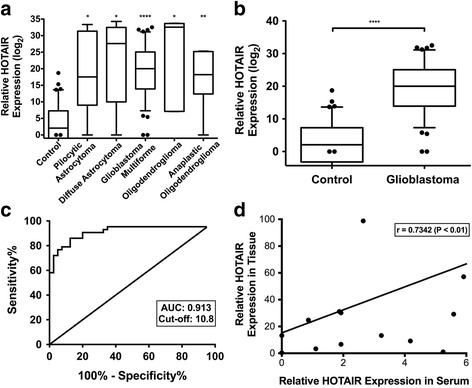
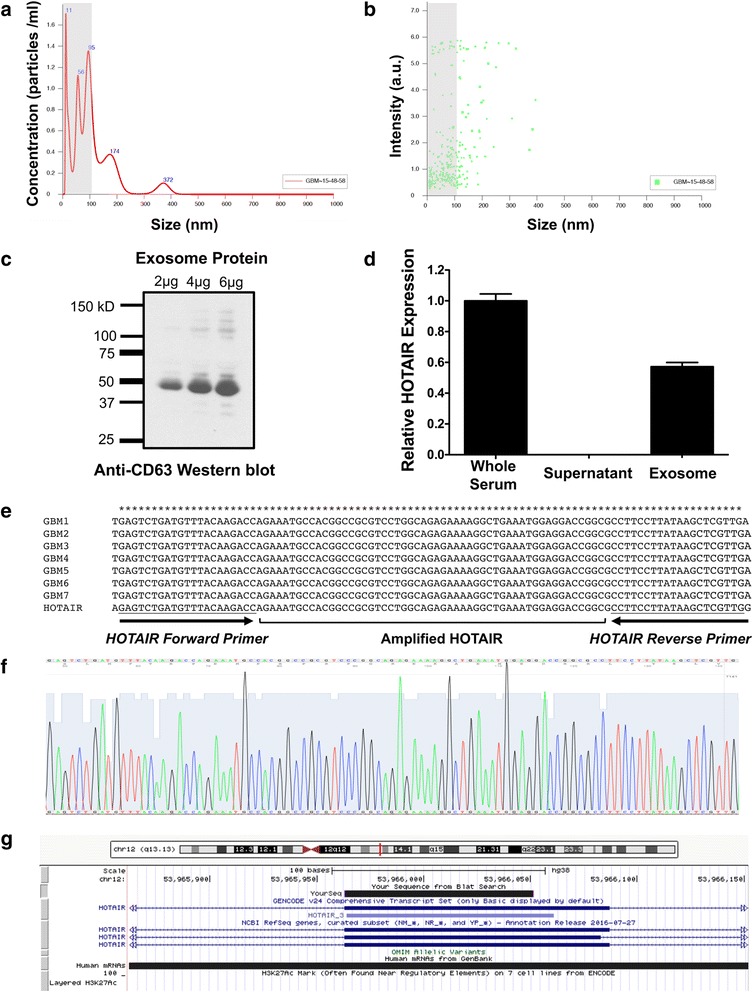
Glioblastoma multiforme (GBM) is the most common and aggressive malignant adult primary brain tumor. Despite surgical resection followed by radiotherapy and chemotherapy, the median survival rate is approximately 14 months. Although experimental therapies are in clinical trials for GBM, there is an urgent need for a peripheral GBM biomarker for measuring treatment response. As we have previously demonstrated that the long noncoding RNA HOX Transcript Antisense Intergenic RNA, or HOTAIR, is dysregulated in GBM and required for GBM cell proliferation, we hypothesized that HOTAIR expression may be utilized as a peripheral biomarker for GBM. HOTAIR expression was measured in serum from 43 GBM and 40 controls using quantitative real-time PCR (qRT-PCR). The PCR products were subsequently subcloned into pCR™4-TOPO®TA vectors for DNA sequencing. A ROC curve was also generated to examine HOTAIR's prognostic value. The amount of HOTAIR in serum exosomes and exosome-depleted supernatant was calculated by qRT-PCR. The relative HOTAIR expression was also investigated in 15 pairs of GBM serum and tumors. We detected HOTAIR in serum from GBM patients. HOTAIR levels in serum samples from GBM patients was significantly higher than in the corresponding controls (P < 0.0001). The area under the ROC curve distinguishing GBM patients from controls was 0.913 (95% CI: 0.845-0.982, P < 0.0001), with 86.1% sensitivity and 87.5% specificity at the cut-off value of 10.8. HOTAIR expression was significantly correlated with high grade brain tumors. In addition, Pearson correlation analysis indicated a medium correlation of serum HOTAIR levels and the corresponding tumor HOTAIR levels (r = 0.734, P < 0.01). We confirmed via sequencing that the amplified HOTAIR from serum contained the HOTAIR sequence and maps to the known HOTAIR locus at 12q13. The serum-derived exosomes contain HOTAIR and the purified exosomes were validated by western blot and nanoparticle tracking analysis. Importantly, our results demonstrate that serum HOTAIR can be used as a novel prognostic and diagnostic biomarker for GBM.
Keywords: Biomarker; Cancer; Glioblastoma; HOTAIR; Long noncoding RNA.
Conflict of interest statement
Ethics approval and consent to participate
All the procedures performed in this study involving human participants were in accordance with the ethical standards of the institutional and/or national research committee (IRB Study Number: 20170887) and with the 1964 Helsinki declaration and its later amendments or comparable ethical standards. Informed consent was obtained from all individual participants included in this study.
Consent for publication
Not applicable.
Competing interests
The authors declare that they have no competing interests.
Publisher’s Note
Springer Nature remains neutral with regard to jurisdictional claims in published maps and institutional affiliations.
Figures
References
-
- Stuplich M, Hadizadeh DR, Kuchelmeister K, Scorzin J, Filss C, Langen KJ, Schafer N, Mack F, Schuller H, Simon M, et al. Late and prolonged pseudoprogression in glioblastoma after treatment with lomustine and temozolomide. J Clin Oncol. 2012;30:e180–e183. doi: 10.1200/JCO.2011.40.9565. - DOI - PubMed
-
- Pastori C, Kapranov P, Penas C, Peschansky V, Volmar CH, Sarkaria JN, Bregy A, Komotar R, St Laurent G, Ayad NG, Wahlestedt C. The Bromodomain protein BRD4 controls HOTAIR, a long noncoding RNA essential for glioblastoma proliferation. Proc Natl Acad Sci U S A. 2015;112:8326–8331. doi: 10.1073/pnas.1424220112. - DOI - PMC - PubMed
Publication types
MeSH terms
Substances
LinkOut - more resources
Full Text Sources
Other Literature Sources
Medical
Research Materials
