


Traditional ecological knowledge-based assessment of threatened woody species and their potential substitutes in the Atakora mountain chain, a threatened hotspot of biodiversity in Northwestern Benin, West Africa
- PMID: 29558963
- PMCID: PMC5859633
- DOI: 10.1186/s13002-018-0219-6
Traditional ecological knowledge-based assessment of threatened woody species and their potential substitutes in the Atakora mountain chain, a threatened hotspot of biodiversity in Northwestern Benin, West Africa
Abstract
Background: Atakora mountains in Benin are a unique but fragile ecosystem, harboring many endemic plant species. The ecosystem is undergoing degradation, and the woody vegetation is dramatically declining due to high anthropogenic actions and recurrent drought. This study aimed to (i) assess the diversity of threatened woody species and (ii) identify their potential substitutes in the three regions of the Atakora mountains namely East Atakora, Central Atakora, and West Atakora.
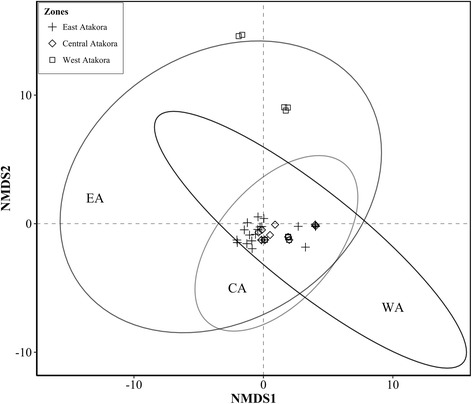
Methods: The data were collected during expeditions on surveyed localities through semi-structured individual interviews. Free-listing was used to record threatened woody species and which were important and why. Alpha-diversity indices were used to assess diversity of threatened and important threatened woody species. A correspondence analysis was used to determine the reason supporting their importance. Differences in species composition were assessed using analysis of similarities. A number of potential substitutes were compared among species using generalized linear models.
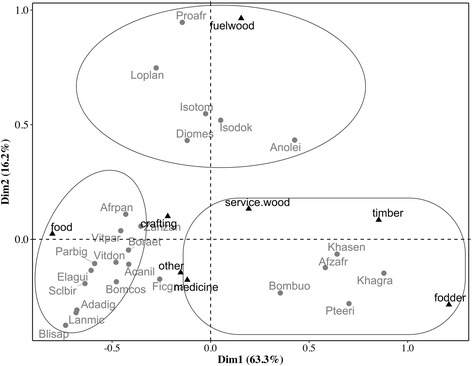
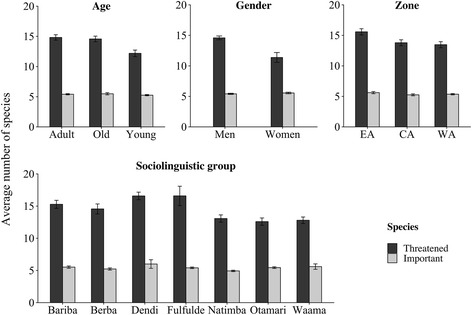
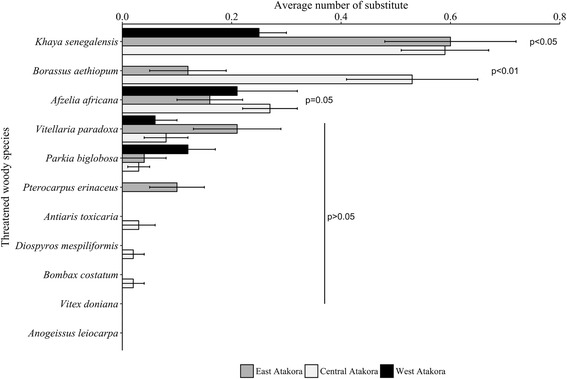
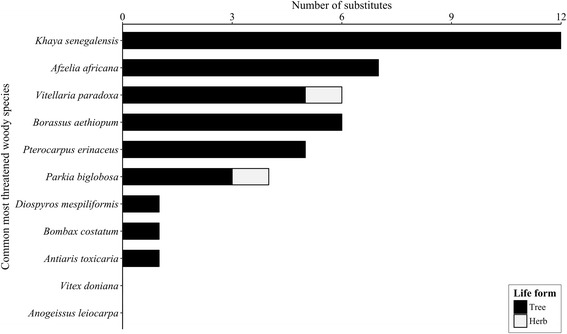
Results: A total of 117 woody species (37 families and 92 genera) were identified. The most prominent families were Fabaceae (19.66%), Combretaceae (12.82%), and Moraceae (10.26%), and the richest genera were Ficus (10 species), Combretum (6), and Terminalia (5). Most threatened species differed across regions (East Atakora, Central Atakora, and West Atakora) and included Afzelia africana, Anogeissus leiocarpa, Borassus aethiopum, Diospyros mespiliformis, Khaya senegalensis, Milicia excelsa, and Pterocarpus erinaceus. Most socio-economically important species (K. senegalensis, Parkia biglobosa, Vitellaria paradoxa, and V. doniana) were used mainly for food, timber, and fuelwood purposes. Old and adult people, and Dendi and Fulfulde sociolinguistic groups had greater knowledge of threatened woody plant species. High intercultural differentiations in species composition were detected between Bariba-Berba and Bariba-Natimba. Knowledge of substitutes also differed across regions with P. erinaceus, Isoberlinia spp., and A. africana being the most cited substitutes.
Conclusion: Basic data was provided here to inform decision and guide efficient management of woody resources. There was evidence that immediate conservation measures are required for some high economic value woody taxa which were critically threatened. Ex-situ conservation of these species while promoting their integration into agroforestry-based systems were recommended. Besides, community-based management programs and community-led initiatives involving knowledgeable people from different horizons will lead to a long-lasting conservation of these threatened resources.
Keywords: ANOSIM; Atakora mountain chain; Beta-diversity; Forest resources; Socio-cultural factors.
Conflict of interest statement
Ethics approval and consent to participate
No ethical approval was needed for this study. Prior to data collection, the participants gave oral consent to participate in the study.
Consent for publication
The respondents were informed that their opinions were to be published in a scientific paper and gave their approval.
Competing interests
The authors declare that they have no competing interests.
Publisher’s Note
Springer Nature remains neutral with regard to jurisdictional claims in published maps and institutional affiliations.
Figures


References
-
- Vodouhê FG, Adégbidi A, Coulibaly O, Sinsin B. Parkia biglobosa (Jacq.) R. Br. Ex Benth. harvesting as a tool for conservation and source of income for local people in Pendjari Biosphere Reserve. Acta Botanica Gallica. 2011;158:595–608. doi: 10.1080/12538078.2011.10516297. - DOI
-
- Sinsin B, Matig OE, Assogbadjo A, Gaoué O, Sinadouwirou T. Dendrometric characteristics as indicators of pressure of Afzelia africana Sm. dynamic changes in trees found in different climatic zones of Benin. Biodivers Conserv. 2004;13:1555–1570. doi: 10.1023/B:BIOC.0000021328.56517.46. - DOI
-
- Shackleton S, Delang CO, Angelsen A. From subsistence to safety nets and cash income: exploring the diverse values of non-timber forest products for livelihoods and poverty alleviation. In: Non-timber forest products in the global context. Berlin: Springer; 2011. p. 55–81.
-
- Shackleton S, Gumbo D. Contribution of non-wood forest products to livelihoods and poverty alleviation. In: Chidumayo EN, Gumbo DJ, editors. The dry forests and woodlands of Africa: managing for products and services. Earthscan forestry library: London; 2010.
MeSH terms
LinkOut - more resources
Full Text Sources
Other Literature Sources
Miscellaneous
