


Addition of the Aβ42/40 ratio to the cerebrospinal fluid biomarker profile increases the predictive value for underlying Alzheimer's disease dementia in mild cognitive impairment
- PMID: 29558986
- PMCID: PMC5861634
- DOI: 10.1186/s13195-018-0362-2
Addition of the Aβ42/40 ratio to the cerebrospinal fluid biomarker profile increases the predictive value for underlying Alzheimer's disease dementia in mild cognitive impairment
Abstract
Background: Cerebrospinal fluid (CSF) biomarkers have been used to increase the evidence of underlying Alzheimer's disease (AD) pathology in mild cognitive impairment (MCI). However, CSF biomarker-based classification often results in conflicting profiles with controversial prognostic value. Normalization of the CSF Aβ42 concentration to the level of total amyloid beta (Aβ), using the Aβ42/40 ratio, has been shown to improve the distinction between AD and non-AD dementia. Therefore, we evaluated whether the Aβ42/40 ratio would improve MCI categorization and more accurately predict progression to AD.
Methods: Our baseline population consisted of 197 MCI patients, of which 144 had a follow-up ≥ 2 years, and comprised the longitudinal study group. To establish our own CSF Aβ42/40 ratio reference value, a group of 168 AD-dementia patients and 66 neurological controls was also included. CSF biomarker-based classification was operationalized according to the framework of the National Institute of Aging-Alzheimer Association criteria for MCI.
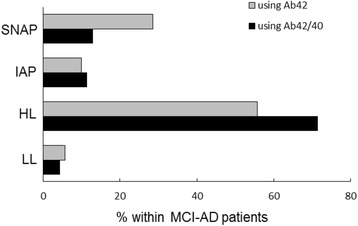
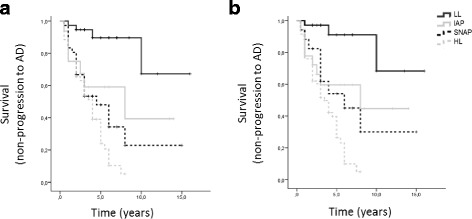
Results: When using the core CSF biomarkers (Aβ42, total Tau and phosphorylated Tau), 30% of the patients fell into the high-AD-likelihood (HL) group (both amyloid and neurodegeneration markers positive), 30% into the low-AD-likelihood group (all biomarkers negative), 28% into the suspected non-Alzheimer pathophysiology (SNAP) group (only neurodegeneration markers positive) and 12% into the isolated amyloid pathology group (only amyloid-positive). Replacing Aβ42 by the Aβ42/40 ratio resulted in a significant increase in the percentage of patients with amyloidosis (42-59%) and in the proportion of interpretable biological profiles (61-75%), due to a reduction by half in the number of SNAP cases and an increase in the proportion of the HL subgroup. Survival analysis showed that risk of progression to AD was highest in the HL group, and increased when the Aβ42/40 ratio, instead of Aβ42, combined with total Tau and phosphorylated Tau was used for biomarker-based categorization.
Conclusions: Our results confirm the usefulness of the CSF Aβ42/40 ratio in the interpretation of CSF biomarker profiles in MCI patients, by increasing the proportion of conclusive profiles and enhancing their predictive value for underlying AD.
Keywords: Alzheimer’s disease; Aβ42/40 ratio; CSF biomarkers; Mild cognitive impairment.
Conflict of interest statement
Ethics approval and consent to participate
This study was performed in accordance with the ethical standards laid down in the 1964 Declaration of Helsinki and was approved by the Ethics Board of Coimbra University Hospital. All subjects or responsible caregivers, whichever appropriate, gave their informed consent.
Consent for publication
Not applicable.
Competing interests
The authors declare that they have no competing interests.
Publisher’s Note
Springer Nature remains neutral with regard to jurisdictional claims in published maps and institutional affiliations.
Figures
References
-
- Prince M, Wimo A, Guerchet M, Ali G, Wu Y, Prina M. World Alzheimer Report 2015. The global impact of dementia. An analysis of prevalence, incidence, cost & trends. London: Alzheimer’s Disease International (ADI); 2015.
-
- Morris JC. Early-stage and preclinical Alzheimer disease. Alzheimer Dis Assoc Disord. 2005;1:163–176. - PubMed
-
- McKhann GM, Knopman DS, Chertkow H, Hyman BT, Jack CR, Jr, Kawas CH, Klunk WE, Koroshetz WJ, Manly JJ, Mayeux R, Mohs RC, Morris JC, Rossor MN, Scheltens P, Carrillo MC, Thies B, Weintraub S, Phelps CH. The diagnosis of dementia due to Alzheimer’s disease: recommendations from the National Institute on Aging-Alzheimer's Association workgroups on diagnostic guidelines for Alzheimer's disease. Alzheimers Dement. 2011;7:263–269. doi: 10.1016/j.jalz.2011.03.005. - DOI - PMC - PubMed
Publication types
MeSH terms
Substances
Grants and funding
LinkOut - more resources
Full Text Sources
Other Literature Sources
Medical
