Review
. 2018 Nov:73:52-63.
doi: 10.1016/j.matbio.2018.03.012. Epub 2018 Mar 17.

Matrix remodeling in chronic lung diseases

Affiliations
Review

Matrix remodeling in chronic lung diseases

Bon-Hee Gu et al. Matrix Biol. 2018 Nov.

Abstract

Multicellular organisms synthesize and renew components of their subcellular and scaffolding proteins, collectively known as the extracellular matrix molecules (ECMs). In the lung, ECMs maintain tensile strength, elasticity, and dictate the specialized function of multiple cell lineages. These functions are critical in lung homeostatic processes including cellular migration and proliferation during morphogenesis or in response to repair. Alterations in lung ECMs that expose cells to new cryptic fragments, generated in response to endogenous proteinases or exogenous toxins, are associated with the development of several common respiratory diseases. How lung ECMs provide or relay vital signals to epithelial and mesenchymal cells has shed new light on development and progression of several common chronic respiratory diseases. This review will consider how ECMs regulate lung homeostasis and their reorganization under pathological conditions that can modulate the inflammatory diseases asthma, chronic obstructive pulmonary disease (COPD), and idiopathic pulmonary fibrosis (IPF). Better understanding of changes in the distribution of lung ECM could provide novel therapeutic approaches to treat chronic lung diseases.


Conflict of interest statement

Competing interests: The authors do not have any conflict of interest

Figures

Figure 1
Figure 1. Composition and Distribution of lung ECM
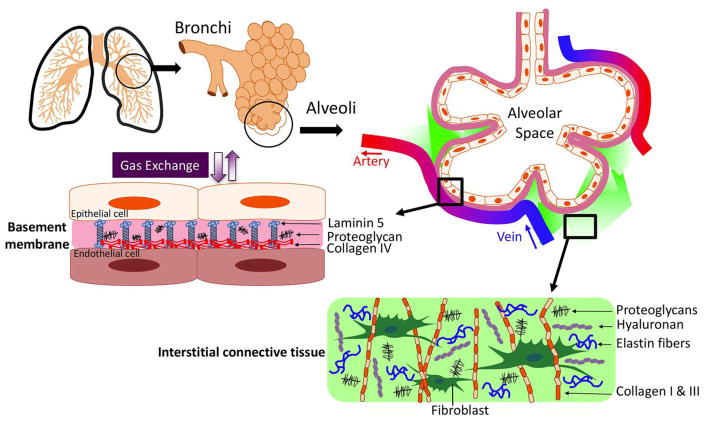
The ECM basement membrane matrix is composed of nonfibrillar collagens, laminin, and proteoglycans that support many vital physiological lung function. In the proximal airway, basement membrane ECM is dense, while the distal alveoli have an ultrathin basement membrane that aids in effective gas exchange. The lung’s interstitial connective tissue provides necessary elastic properties and tensile strength and is composed of complex networks of fibrous proteins (fibrillar collagen and elastin) as well as hyaluronan and proteoglycans. Excessive accumulation or degradation of ECM molecules within the interstitial matrix is thought to underlie the pathogenesis of chronic lung diseases like emphysema and idiopathic fibrosis.
Figure 2
Figure 2. Matrix/Matrikine-derived signaling in the lung
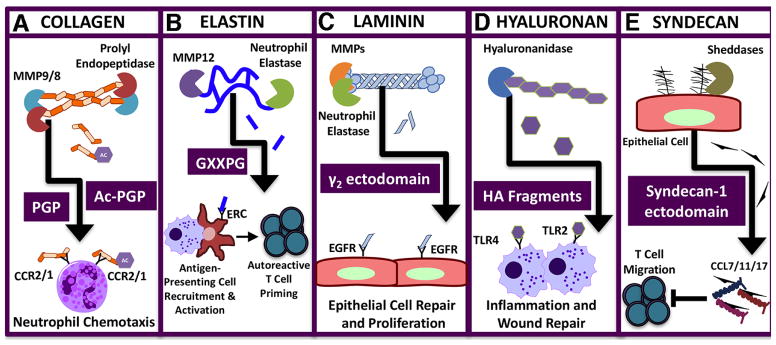
Lung proteinases generate a wide array of matrikines that initiate or dampen inflammatory events in response to diverse insults. A) Collagen fragments, PGP and Ac-PGP, promote neutrophil recruitment to the lung in inflammatory diseases such as COPD. B) The elastin matrikine GXXPG promotes chemotaxis of monocytes and antigen-presenting cells following chronic exposure to cigarette smoke; elastin fragments initiate the induction of elastin-reactive T cells that accelerate the pathogenesis of emphysema. C) Laminin matrikine γ2 ectodomain binds to the epithelial growth factor receptor (EGFR) to trigger repair mechanisms and promoting proliferation. D) Hyaluronan fragments initiate inflammation by binding to the pattern recognition receptors TLR2 and TLR4. E) Syndecan matrikine, generated from syndecan-1 ectodomains, neutralizes specific chemokines and prevents T cell migration in allergic airway disease.
Figure 3
Figure 3. Lung disease pathogenesis by proteolytic enzyme/ECM imbalance
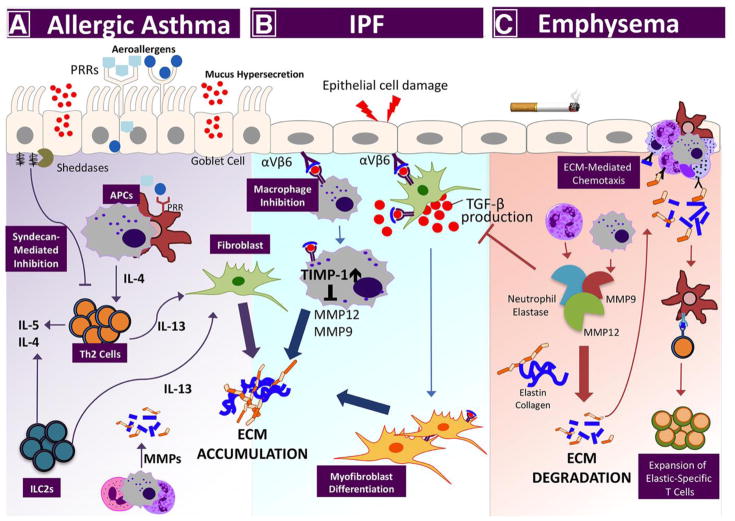
Perturbations among the ECM networks of the lung are a hallmark feature of the most serious chronic lung diseases: asthma, IPF, and emphysema. A) In allergic asthma, aeroallergens bind pattern recognition receptors on airway epithelial cells and local antigen-presenting cells, initiating Th2-associated inflammation. Signature Th2 cytokines, (e.g., IL-13) from conventional T cells, and innate lymphoid cells (ILCs), signal through local fibroblasts to promote collagen synthesis, which leads to subepithelial fibrosis. Lung sheddases cleave proteoglycans, (e.g., syndecan-1) to release bioactive fragments that bind chemokines and impede Th2 cell recruitment. B) In response to cell injury, the immunosuppressive cytokine TGF-β promotes myofibroblast differentiation, inhibits macrophage MMP expression, and increases expression of tissue inhibitors of metalloproteinases (TIMPs) to promote idiopathic pulmonary fibrosis (IPF). (C) In emphysema, inflammatory cells secrete multiple proteinases, (e.g., MMP9, MMP12, and neutrophil elastase) that degrade collagen and elastin in the interstitial matrix. Collagen- and elastin-derived matrikines further promote lung inflammatory cell recruitment. Elastin fragments are also processed by antigen-presenting cells and presented to T cells in the regional lymph nodes to generate autoreactive, elastic-specific T cells that accelerate disease persistence and severity.

References

    1. Hynes RO, Naba A. Overview of the matrisome--an inventory of extracellular matrix constituents and functions. Cold Spring Harb Perspect Biol. 2012;4(1):a004903. - PMC - PubMed
    1. Hendrix AY, Kheradmand F. The Role of Matrix Metalloproteinases in Development, Repair, and Destruction of the Lungs. Prog Mol Biol Transl Sci. 2017;148:1–29. - PubMed
    1. Couchman JR. Transmembrane signaling proteoglycans. Annu Rev Cell Dev Biol. 2010;26:89–114. - PubMed
    1. Raghow R. The role of extracellular matrix in postinflammatory wound healing and fibrosis. FASEB J. 1994;8(11):823–31. - PubMed
    1. Mecham RP. Overview of extracellular matrix. Curr Protoc Cell Biol. 2012;Chapter 10(Unit 10):1. - PubMed

Publication types

Substances