. 2018 Mar 6:9:65.
doi: 10.3389/fpsyt.2018.00065. eCollection 2018.

Association of the Polygenic Scores for Personality Traits and Response to Selective Serotonin Reuptake Inhibitors in Patients with Major Depressive Disorder

Affiliations

Association of the Polygenic Scores for Personality Traits and Response to Selective Serotonin Reuptake Inhibitors in Patients with Major Depressive Disorder

Azmeraw T Amare et al. Front Psychiatry. .

Abstract

Studies reported a strong genetic correlation between the Big Five personality traits and major depressive disorder (MDD). Moreover, personality traits are thought to be associated with response to antidepressants treatment that might partly be mediated by genetic factors. In this study, we examined whether polygenic scores (PGSs) derived from the Big Five personality traits predict treatment response and remission in patients with MDD who were prescribed selective serotonin reuptake inhibitors (SSRIs). In addition, we performed meta-analyses of genome-wide association studies (GWASs) on these traits to identify genetic variants underpinning the cross-trait polygenic association. The PGS analysis was performed using data from two cohorts: the Pharmacogenomics Research Network Antidepressant Medication Pharmacogenomic Study (PGRN-AMPS, n = 529) and the International SSRI Pharmacogenomics Consortium (ISPC, n = 865). The cross-trait GWAS meta-analyses were conducted by combining GWAS summary statistics on SSRIs treatment outcome and on the personality traits. The results showed that the PGS for openness and neuroticism were associated with SSRIs treatment outcomes at p < 0.05 across PT thresholds in both cohorts. A significant association was also found between the PGS for conscientiousness and SSRIs treatment response in the PGRN-AMPS sample. In the cross-trait GWAS meta-analyses, we identified eight loci associated with (a) SSRIs response and conscientiousness near YEATS4 gene and (b) SSRI remission and neuroticism eight loci near PRAG1, MSRA, XKR6, ELAVL2, PLXNC1, PLEKHM1, and BRUNOL4 genes. An assessment of a polygenic load for personality traits may assist in conjunction with clinical data to predict whether MDD patients might respond favorably to SSRIs.

Keywords: antidepressants; major depression; personality traits; pharmacogenomics; polygenic score; selective serotonin reuptake inhibitors.


Figures
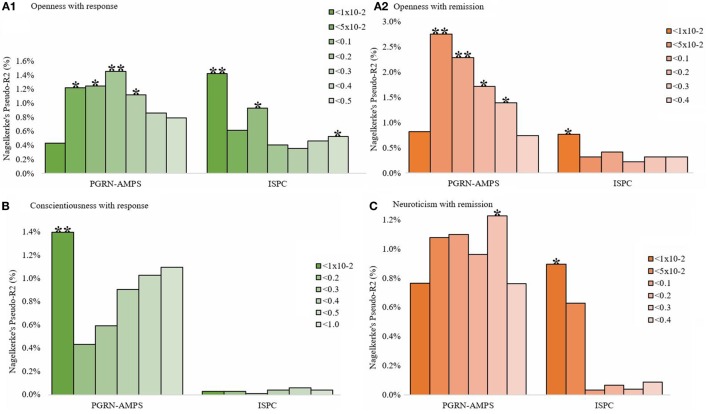
Figure 1
Figure 1
The bar graphs (A–C) show the association of the PGSs for the Big Five personality traits with SSRIs response or remission at different p-value thresholds (PT) after 4 weeks of treatment in the PGRN-AMPS (n = 529) and ISPC (n = 865) samples. The y-axis (Nagelkerke’s Pseudo-R2) refers to the percentage of variance in SSRIs treatment response/remission accounted for the PGSs of the Big Five personality traits at a particular PT in each sample. On the x-axis, plotted from left to right, are the GWAS PT for personality traits used to group the SNPs for the PGSs. The *sign on the top of each bar signify the statistical significance of the PGS association as *p < 0.05, **p < 0.01, ***p < 0.001. Abbreviations: PGRN-AMPS, the Pharmacogenomics Research Network Antidepressant Medication Pharmacogenomic Study; ISPC, the International SSRI Pharmacogenomics Consortium study; SNP, single nucleotide polymorphism; PGS, polygenic score; SSRIs, selective serotonin reuptake inhibitors.
Figure 2
Figure 2
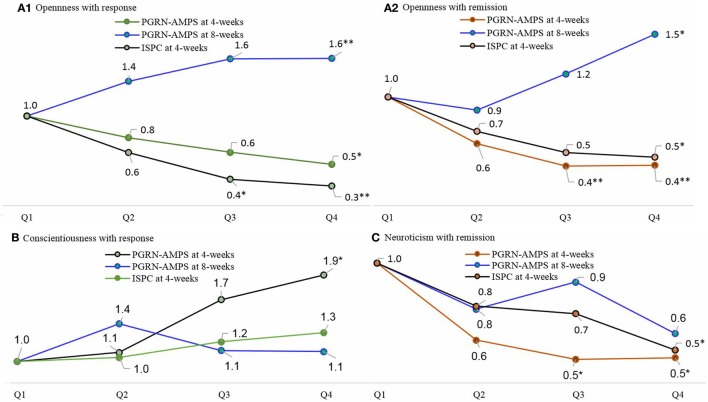
The line plots represent the ORs for favorable response or remission to selective serotonin reuptake inhibitors treatment in patients with MDD with a high personality traits polygenic load (Q2, Q3, and Q4) compared to patients with the lowest polygenic load (Q1), estimated at the most significant p-value thresholds. The quartile-based polygenic scores analyses were performed using data at 4 weeks in the ISPC and at 4 and 8 weeks in the PGRN-AMPS. A polygenic loading for openness personality trait was initially associated with poor response and remission to selective serotonin reuptake inhibitors (SSRIs) in the first 4 weeks of treatment (ISPC, PGRN-AMPS at 4 weeks). After a longer (8 weeks) treatment follow-up, the genetic loading for openness had shown a favorable effect to SSRIs response and remission (PGRN-AMPS at 8 weeks). The polygenic loading for conscientiousness personality was favorably associated with response to SSRIs treatment. However, a polygenic loading for neuroticism personality had shown a negative impact on SSRIs remission. The ORs are reported on the lines and the *sign indicates the statistical significance of the ORs as *p < 0.05, **p < 0.01, ***p < 0.001. Abbreviations: PGRN-AMPS, the Pharmacogenomics Research Network Antidepressant Medication Pharmacogenomic Study; ISPC, the International SSRI Pharmacogenomics Consortium study. OR, odds ratio; Q1, quartiles 1; Q2, quartiles 2; Q3, quartiles 3; Q4, quartiles 4; MDD, major depressive disorder.
Figure 3
Figure 3
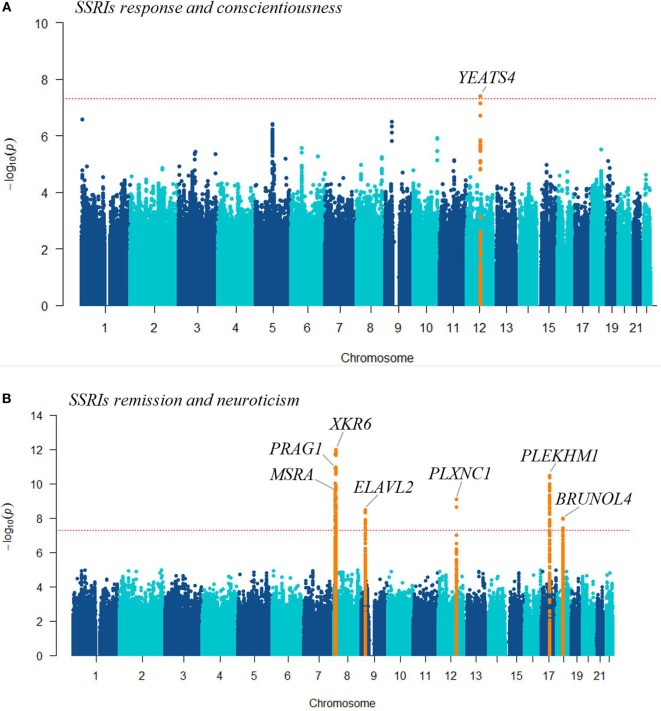
The Manhattan plots show the results of the cross-trait meta-analysis of genome-wide association studies (GWASs) on selective serotonin reuptake inhibitors treatment outcomes (response or remission) with GWASs on: (A) conscientiousness personality trait; (B) neuroticism personality, highlighting the loci that showed genome-wide significance (orange), and the nearest genes. The −log10 (cross-trait p-value) is plotted against the physical position of each SNP on each chromosome. The threshold for genome-wide significance (cross-trait p-value <5 × 10−8) is indicated by the red dotted horizontal line.

References

    1. Whiteford HA, Degenhardt L, Rehm J, Baxter AJ, Ferrari AJ, Erskine HE, et al. Global burden of disease attributable to mental and substance use disorders: findings from the global burden of disease study 2010. Lancet (2013) 382(9904):1575–86. 10.1016/S0140-6736(13)61611-6 - DOI - PubMed
    1. Global Burden of Disease Study 2013 Collaborators. Global, regional, and national incidence, prevalence, and years lived with disability for 301 acute and chronic diseases and injuries in 188 countries, 1990-2013: a systematic analysis for the global burden of disease study 2013. Lancet (2015) 386(9995):743–800. 10.1016/S0140-6736(15)60692-4 - DOI - PMC - PubMed
    1. Andrade L, Caraveo-Anduaga JJ, Berglund P, Bijl RV, De Graaf R, Vollebergh W, et al. The epidemiology of major depressive episodes: results from the International Consortium of Psychiatric Epidemiology (ICPE) surveys. Int J Methods Psychiatr Res (2003) 12(1):3–21. 10.1002/mpr.138 - DOI - PMC - PubMed
    1. Ferrari AJ, Charlson FJ, Norman RE, Patten SB, Freedman G, Murray CJ, et al. Burden of depressive disorders by country, sex, age, and year: findings from the global burden of disease study 2010. PLoS Med (2013) 10(11):e1001547. 10.1371/journal.pmed.1001547 - DOI - PMC - PubMed
    1. Hieronymus F, Emilsson JF, Nilsson S, Eriksson E. Consistent superiority of selective serotonin reuptake inhibitors over placebo in reducing depressed mood in patients with major depression. Mol Psychiatry (2016) 21(4):523–30. 10.1038/mp.2015.53 - DOI - PMC - PubMed

LinkOut - more resources