


Thromboprophylaxis for Patients with High-risk Atrial Fibrillation and Flutter Discharged from the Emergency Department
- PMID: 29560065
- PMCID: PMC5851510
- DOI: 10.5811/westjem.2017.9.35671
Thromboprophylaxis for Patients with High-risk Atrial Fibrillation and Flutter Discharged from the Emergency Department
Abstract
Introduction: Many patients with atrial fibrillation or atrial flutter (AF/FL) who are high risk for ischemic stroke are not receiving evidence-based thromboprophylaxis. We examined anticoagulant prescribing within 30 days of receiving dysrhythmia care for non-valvular AF/FL in the emergency department (ED).
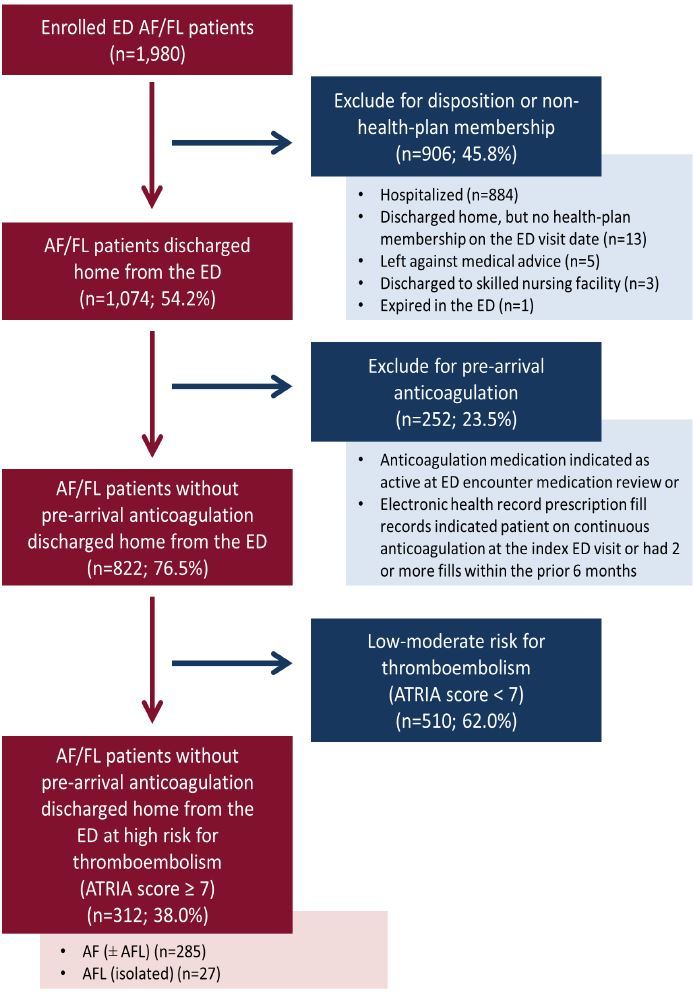
Methods: This prospective study included non-anticoagulated adults at high risk for ischemic stroke (ATRIA score ≥7) who received emergency AF/FL care and were discharged home from seven community EDs between May 2011 and August 2012. We characterized oral anticoagulant prescribing patterns and identified predictors of receiving anticoagulants within 30 days of the index ED visit. We also describe documented reasons for withholding anticoagulation.
Results: Of 312 eligible patients, 128 (41.0%) were prescribed anticoagulation at ED discharge or within 30 days. Independent predictors of anticoagulation included age (adjusted odds ratio [aOR] 0.89 per year, 95% confidence interval [CI] 0.82-0.96); ED cardiology consultation (aOR 1.89, 95% CI [1.10-3.23]); and failure of sinus restoration by time of ED discharge (aOR 2.65, 95% CI [1.35-5.21]). Reasons for withholding anticoagulation at ED discharge were documented in 139 of 227 cases (61.2%), the most common of which were deferring the shared decision-making process to the patient's outpatient provider, perceived bleeding risk, patient refusal, and restoration of sinus rhythm.
Conclusion: Approximately 40% of non-anticoagulated AF/FL patients at high risk for stroke who presented for emergency dysrhythmia care were prescribed anticoagulation within 30 days. Physicians were less likely to anticoagulate older patients and those with ED sinus restoration. Opportunities exist to improve rates of thromboprophylaxis in this high-risk population.
Conflict of interest statement
Conflicts of Interest: By the WestJEM article submission agreement, all authors are required to disclose all affiliations, funding sources and financial or management relationships that could be perceived as potential sources of bias. No author has professional or financial relationships with any companies that are relevant to this study. This work was supported by a grant from the Garfield Memorial National Research Fund, with additional support from The Permanente Medical Group Delivery Science Program (via the Physician Researcher Program).
Figures
References
-
- Wolf PA, Abbott RD, Kannel WB. Atrial fibrillation as an independent risk factor for stroke: the Framingham Study. Stroke. 1991;22(8):983–8. - PubMed
-
- Kirchhof P, Benussi S, Kotecha D, et al. 2016 ESC Guidelines for the management of atrial fibrillation developed in collaboration with EACTS. Eur Heart J. 2016;37(38):2893–962. - PubMed
-
- January CT, Wann LS, Alpert JS, et al. 2014 AHA/ACC/HRS guideline for the management of patients with atrial fibrillation: a report of the American College of Cardiology/American Heart Association Task Force on practice guidelines and the Heart Rhythm Society. Circulation. 2014;130(23):e199–267. - PMC - PubMed
-
- Verma A, Cairns JA, Mitchell LB, et al. 2014 focused update of the Canadian Cardiovascular Society Guidelines for the management of atrial fibrillation. Can J Cardiol. 2014;30(10):1114–30. - PubMed
Publication types
MeSH terms
Substances
Grants and funding
LinkOut - more resources
Full Text Sources
Other Literature Sources
Medical