The role of tumor microenvironment in resistance to anti-angiogenic therapy
- PMID: 29560266
- PMCID: PMC5854986
- DOI: 10.12688/f1000research.11771.1
The role of tumor microenvironment in resistance to anti-angiogenic therapy
Abstract
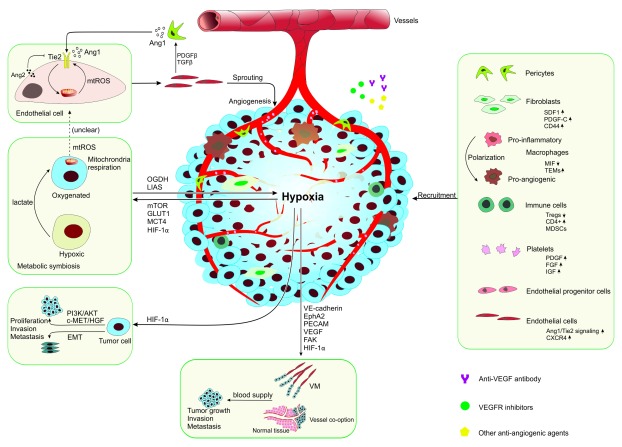
Anti-angiogenic therapy has been demonstrated to increase progression-free survival in patients with many different solid cancers. Unfortunately, the benefit in overall survival is modest and the rapid emergence of drug resistance is a significant clinical problem. Over the last decade, several mechanisms have been identified to decipher the emergence of resistance. There is a multitude of changes within the tumor microenvironment (TME) in response to anti-angiogenic therapy that offers new therapeutic opportunities. In this review, we compile results from contemporary studies related to adaptive changes in the TME in the development of resistance to anti-angiogenic therapy. These include preclinical models of emerging resistance, dynamic changes in hypoxia signaling and stromal cells during treatment, and novel strategies to overcome resistance by targeting the TME.
Keywords: MET signaling; anti-angiogenic therapy; drug resistance; tumor microenvironment.
Conflict of interest statement
Competing interests: RLC has received grant funding from Genentech, Merck, Janssen, Clovis, AZ, and Abbvie and serves on the scientific steering committee as an investigator for Tesaro, Clovis, AZ, and Abbvie. AKS serves on the advisory board for Kiyatec and has received research funding from M-Trap. The other authors declare that they have no competing interests.No competing interests were disclosed.No competing interests were disclosed.
Figures
References
Publication types
Grants and funding
LinkOut - more resources
Full Text Sources
Other Literature Sources
Miscellaneous