


Predicting risk of avian influenza a(H5N1) in Egypt: the creation of a community level metric
- PMID: 29562878
- PMCID: PMC5863456
- DOI: 10.1186/s12889-018-5288-x
Predicting risk of avian influenza a(H5N1) in Egypt: the creation of a community level metric
Abstract
Background: Efficient A(H5N1) control is unlikely to be based on epidemiological data alone. Such control depends on a thorough understanding and appreciation of the interconnectedness of epidemiological, social, and economic factors that contribute to A(H5N1) vulnerability. To date, the control of A(H5N1) in Egypt has been challenging. The disease has been endemic for more than 10 years with a dramatic increase in human cases between December 2014 and March 2015. Part of the problem has been a lack of understanding of the inter-play of drivers, conditions and motives that influence preventive behaviours at the household level.
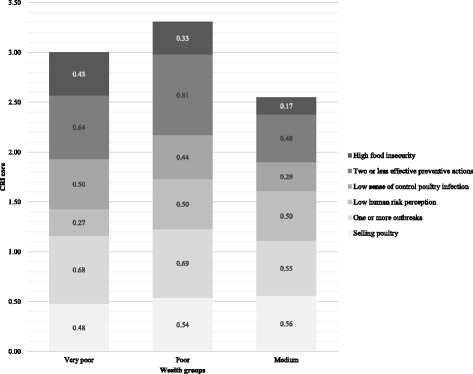
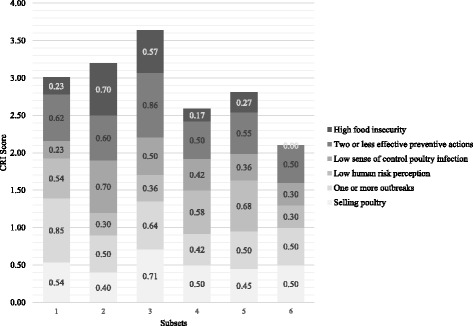
Methods: To address this issue, the authors developed a Composite Risk Index (CRI) to inform decision-makers of critical epidemiological, livelihood, food security and risk perception factors that were found to contribute to A(H5N1) vulnerability at the community level. The CRI consists of seven constructs that were individually scored for each community. The seven constructs included poultry sales, previous flock exposure to A(H5N1), human risk probability, sense of control over the disease, preventative actions taken, level of household food insecurity and community norms toward certain handling and disposal practices. One hundred forty female poultry keepers across four governorates were interviewed in 2010 using a mix of random and purposive sampling techniques. A mixed method approach underpinned the analysis. The study used wealth ranking in order to help decision-makers in understanding the specific constraints of different wealth groups and aid better targeting of A(H5N1) control and prevention strategies.
Results: Poverty, widowhood and lack of education were among the factors associated with high risk scores. CRI scores in those villages where awareness raising had taken place were not significantly different compared to those villages where awareness raising had not taken place.
Conclusions: The aim of the tool is to enable targeting those communities that are likely to be highly vulnerable to A(H5N1) outbreaks and where control and awareness-raising efforts are expected to be most effective. In this manner, policy makers and practitioners will be able to better allocate limited resources to those communities most vulnerable to the negative impact of A(H5N1).
Keywords: Decision support techniques; Egypt; H5N1 subtype; Influenza a virus; Public health; Risk factors.
Conflict of interest statement
Ethics approval and consent to participate
The majority of participants (approx. 55%) were illiterate, therefore verbal consent was asked from the participants after having explained in detail about the purpose of the research and their rights to withdraw at any moment. Confidentiality was guaranteed and respondents were made aware of the fact that participation was voluntary. Participants were furthermore informed of the fact that their names would not be reproduced in any work or publication resulting from this study. Verbal consent was noted on the interview sheet. The University of Reading Ethical Committee granted ethical clearance of the present study including its consent procedure (APD B122). Professor El Garhy (CVO Egypt) granted research permission for this study.
Consent for publication
Not applicable.
Competing interests
The authors declare that they have no competing interests.
Publisher’s Note
Springer Nature remains neutral with regard to jurisdictional claims in published maps and institutional affiliations.
Figures
References
-
- Centre for Health Protection. Avian influenza affected areas (Table 1) and global statistics of avian influenza A(H5N1) (Table 2). 2017. http://www.chp.gov.hk/files/pdf/global_statistics_avian_influenza_e.pdf. Accessed on 9 Jan 2018.
-
- European Centre for Disease Prevention and Control. Human infection with avian influenza A(H5N1) virus, Egypt First update, 13 March 2015. 2015. http://ecdc.europa.eu/en/publications/Publications/Rapid-Risk-Assessment.... Accessed 5 Sept 2016.
-
- Fasina FO, Ifende VI, Ajibade AA. Avian influenza A(H5N1) in humans: lessons from Egypt. Euro Surveill. 2010;15(4) http://www.eurosurveillance.org/ViewArticle.aspx?ArticleId=19473. Accessed on 8 August 2016 - PubMed
-
- Wilson SL, Oushy N. Eco-biosociocultural H5N1Disease Model in Egypt. WIT Trans Biomed Health. 2011; 10.2495/EHR110231.
MeSH terms
LinkOut - more resources
Full Text Sources
Other Literature Sources
Medical
