


Patterns of health behaviour associated with active travel: a compositional data analysis
- PMID: 29562923
- PMCID: PMC5861598
- DOI: 10.1186/s12966-018-0662-8
Patterns of health behaviour associated with active travel: a compositional data analysis
Abstract
Background: Active travel (walking or cycling for transport) is associated with favourable health outcomes in adults. However, little is known about the concurrent patterns of health behaviour associated with active travel. We used compositional data analysis to explore differences in how people doing some active travel used their time compared to those doing no active travel, incorporating physical activity, sedentary behaviour and sleep.
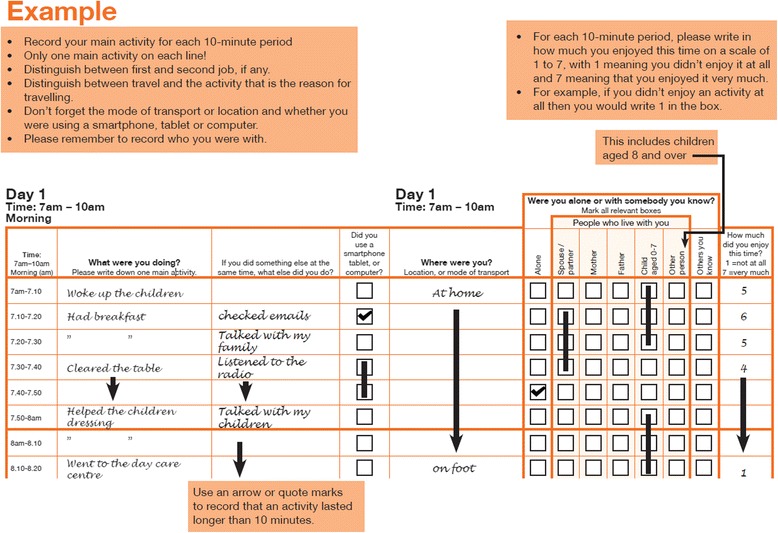
Methods: We analysed cross-sectional data from the 2014/15 United Kingdom Harmonised European Time Use Survey. Participants recorded two diary days of activity, and we randomly selected one day from participants aged 16 years or over. Activities were categorised into six mutually exclusive sets, accounting for the entire 24 h: (1) sleep; (2) leisure moderate to vigorous physical activity (MVPA); (3) leisure sedentary screen time; (4) non-discretionary time (work, study, chores and caring duties); (5) travel and (6) other. This mixture of activities was defined as a time-use composition. A binary variable was created indicating whether participants reported any active travel on their selected diary day. We used compositional multivariate analysis of variance (MANOVA) to test whether mean time-use composition differed between individuals reporting some active travel and those reporting no active travel, adjusted for covariates. We then used adjusted linear regression models and bootstrap confidence intervals to identify which of the six activity sets differed between groups.
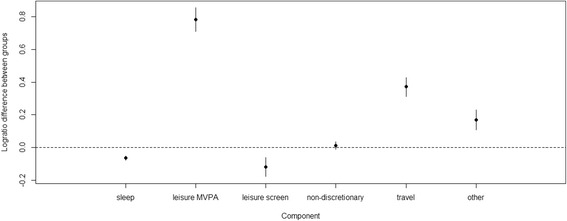
Results: 6143 participants (mean age 48 years; 53% female) provided a valid diary day. There was a statistically significant difference in time-use composition between those reporting some active travel and those reporting no active travel. Those undertaking active travel reported a relatively greater amount of time in leisure MVPA and travel, and a relatively lower amount of time in leisure sedentary screen time and sleep.
Conclusions: Compared to those not undertaking active travel, those who did active travel reported 11 min more in leisure MVPA and 18 min less in screen time per day, and reported lower sleep. From a health perspective, higher MVPA and lower screen time is favourable, but the pattern of sleep is more complex. Overall, active travel was associated with a broadly health-promoting composition of time across multiple behavioural domains, which supports the public health case for active travel.
Keywords: Active travel; Bicycling; Compositional data analysis; Physical activity; Screen time; Sedentary behaviour; Sleep; Walking.
Conflict of interest statement
Ethics approval and consent to participate
The study was approved by the Research Ethics Committee of the Department of Sociology (DREC) at the University of Oxford (2014_01_02_R1).
Consent for publication
Not applicable.
Competing interests
LF reports grants from British Heart Foundation, Cancer Research UK, Economic and Social Research Council, Medical Research Council, the National Institute for Health Research, and the Wellcome Trust, under the auspices of the UK Clinical Research Collaboration (UKCRC), during the conduct of the study; DD reports grants from the Australian Government Research Training Program during the course of the study; AA reports no competing financial interests; TO reports no competing financial interests; DO reports grants from Medical Research Council, grants from UKCRC, during the conduct of the study.
Publisher’s Note
Springer Nature remains neutral with regard to jurisdictional claims in published maps and institutional affiliations.
Figures
References
-
- Pratt M, Sarmiento OL, Montes F, Ogilvie D, Marcus BH, Perez LG, Brownson RC. For the lancet physical activity series working group: the implications of megatrends in information and communication technology and transportation for changes in global physical activity. Lancet. 2012;380(9838):282–293. doi: 10.1016/S0140-6736(12)60736-3. - DOI - PMC - PubMed
-
- Kelly P, Kahlmeier S, Götschi T, Orsini N, Richards J, Roberts N, Scarborough P, Foster C. Systematic review and meta-analysis of reduction in all-cause mortality from walking and cycling and shape of dose response relationship. Int J Behav Nutr Phys Act. 2014;11:132. doi: 10.1186/s12966-014-0132-x. - DOI - PMC - PubMed
-
- Celis-Morales CA, Lyall DM, Welsh P, Anderson J, Steell L, Guo Y, Maldonado R, Mackay DF, Pell JP, Sattar N, et al. Association between active commuting and incident cardiovascular disease, cancer, and mortality: prospective cohort study. Br Med J. 2017;357:j1456. doi: 10.1136/bmj.j1456. - DOI - PubMed
Publication types
MeSH terms
Grants and funding
- ES/L011662/1/Economic and Social Research Council/International
- 087636/Z/08/Z/United Kingdom Clinical Research Collaboration/International
- MR/K023187/1/MRC_/Medical Research Council/United Kingdom
- BHF_/British Heart Foundation/United Kingdom
- ES/G007462/1/United Kingdom Clinical Research Collaboration/International
LinkOut - more resources
Full Text Sources
Other Literature Sources
Medical
