


Rethinking the treatment of chronic fatigue syndrome-a reanalysis and evaluation of findings from a recent major trial of graded exercise and CBT
- PMID: 29562932
- PMCID: PMC5863477
- DOI: 10.1186/s40359-018-0218-3
Rethinking the treatment of chronic fatigue syndrome-a reanalysis and evaluation of findings from a recent major trial of graded exercise and CBT
Abstract
Background: The PACE trial was a well-powered randomised trial designed to examine the efficacy of graded exercise therapy (GET) and cognitive behavioural therapy (CBT) for chronic fatigue syndrome. Reports concluded that both treatments were moderately effective, each leading to recovery in over a fifth of patients. However, the reported analyses did not consistently follow the procedures set out in the published protocol, and it is unclear whether the conclusions are fully justified by the evidence.
Methods: Here, we present results based on the original protocol-specified procedures. Data from a recent Freedom of Information request enabled us to closely approximate these procedures. We also evaluate the conclusions from the trial as a whole.
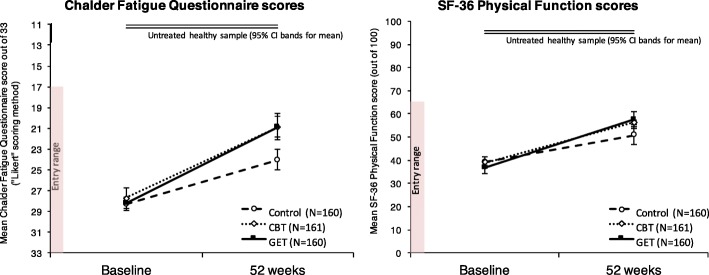
Results: On the original protocol-specified primary outcome measure - overall improvement rates - there was a significant effect of treatment group. However, the groups receiving CBT or GET did not significantly outperform the Control group after correcting for the number of comparisons specified in the trial protocol. Also, rates of recovery were consistently low and not significantly different across treatment groups. Finally, on secondary measures, significant effects were almost entirely confined to self-report measures. These effects did not endure beyond two years.
Conclusions: These findings raise serious concerns about the robustness of the claims made about the efficacy of CBT and GET. The modest treatment effects obtained on self-report measures in the PACE trial do not exceed what could be reasonably accounted for by participant reporting biases.
Keywords: Chronic fatigue syndrome; Cognitive behavioral therapy; Graded exercise therapy; Myalgic encephalomyelitis.
Conflict of interest statement
Ethics approval and consent to participate
Not applicable. The research reported in this article utilises data already available in the public domain.
Consent for publication
Not applicable.
Competing interests
All authors have read the competing interests statement, and declare no competing interests. TK is a (volunteer) committee member of the Irish ME/CFS Association.
Publisher’s Note
Springer Nature remains neutral with regard to jurisdictional claims in published maps and institutional affiliations.
Figures
References
-
- White PD, Sharpe MC, Chalder T, DeCesare JC, Walwyn R. Protocol for the PACE trial: a except to say it was “before the analysis occurredcognitive behaviour therapy, and graded exercise as supplements to standardised specialist medical care versus standardised specialist medical care alone for patients with the chronic fatigue syndrome/myalgic encephalomyelitis or encephalopathy. BMC Neurol 2007;7:1. - PMC - PubMed
-
- White PD, Goldsmith KA, Johnson AL, Potts L, et al. Comparison of adaptive pacing therapy, cognitive behaviour therapy, graded exercise therapy, and specialist medical care for chronic fatigue syndrome (PACE): a randomised trial. Lancet. 2011;377(9768):823–836. doi: 10.1016/S0140-6736(11)60096-2. - DOI - PMC - PubMed
-
- McCrone P, Sharpe M, Chalder T, Knapp M, Johnson AL, Goldsmith KA, White PD. Adaptive pacing, cognitive behaviour therapy, graded exercise, and specialist medical care for chronic fatigue syndrome: a cost-effectiveness analysis. PLoS One. 2012;7:e40808. doi: 10.1371/journal.pone.0040808. - DOI - PMC - PubMed
Publication types
MeSH terms
LinkOut - more resources
Full Text Sources
Other Literature Sources
Medical
