


The intention to use an electronic health record and its antecedents among three different categories of clinical staff
- PMID: 29562942
- PMCID: PMC5863455
- DOI: 10.1186/s12913-018-3022-0
The intention to use an electronic health record and its antecedents among three different categories of clinical staff
Abstract
Background: Like other sectors, the healthcare sector has to deal with the issue of users' acceptance of IT. In healthcare, different factors affecting healthcare professionals' acceptance of software applications have been investigated. Unfortunately, inconsistent results have been found, maybe because the different studies focused on different IT and occupational groups. Consequently, more studies are needed to investigate these implications for recent technology, such as Electronic Health Records (EHR).
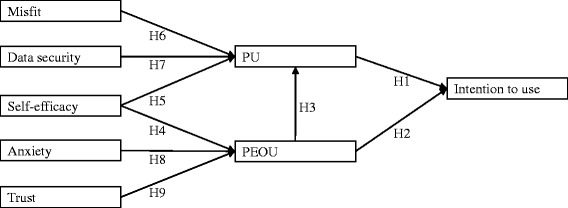
Methods: Given these findings in the existing literature, we pose the following research question: "To what extent do the different categories of clinical staff (physicians, paraprofessionals and administrative personnel) influence the intention to use an EHR and its antecedents?" To answer this research question we develop a research model that we empirically tested via a survey, including the following variables: intention to use, ease of use, usefulness, anxiety, self-efficacy, trust, misfit and data security. Our purpose is to clarify the possible differences existing between different staff categories.
Results: For the entire personnel, all the hypotheses are confirmed: anxiety, self-efficacy, trust influence ease of use; ease of use, misfit, self-efficacy, data security impact usefulness; usefulness and ease of use contribute to intention to use the EHR. They are also all confirmed for physicians, residents, carers and nurses but not for secretaries and assistants. Secretaries' and assistants' perception of the ease of use of EHR does not influence their intention to use it and they could not be influenced by self-efficacy in the development of their perception of the ease of use of EHR.
Conclusions: These results may be explained by the fact that secretaries, unlike physicians and nurses, have to follow rules and procedures for their work, including working with EHR. They have less professional autonomy than healthcare professionals and no medical responsibility. This result is also in line with previous literature highlighting that administrators are more motivated by the use of IT in healthcare.
Keywords: Administrative personnel; Clinical staff; Electronic health record; Intention to use; Paraprofessionals; Physicians; Survey.
Conflict of interest statement
Ethics approval and consent to participate
This study does not include any data on subjects, human material, or human data from patients. All the data were provided by voluntary answers to a questionnaire by the employees of the hospital. We followed strict ethical procedures at every stage of the study to ensure data confidentiality and anonymity of the study participants. We duly explained the purpose of the study to all employees before verbally obtaining their consent to freely participate. All the participants consented to answer anonymously to the questions asked by questionnaire. The survey was presented and accepted by the Medical Commission of the Hospital, the Users’ Commission and the Executive Board of the Hospital. All the data were collected anonymously. The respondents accepted to answer to the questions asked. No other ethics approval was necessary to be compliant with the French regulation.
Consent for publication
Not applicable.
Competing interests
The authors declare that they have no competing interests.
Publisher’s Note
Springer Nature remains neutral with regard to jurisdictional claims in published maps and institutional affiliations.
Figures
References
-
- Lapointe L, Rivard S. A multilevel model of resistance to information technology implementation. MIS Q. 2005;29(3):461–491. 10.2307/25148692.
-
- Rivard S, Lapointe L, Kappos A. An organizational culture-based theory of clinical information systems implementation in hospitals. J Assoc Inf Syst. 2011;12:123–162.
-
- Venkatesh V, Davis FD, Morris MG. Dead or alive? The development, trajectory and future of technology adoption research. J Assoc Inf Syst. 2007;8:267.
-
- Davis FD. Perceived usefulness, perceived ease of use, and user acceptance of information technology. MIS Q. 1989:13(3):319–340. 10.2307/249008.
-
- Chau PY, Hu PJ-H. Investigating healthcare professionals’ decisions to accept telemedicine technology: an empirical test of competing theories. Inf Manage. 2002;39:297–311. doi: 10.1016/S0378-7206(01)00098-2. - DOI
Publication types
MeSH terms
LinkOut - more resources
Full Text Sources
Other Literature Sources
