. 2018 Mar 21;8(1):4954.
doi: 10.1038/s41598-018-23200-0.

Effects of the novel pesticide flupyradifurone (Sivanto) on honeybee taste and cognition

Affiliations

Effects of the novel pesticide flupyradifurone (Sivanto) on honeybee taste and cognition

Hannah Hesselbach et al. Sci Rep. .

Abstract

Due to intensive agriculture honeybees are threatened by various pesticides. The use of one group of them, the neonicotinoids, was recently restricted by the European Union. These chemicals bind to the nicotinic acetylcholine receptor (nAchR) in the honeybee brain. Recently, Bayer AG released a new pesticide by the name of "Sivanto" against sucking insects. It is assumed to be harmless for honeybees, although its active ingredient, flupyradifurone, binds nAchR similar to the neonicotinoids. We investigated if this pesticide affects the taste for sugar and cognitive performance in honeybee foragers. These bees are directly exposed to the pesticide while foraging for pollen or nectar. Our results demonstrate that flupyradifurone can reduce taste and appetitive learning performance in honeybees foraging for pollen and nectar, although only the highest concentration had significant effects. Most likely, honeybee foragers will not be exposed to these high concentrations. Therefore, the appropriate use of this pesticide is considered safe for honeybees, at least with respect to the behaviors studied here.


Conflict of interest statement

The authors declare no competing interests.

Figures
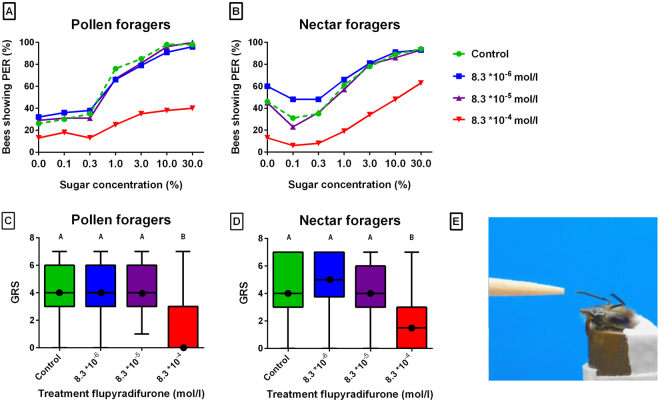
Figure 1
Figure 1
(A,B) Gustatory response curves of untreated bees (dotted) and flupyradifurone-treated bees in pollen foragers (A) and nectar foragers (B). Numbers of bees showing PER treated with flupyradifurone in the concentration of 8.3*10-4 mol/l were significantly lower than in the controls among the pollen foragers (P < 0.001) and the nectar foragers (P < 0.001). (C,D) Median gustatory response scores (GRS; intermediate lines) and quartiles (upper and lower lines) of untreated bees and flupyradifurone-treated bees in pollen foragers (C) and nectar foragers of the honeybee (D). Bees treated with 8.3 *10-4 g mol/l flupyradifurone had significantly lower GRS than the controls in the pollen forager group (P < 0.001) and in the nectar forager group (P < 0.001). For the numbers of bees per treatment see Table 1, for the test results see Supplementary Tables T3, 4. (E) Fixed bee.
Figure 2
Figure 2
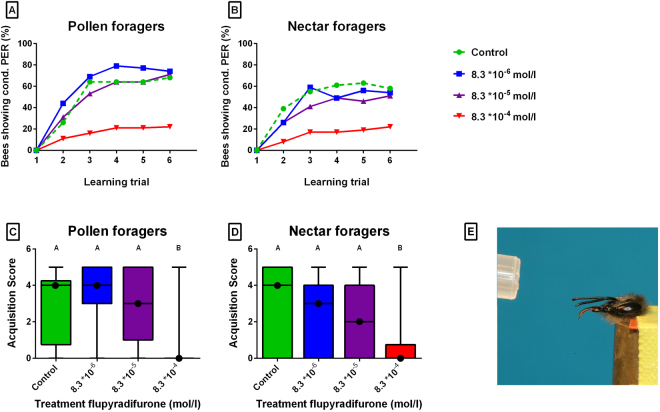
(A,B) Acquisition curves of untreated bees (dotted) and treated bees in pollen foragers (A) and in nectar foragers (B). In all groups, the number of bees showing the conditioned proboscis extension response (cond. PER) increased with learning trials The learning curves of bees treated with the flupyradifurone in the concentration of 8.3 * 10−4 mol/l differed significantly from the control in pollen foragers (P < 0.001) and nectar foragers (P < 0.001). (C,D) Median acquisition score (intermediate lines) and quartiles (upper and lower lines) of untreated bees and flupyradifurone-treated bees in pollen foragers (C) and in nectar foragers (D). There was a significant difference between flupyradifurone in the concentration of 8.3 * 10−4 mol/l and the control in pollen foragers (P < 0.005) and in nectar foragers (P < 0.001). For the numbers of bees per treatment see Table 1, for the test results see Supplementary Tables T3, 4. (E) Bee showing conditioned PER.
Figure 3
Figure 3
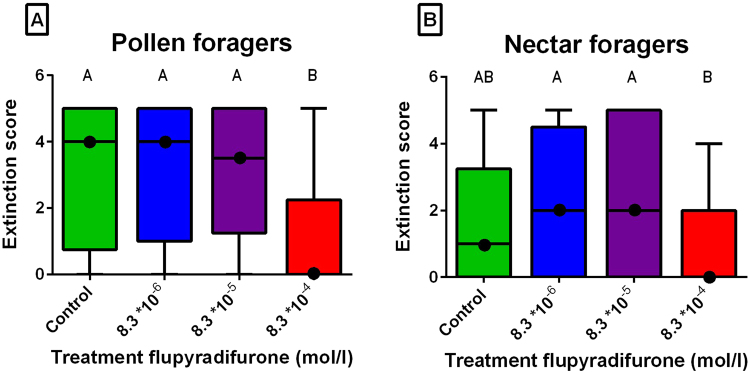
(A,B) Median extinction score (intermediate lines) and quartiles (upper and lower lines) of untreated bees and flupyradifurone-treated bees in pollen foragers (C) and in nectar foragers (D). There was a significant difference between flupyradifurone in the concentration of 8.3 * 10−4 mol/l and the control in pollen foragers (P < 0.005). In nectar foragers 8.3 * 10−4 mol/l was significantly different from 8.3 * 10−5 mol/l (P < 0.05) and 8.3 * 10−6 mol/l (P < 0.05). For the numbers of bees per treatment see Table 1, for the test results see Supplementary Tables T3, 4.

References

    1. Klatt, B. K. et al. Bee pollination improves crop quality, shelf life and commercial value. Proceedings. Biological sciences281 (2014). - PMC - PubMed
    1. Klein A-M, et al. Importance of pollinators in changing landscapes for world crops. Proceedings. Biological sciences. 2007;274:303–313. doi: 10.1098/rspb.2006.3721. - DOI - PMC - PubMed
    1. Potts SG, et al. Global pollinator declines: Trends, impacts and drivers. Trends in ecology & evolution. 2010;25:345–353. doi: 10.1016/j.tree.2010.01.007. - DOI - PubMed
    1. Tosi S, Costa C, Vesco U, Quaglia G, Guido G. A 3-year survey of Italian honey bee-collected pollen reveals widespread contamination by agricultural pesticides. Science of the total environment. 2018;615:208–218. doi: 10.1016/j.scitotenv.2017.09.226. - DOI - PubMed
    1. Mitchell EAD, et al. A worldwide survey of neonicotinoids in honey. Science (New York, N.Y.) 2017;358:109–111. doi: 10.1126/science.aan3684. - DOI - PubMed

Publication types

MeSH terms

LinkOut - more resources