. 2018 Mar 21;8(1):4949.
doi: 10.1038/s41598-018-23197-6.

Pupil size reflects successful encoding and recall of memory in humans

Affiliations

Pupil size reflects successful encoding and recall of memory in humans

Michal T Kucewicz et al. Sci Rep. .

Erratum in

Abstract

Pupil responses are known to indicate brain processes involved in perception, attention and decision-making. They can provide an accessible biomarker of human memory performance and cognitive states in general. Here we investigated changes in the pupil size during encoding and recall of word lists. Consistent patterns in the pupil response were found across and within distinct phases of the free recall task. The pupil was most constricted in the initial fixation phase and was gradually more dilated through the subsequent encoding, distractor and recall phases of the task, as the word items were maintained in memory. Within the final recall phase, retrieving memory for individual words was associated with pupil dilation in absence of visual stimulation. Words that were successfully recalled showed significant differences in pupil response during their encoding compared to those that were forgotten - the pupil was more constricted before and more dilated after the onset of word presentation. Our results suggest pupil size as a potential biomarker for probing and modulation of memory processing.


Conflict of interest statement

J.D. is employed in the Medicton Group Ltd. as an engineer working on the I4 tracking system. V.F. is the chief executive officer of the Medicton Group Ltd., which developed the I4 tracking system. All other authors express no conflicts of interest.

Figures
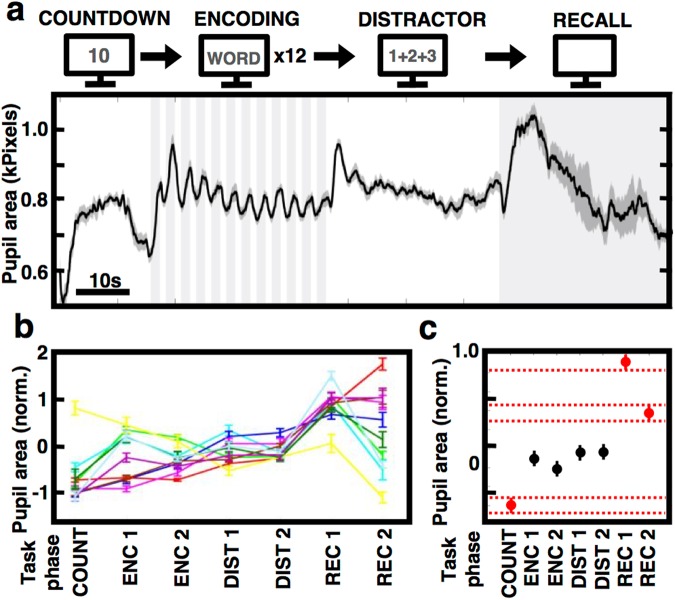
Figure 1
Figure 1
Pupil dilation is modulated by different phases of the free recall verbal memory task. (a) Trial-averaged changes in pupil size of one subject across four phases of the free recall task. Shaded areas mark epochs of word presentation on the screen and their recall with blank screen. Notice the consistent and stereotypical pupil responses across the trials revealing gradually increasing size in successive task phases. (b) Mean changes in pupil size are summarized in 12 s time bins of the four task phases for every subject (colors are different subjects). (c) Post-hoc ANOVA group comparison of means from the task phase bins (as in ‘b’) shows that pupil area was decreased during countdown and increased during recall. Red dotted lines are 95% confidence intervals. Note: the two phases are characterized by no cognitive load in the former and maximum load in the latter.
Figure 2
Figure 2
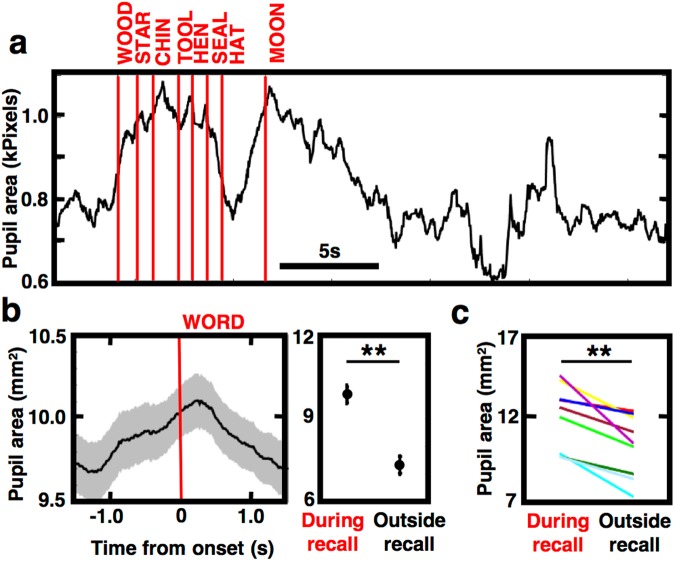
Pupil size is increased in response to free recall of remembered words. (a) Example of pupil area modulation during free recall of remembered words from one recall trial. Red lines mark the start time of word vocalization. Notice that recall of words is associated with pupil dilation with no changes in the screen display. (b) Mean pupil responses from all recalled word epochs in one patient are aligned to the onset of vocalization (left). Notice the consistent dilation starting before and peaking at the time of vocalization. Mean pupil area in ±1 s epochs around the word vocalization (‘during recall’) is significantly greater than in the remaining recall epochs (‘outside recall’) with no vocalization (**p < 0.01). (c) Across-subject comparison (colors are different subjects) of the pupil area in the two epoch types shows consistently more dilated pupil during recall of remembered words (*p < 0.05).
Figure 3
Figure 3
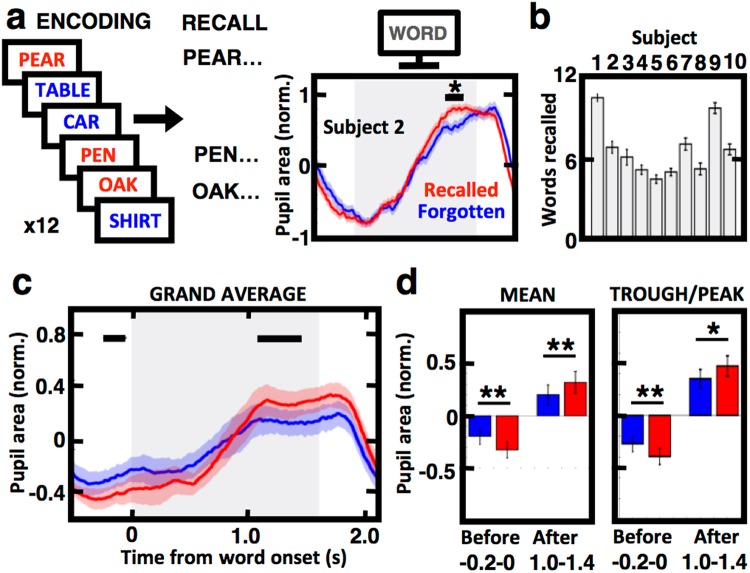
Remembered and forgotten words show different pupil responses during memory encoding. (a) Diagram on the left shows an example list of words presented in a sequence during encoding trials with subsequently recalled (red) and forgotten (blue) words. Mean pupil responses to presentation of words on the two trial types (right) in one example subject reveal more dilated peak response during encoding of the recalled words (horizontal bar below the asterisks indicates 50 ms bins with significant difference with p < 0.01). Shaded area marks the time of word presentation on the screen. (b) Mean memory performance of the ten subjects. (c) Subject-averaged pupil response to word encoding is presented as in ‘a’. Notice that pupil was more constricted on the recalled word trials just before the screen presentation, and more dilated at the peak response during encoding (bars indicate the time bins of the greatest difference). (d) Comparison of the subject means (left) and peak/trough values (right) in the epochs ‘Before’ and ‘After’ presentation onset (see ‘c’) confirms differential modulation of the pupil size between the trials with recalled and forgotten words (**p < 0.01, *p < 0.05 with Bonferroni correction for multiple comparisons).

References

    1. Hess EH, Polt JM. Pupil Size as Related to Interest Value of Visual Stimuli. Science. 1960;132:349–350. doi: 10.1126/science.132.3423.349. - DOI - PubMed
    1. Hess EH, Polt JM. Pupil Size in Relation to Mental Activity during Simple Problem-Solving. Science. 1964;143:1190–1192. doi: 10.1126/science.143.3611.1190. - DOI - PubMed
    1. Kahneman D, Beatty J. Pupil Diameter and Load on Memory. Science. 1966;154:1583–1585. doi: 10.1126/science.154.3756.1583. - DOI - PubMed
    1. Einhäuser W, Stout J, Koch C, Carter O. Pupil dilation reflects perceptual selection and predicts subsequent stability in perceptual rivalry. Proc. Natl. Acad. Sci. 2008;105:1704–1709. doi: 10.1073/pnas.0707727105. - DOI - PMC - PubMed
    1. Einhäuser W, Koch C, Carter OL. Pupil dilation betrays the timing of decisions. Front. Hum. Neurosci. 2010;4:18. - PMC - PubMed

Publication types