


Gender-Based Violence and Armed Conflict: A Community-Informed Socioecological Conceptual Model From Northeastern Uganda
- PMID: 29563663
- PMCID: PMC5858720
- DOI: 10.1177/0361684317705086
Gender-Based Violence and Armed Conflict: A Community-Informed Socioecological Conceptual Model From Northeastern Uganda
Abstract
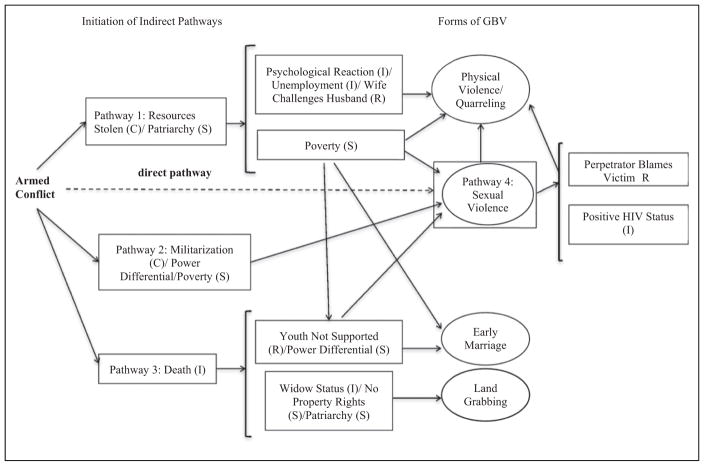
The high prevalence of gender-based violence (GBV) in armed conflict has been documented in various national contexts, but less is known about the complex pathways that constitute the relation between the two. Employing a community-based collaborative approach, we constructed a community-informed socioecological conceptual model from a feminist perspective, detailing how armed conflict relates to GBV in a conflict-affected rural community in Northeastern Uganda. The research questions were as follows: (1) How does the community conceptualize GBV? and (2) How does armed conflict relate to GBV? Nine focus group discussions divided by gender, age, and profession and six key informant interviews were conducted. Participants' ages ranged from 9 to 80 years (n =34 girls/women, n = 43 boys/men). Grounded theory was used in analysis. Participants conceptualized eight forms of and 22 interactive variables that contributed to GBV. Armed conflict affected physical violence/quarreling, sexual violence, early marriage, and land grabbing via a direct pathway and four indirect pathways initiated through looting of resources, militarization of the community, death of a parent(s) or husband, and sexual violence. The findings suggest that community, organizational, and policy-level interventions, which include attention to intersecting vulnerabilities for exposure to GBV in conflict-affected settings, should be prioritized. While tertiary psychological interventions with women and girls affected by GBV in these areas should not be eliminated, we suggest that policy makers and members of community and organizational efforts make systemic and structural changes. Online slides for instructors who want to use this article for teaching are available on PWQ's website at http://journals.sagepub.com/page/pwq/suppl/index.
Keywords: Uganda; armed conflict; community-based approach; gender-based violence; socioecological model.
Conflict of interest statement
Declaration of Conflicting Interests The author(s) declared no potential conflicts of interest with respect to the research, authorship, and/or publication of this article.
Figures
References
-
- Adomako Ampofo A, Beoku-Betts J, Osirim MJ. Researching African women and gender studies: New social science perspectives. African and Asian Studies. 2008;7:327–341. doi: 10.1163/156921008x359560. - DOI
-
- Akhter S, Kusakabe K. Gender-based violence among documented Rohingya refugees in Bangladesh. Indian Journal of Gender Studies. 2014;21:225–246. doi: 10.1177/0971521514525088. - DOI
-
- Amnesty International. Uganda, doubly traumatized: Lack of access to justice for female victims of sexual and gender-based violence in Northern Uganda. 2007 Retrieved from http://www.amnesty.org/en/library/info/AFR59/005/2007.
Grants and funding
LinkOut - more resources
Full Text Sources
Other Literature Sources