


The trends and projections in the incidence and mortality of liver cancer in urban Shanghai: a population-based study from 1973 to 2020
- PMID: 29563840
- PMCID: PMC5849921
- DOI: 10.2147/CLEP.S153951
The trends and projections in the incidence and mortality of liver cancer in urban Shanghai: a population-based study from 1973 to 2020
Abstract
Background: In 2012, liver cancer ranked as the fifth and eighth most common cancer in men and women, respectively, in urban Shanghai. This study aims to present the trend and projection of age-specific incidence and mortality of liver cancer in Shanghai.
Methods: We extracted data of liver cancer incident cases and deaths between 1973 and 2012. An age-period-cohort model was used to analyze the data.
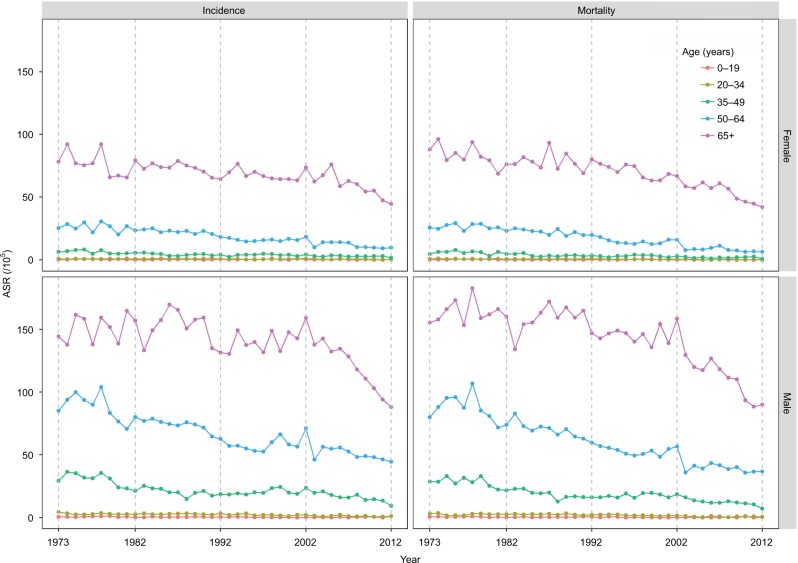
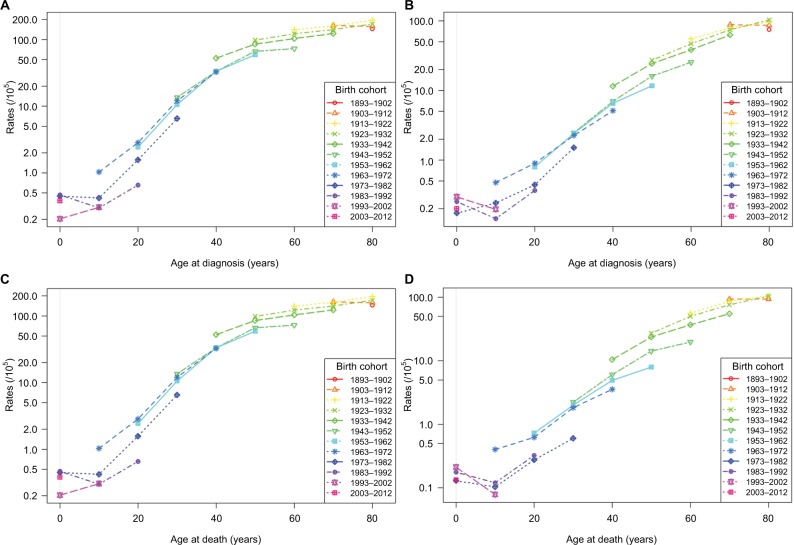
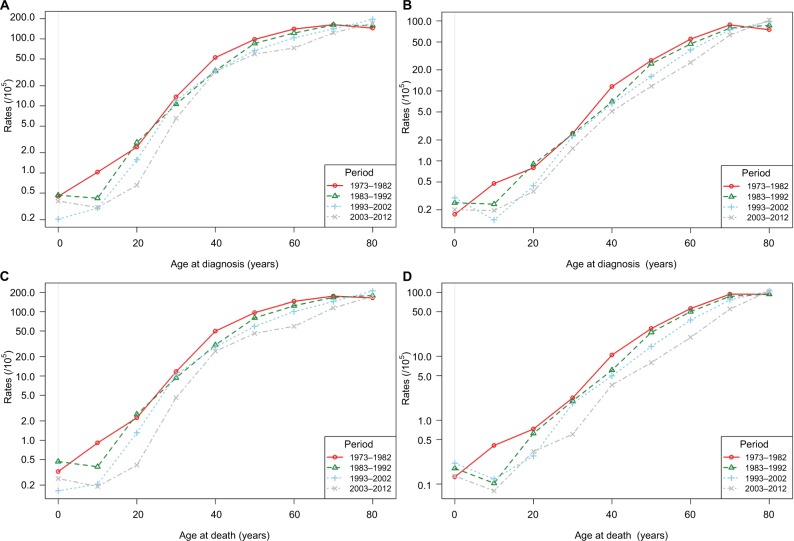
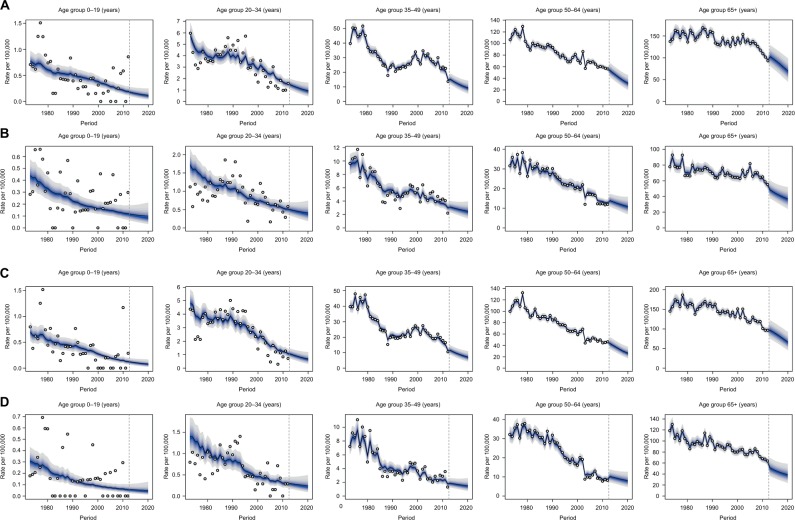
Results: A total of 47,344 men and 18,692 women were diagnosed with liver cancer from 1973 to 2012. The overall age-standardized incidence was 26.89 and 8.89 per 100,000 for men and women, respectively. Correspondingly, a total of 44,355 and 18,084 men and women died from liver cancer during this period. The overall age-standardized death rate was 25.34 per 100,000 in men and 9.39 per 100,000 in women. Between 1973 and 2012, liver cancer incidence and mortality in all age groups, except people aged 0-19 years, experienced a significant decline. Similar temporal patterns were detected in liver cancer mortality in both sexes when compared with incidence. Liver cancer incidence and mortality are expected to further decline among all age groups in 2013-2020 in both sexes, though the numbers of incident cases will remain stable.
Conclusion: Incidence and mortality of liver cancer in urban Shanghai have decreased by about 40% and 50%, respectively, over the past four decades. This decline is expected to continue in the near future. However, the population is aging, which is reflected in the increasing crude rates and decreasing age-adjusted rates.
Keywords: Shanghai; incidence; liver cancer; mortality.
Conflict of interest statement
Disclosure The authors report no conflicts of interest in this work.
Figures
References
-
- Fitzmaurice C, Allen C, Barber RM, et al. Global, regional, and national cancer incidence, mortality, years of life lost, years lived with disability, and disability-adjusted life-years for 32 cancer groups, 1990 to 2015: a systematic analysis for the global burden of disease study. JAMA Oncol. 2017;3(4):524–548. - PMC - PubMed
-
- Chen JG, Zhang SW. Liver cancer epidemic in China: past, present and future. Semin Cancer Biol. 2011;21(1):59–69. - PubMed
LinkOut - more resources
Full Text Sources
Other Literature Sources
Miscellaneous
