Review
. 2018 Feb 1:2018:7946431.
doi: 10.1155/2018/7946431. eCollection 2018.

Gut Microbiota-Immune System Crosstalk and Pancreatic Disorders

Affiliations
Review

Gut Microbiota-Immune System Crosstalk and Pancreatic Disorders

D Pagliari et al. Mediators Inflamm. .

Abstract

Gut microbiota is key to the development and modulation of the mucosal immune system. It plays a central role in several physiological functions, in the modulation of inflammatory signaling and in the protection against infections. In healthy states, there is a perfect balance between commensal and pathogens, and microbiota and the immune system interact to maintain gut homeostasis. The alteration of such balance, called dysbiosis, determines an intestinal bacterial overgrowth which leads to the disruption of the intestinal barrier with systemic translocation of pathogens. The pancreas does not possess its own microbiota, and it is believed that inflammatory and neoplastic processes affecting the gland may be linked to intestinal dysbiosis. Increasing research evidence testifies a correlation between intestinal dysbiosis and various pancreatic disorders, but it remains unclear whether dysbiosis is the cause or an effect. The analysis of specific alterations in the microbiome profile may permit to develop novel tools for the early detection of several pancreatic disorders, utilizing samples, such as blood, saliva, and stools. Future studies will have to elucidate the mechanisms by which gut microbiota is modulated and how it tunes the immune system, in order to be able to develop innovative treatment strategies for pancreatic disorders.


Figures
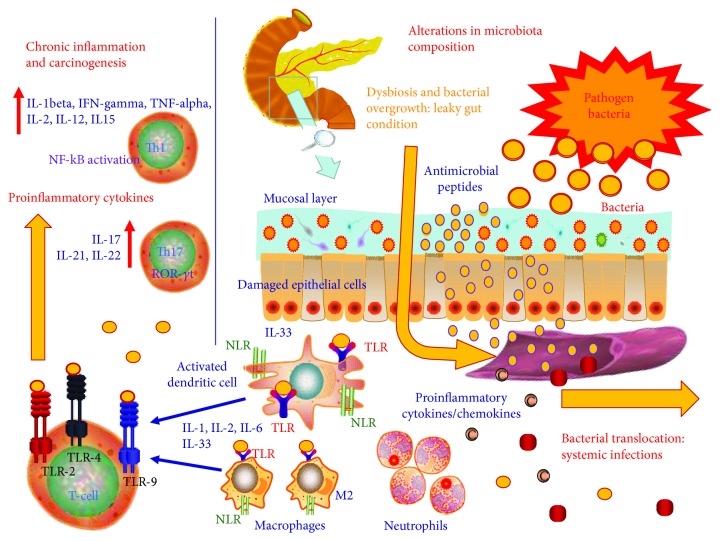
Figure 1
Figure 1
Role of leaky gut in pancreatic inflammation and carcinogenesis. The breakdown of the relationship among physiologic and pathogenic bacteria, the immune system, and intestinal epithelial barrier leads to dysbiosis. The pancreas does not possess its own microbiota, and thus, inflammatory and neoplastic processes affecting the gland may be linked to intestinal dysbiosis. In this way, during bacterial overgrowth, leaky gut is responsible for the translocation of bacteria and toxins to the pancreas. Bacterial translocation is involved in pancreatic inflammation due to toxin diffusion and complications like fibrosis, digestive and absorption disorders, diabetes, or cancer. TLR: Toll-like receptors; NLRs: NOD-like receptors; IL: interleukin; IFN: interferon; TNF: tumor necrosis factor; ROR-γt: RAR-related orphan receptor-gamma t; NF-kB: nuclear factor kappa-B.

References

    1. Leal-Lopes C., Velloso F. J., Campopiano J. C., Sogayar M. C., Correa R. G. Roles of commensal microbiota in pancreas homeostasis and pancreatic pathologies. Journal of Diabetes Research. 2015;2015:20. doi: 10.1155/2015/284680.284680 - DOI - PMC - PubMed
    1. Savage D. C. Microbial ecology of the gastrointestinal tract. Annual Review of Microbiology. 1977;31(1):107–133. doi: 10.1146/annurev.mi.31.100177.000543. - DOI - PubMed
    1. Whitman W. B., Coleman D. C., Wiebe W. J. Prokaryotes: the unseen majority. Proceedings of the National Academy of Sciences of the United States of America. 1998;95(12):6578–6583. doi: 10.1073/pnas.95.12.6578. - DOI - PMC - PubMed
    1. Chen B., Sun L., Zhang X. Integration of microbiome and epigenome to decipher the pathogenesis of autoimmune diseases. Journal of Autoimmunity. 2017;83:31–42. doi: 10.1016/j.jaut.2017.03.009. - DOI - PubMed
    1. Ehrlich S. D. The human gut microbiome impacts health and disease. Comptes Rendus Biologies. 2016;339(7-8):319–323. doi: 10.1016/j.crvi.2016.04.008. - DOI - PubMed

MeSH terms

LinkOut - more resources
