Multimorbidity and out-of-pocket expenditure on medicines: a systematic review
- PMID: 29564155
- PMCID: PMC5859814
- DOI: 10.1136/bmjgh-2017-000505
Multimorbidity and out-of-pocket expenditure on medicines: a systematic review
Abstract
Background: Multimorbidity, the presence of two or more non-communicable diseases (NCD), is a costly and complex challenge for health systems globally. Patients with NCDs incur high levels of out-of-pocket expenditure (OOPE), often on medicines, but the literature on the association between OOPE on medicines and multimorbidity has not been examined systematically.
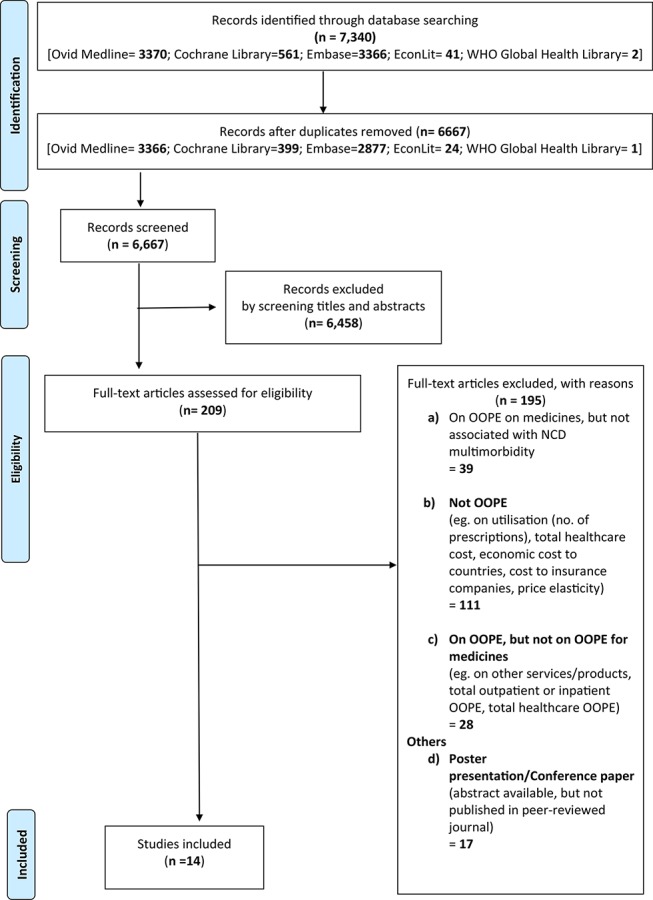
Methods: A systematic review was conducted via searching medical and economics databases including Ovid Medline, EMBASE, EconLit, Cochrane Library and the WHO Global Health Library from year 2000 to 2016. Study quality was assessed using Newcastle-Ottawa Scale. PROSPERO: CRD42016053538.
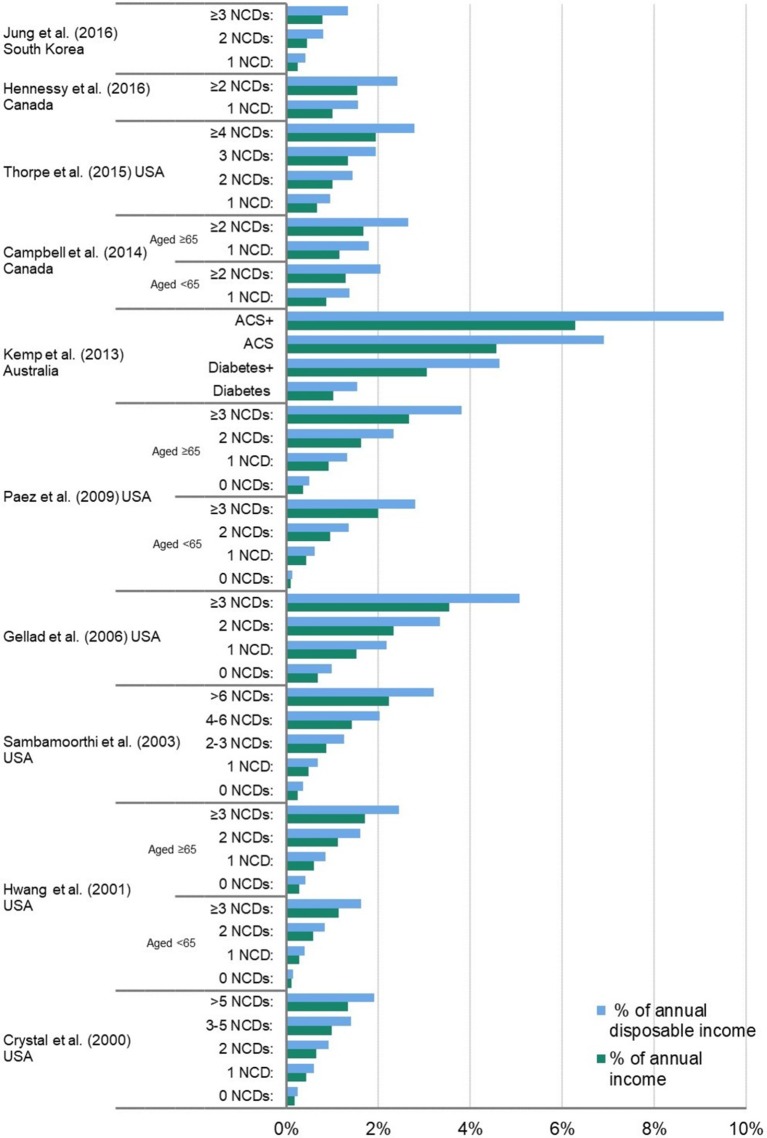
Findings: 14 articles met inclusion criteria. Findings indicated that multimorbidity was associated with higher OOPE on medicines. When number of NCDs increased from 0 to 1, 2 and ≥3, annual OOPE on medicines increased by an average of 2.7 times, 5.2 times and 10.1 times, respectively. When number of NCDs increased from 0 to 1, 2, ≥2 and ≥3, individuals spent a median of 0.36% (IQR 0.15%-0.51%), 1.15% (IQR 0.62%-1.64%), 1.41% (IQR 0.86%-2.15%), 2.42% (IQR 2.05%-2.64%) and 2.63% (IQR 1.56%-4.13%) of mean annual household net adjusted disposable income per capita, respectively, on annual OOPE on medicines. More multimorbidities were associated with higher OOPE on medicines as a proportion of total healthcare expenditures by patients. Some evidence suggested that the elderly and low-income groups were most vulnerable to higher OOPE on medicines. With the same number of NCDs, certain combinations of NCDs yielded higher medicine OOPE. Non-adherence to medicines was a coping strategy for OOPE on medicines.
Conclusion: Multimorbidity of NCDs is increasingly costly to healthcare systems and OOPE on medicines can severely compromise financial protection and universal health coverage. It is crucial to recognise the need for better equity and financial protection, and policymakers should consider health system financial options, cost sharing policies and service patterns for those with NCD multimorbidities.
Keywords: public health.
Conflict of interest statement
Competing interests: None declared.
Figures
Comment in
-
The case for a global focus on multiple chronic conditions.BMJ Glob Health. 2018 Jun 22;3(3):e000874. doi: 10.1136/bmjgh-2018-000874. eCollection 2018. BMJ Glob Health. 2018. PMID: 29989034 Free PMC article. No abstract available.
References
-
- The United Nations. 2011 high-level meeting on prevention and control of non-communicable diseases. http://www.un.org/en/ga/ncdmeeting2011/ (accessed 15 Jan 2017).
-
- World Health Organisation. Global action plan for the prevention and control of NCDs 2013-2020. http://www.who.int/nmh/publications/ncd-action-plan/en/ (accessed 15 Jan 2017).
LinkOut - more resources
Full Text Sources
Other Literature Sources
Miscellaneous