Sarcopenic Obesity in Elderly Korean Women: A Nationwide Cross-sectional Study
- PMID: 29564306
- PMCID: PMC5854823
- DOI: 10.11005/jbm.2018.25.1.53
Sarcopenic Obesity in Elderly Korean Women: A Nationwide Cross-sectional Study
Abstract
Background: Sarcopenia causes loss of muscle mass in the elderly and is associated with development of metabolic syndrome in those with obesity. This study evaluated the prevalence of sarcopenic obesity (SO) in healthy Korean elderly women.
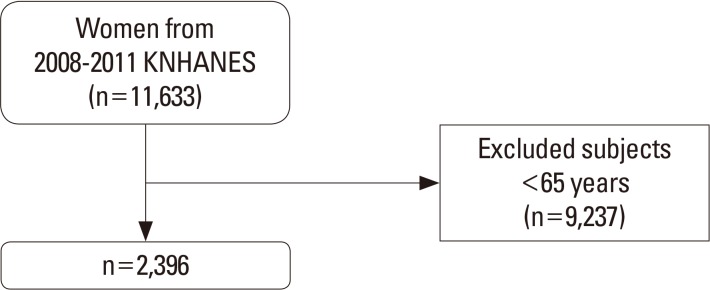
Methods: This study was based on data from the Korea National Health and Nutrition Examination Survey IV and V, 2008-2011. Whole body dual energy X-ray absorptiometry and body mass index measurement were performed for all patients. Women aged 65 years or older were included in this study. Total appendicular extremity muscle mass was used to determine the skeletal muscle mass index.
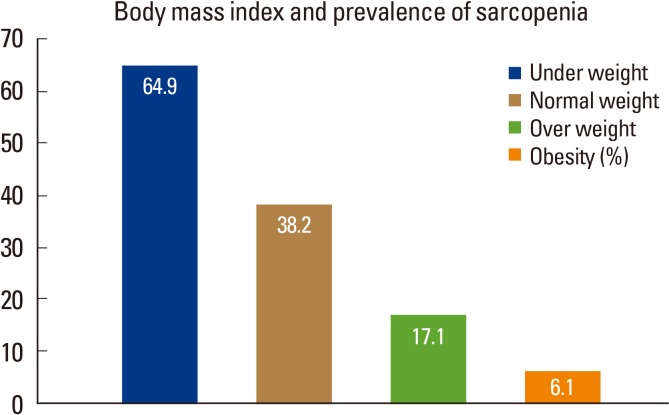
Results: Of 2,396 women aged 65 years or older, a total of 1,491 (62.2%) were underweight, normal weight, or overweight, while 905 (37.8%) were obese. The prevalence of sarcopenia using a cut-off value of 5.4 kg/m2 was 64.9% (63/97) in underweight women, 38.2% (320/838) in normal weight women, 17.1% (95/556) in overweight women, and 6.1% (55/905) in obese women.
Conclusions: The prevalence of sarcopenia was different among groups. The prevalence rate in obese women was lower than that in non-obese women. SO is a new category of obesity in older adults with high adiposity coupled with low muscle mass. The prevalence of SO was lower than that in previous studies because of differences in the definition. A consensus definition of SO needs to be established.
Keywords: Body mass index; Korea; Obesity; Sarcopenia; Women.
Conflict of interest statement
No potential conflict of interest relevant to this article was reported.
Figures
References
-
- Rosenberg IH. Sarcopenia: origins and clinical relevance. J Nutr. 1997;127:990s–991s. - PubMed
-
- Visser M, Goodpaster BH, Kritchevsky SB, et al. Muscle mass, muscle strength, and muscle fat infiltration as predictors of incident mobility limitations in well-functioning older persons. J Gerontol A Biol Sci Med Sci. 2005;60:324–333. - PubMed
-
- Xue QL, Walston JD, Fried LP, et al. Prediction of risk of falling, physical disability, and frailty by rate of decline in grip strength: the women's health and aging study. Arch Intern Med. 2011;171:1119–1121. - PubMed
-
- Riechman SE, Schoen RE, Weissfeld JL, et al. Association of physical activity and visceral adipose tissue in older women and men. Obes Res. 2002;10:1065–1073. - PubMed
-
- Baumgartner RN. Body composition in healthy aging. Ann N Y Acad Sci. 2000;904:437–448. - PubMed
LinkOut - more resources
Full Text Sources
Other Literature Sources