


Compositional Quality and Potential Gastrointestinal Behavior of Probiotic Products Commercialized in Italy
- PMID: 29564327
- PMCID: PMC5845905
- DOI: 10.3389/fmed.2018.00059
Compositional Quality and Potential Gastrointestinal Behavior of Probiotic Products Commercialized in Italy
Erratum in
-
Corrigendum: Compositional quality and potential gastrointestinal behavior of probiotic products commercialized in Italy.Front Med (Lausanne). 2023 Jan 27;9:1091788. doi: 10.3389/fmed.2022.1091788. eCollection 2022. Front Med (Lausanne). 2023. PMID: 36777161 Free PMC article.
Abstract
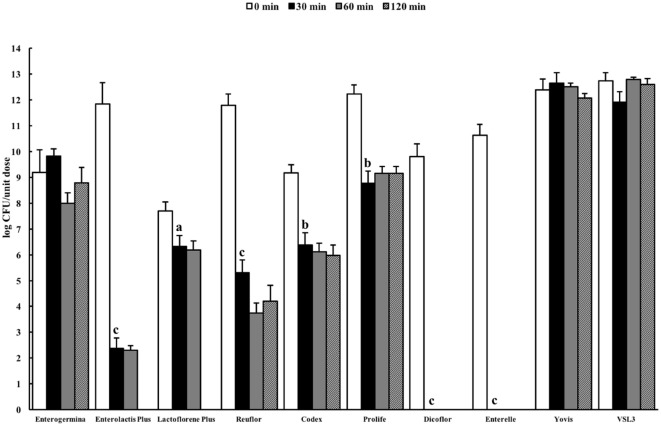
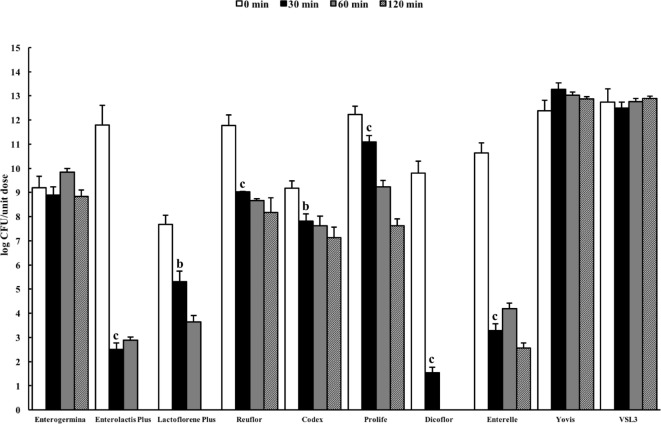
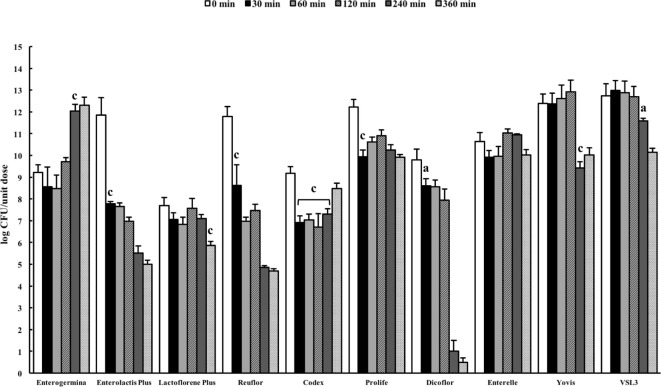
Recent guidelines indicate that oral probiotics, living microorganisms able to confer a health benefit on the host, should be safe for human consumption, when administered in a sufficient amount, and resist acid and bile to exert their beneficial effects (e.g., metabolic, immunomodulatory, anti-inflammatory, competitive). This study evaluated quantitative and qualitative aspects and the viability in simulated gastric and intestinal juices of commercial probiotic formulations available in Italy. Plate counting and MALDI-TOF mass spectrometry were used to enumerate and identify the contained organisms. In vitro studies with two artificial gastric juices and pancreatin-bile salt solution were performed to gain information on the gastric tolerance and bile resistance of the probiotic formulations. Most preparations satisfied the requirements for probiotics and no contaminants were found. Acid resistance and viability in bile were extremely variable depending on the composition of the formulations in terms of contained species and strains. In conclusion, this study indicates good microbiological quality but striking differences in the behavior in the presence of acids and bile for probiotic formulations marketed in Italy.
Keywords: MALDI-TOF; acid resistance; bile tolerance; gastric juice; intestinal fluid; microbial identification; probiotics.
Figures
References
-
- Hill C, Guarner F, Reid G, Gibson GR, Merenstein DJ, Pot B, et al. Expert consensus document. The international scientific association for probiotics and prebiotics consensus statement on the scope and appropriate use of the term probiotic. Nat Rev Gastroenterol Hepatol (2014) 11(8):506–14.10.1038/nrgastro.2014.66 - DOI - PubMed
-
- Lefevre M, Racedo SM, Ripert G, Housez B, Cazaubiel M, Maudet C, et al. Probiotic strain Bacillus subtilis CU1 stimulates immune system of elderly during common infectious disease period: a randomized, double-blind placebo-controlled study. Immun Ageing (2015) 12(1):24.10.1186/s12979-015-0051-y - DOI - PMC - PubMed
-
- Kolaček S, Hojsak I, Canani RB, Guarino A, Indrio F, Orel R, et al. Commercial probiotic products: a call for improved quality control. A position paper by the ESPGHAN Working Group for probiotics and prebiotics. J Pediatr Gastroenterol Nutr (2017) 65(1):117–24.10.1097/MPG.0000000000001603 - DOI - PubMed
LinkOut - more resources
Full Text Sources
Other Literature Sources
