Review
. 2017 Oct 31;2017(3):e201726.
doi: 10.21542/gcsp.2017.26.

Aneurysmal coronary artery disease: An overview

Affiliations
Review

Aneurysmal coronary artery disease: An overview

Mohamed S ElGuindy et al. Glob Cardiol Sci Pract. .

Abstract

Aneurysmal coronary artery disease (ACAD) comprises both coronary artery aneurysms (CAA) and coronary artery ectasia (CAE). The reported prevalence of ACAD varies widely from 0.2 to 10%, with male predominance and a predilection for the right coronary artery (RCA). Atherosclerosis is the commonest cause of ACAD in adults, while Kawasaki disease is the commonest cause in children and adolescents, as well as in the Far East. Most patients are asymptomatic, but when symptoms do exist, they are usually related to myocardial ischemia. Coronary angiography is the mainstay of diagnosis, but follow up is best achieved using noninvasive imaging that does not involve exposure to radiation. The optimal management strategy in patients with ACAD remains controversial. Medical therapy is indicated for the vast majority of patients and includes antiplatelets and/or anticoagulants. Covered stents effectively limit further expansion of the affected coronary segments. Surgical ligation, resection, and coronary artery bypass grafting are appropriate for large lesions and for associated obstructive coronary artery disease.


Figures
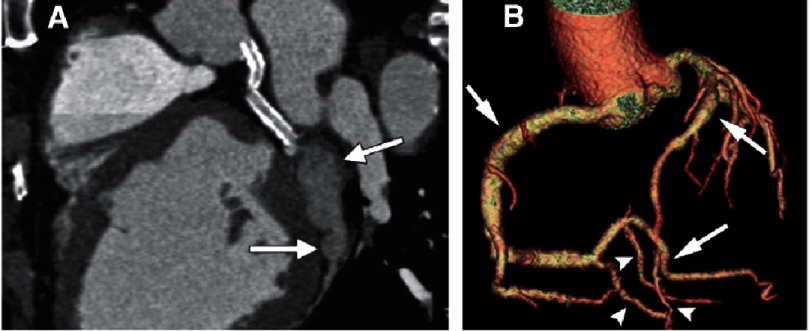
Figure 1.
Figure 1.. Coronary artery aneurysm compared with coronary artery ectasia.
(A) Coronal reformatted image of 55 year-old man with stents in the left main and proximal circumflex coronary arteries. A saccular atherosclerotic aneurysm (arrows) is seen in the mid distal portion of the left circumflex coronary artery. (B) Volume rendered image showing ectasia in the RCA, its posterolateral branch, and the left anterior descending artery (arrows). Note normal diameters (arrowheads) of the coronaries; dilatation of the coronary arteries extends for more than 50% of the vessel length. From Diaz-Zamudio et al. with permission.
Figure 2.
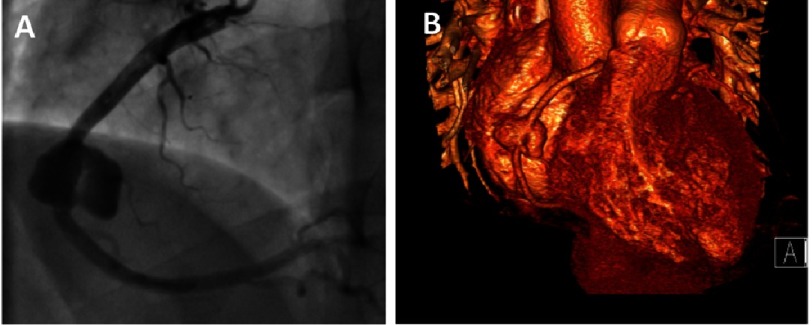
Figure 2.. Giant coronary artery aneurysm.
(A) Coronary angiogram of a 19 year-old male patient with history of Kawasaki disease during childhood showing a “giant” coronary aneurysm affecting the mid segment of the right coronary artery. (B) 3D volume-rendered reconstructed CT image of the same patient.
Figure 3.
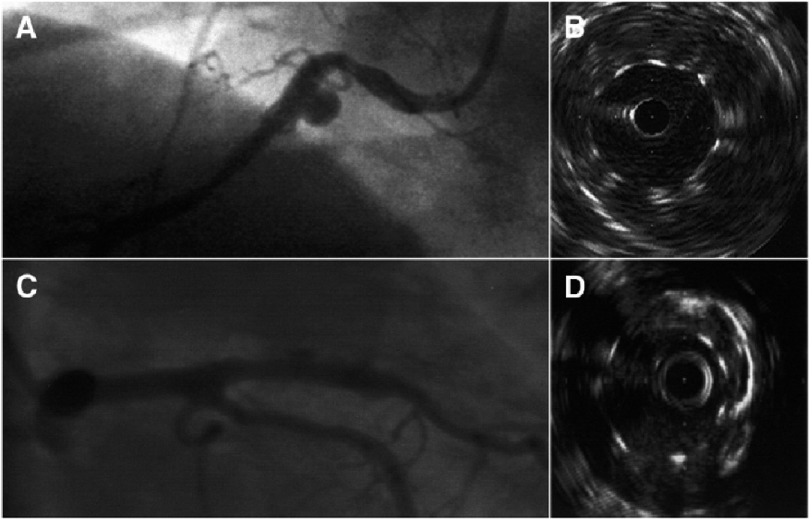
Figure 3.. Angiographic and IVUS images of coronary artery aneurysm.
(A and B) Coronary artery aneurysm detected by coronary angiography and intravascular ultrasound (IVUS) 8 months after bare-metal stent implantation. (C and D) Coronary artery aneurysm detected with coronary angiography and IVUS 3 months after drug-eluting stent implantation. From Aoki et al. with permission.
Figure 4.
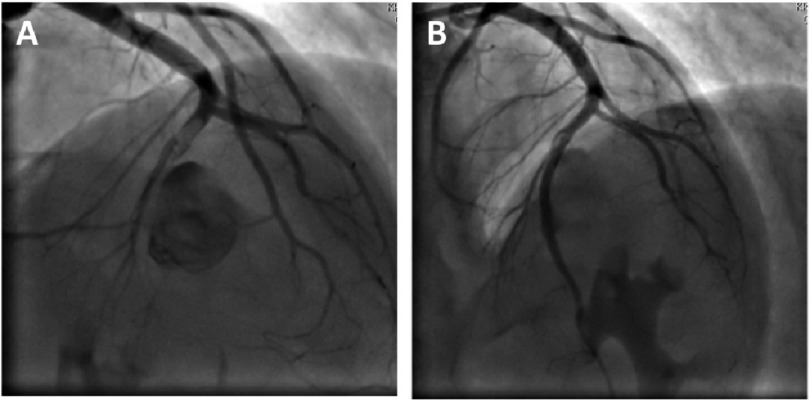
Figure 4.. Percutaneous treatment of a mid-LAD aneurysm.
(A) Coronary angiogram of a 22 year-old male patient presenting with acute anterior ST-elevation myocardial infarction. A giant aneurysm (etiology unknown) is seen in the mid segment of the left anterior descending (LAD) coronary artery which is subtotally occluded after the aneurysmal segment. (B) TIMI 3 flow restored in the distal LAD after primary percutaneous coronary intervention using a 3.0 × 28 mm PTFE-covered stent with cessation of flow into the aneurysm.

References

    1. Pahlavan PS, Niroomand F. Coronary artery aneurysm: A review. Clin. Cardiol. 2006;29:439–43. - PMC - PubMed
    1. Falsetti HL, Carrol RJ. Coronary artery aneurysm. A review of the literature with a report of 11 new cases. Chest. 1976;69:630–6. - PubMed
    1. Mata KM, et al. In: Novel strategies in ischemic heart disease. Lakshmanadoss U, editor. Intech; 2012. pp. 381–404. doi: 10.5772/1471 .
    1. Markis JE, et al. Clinical significance of coronary arterial ectasia. Am. J. Cardiol. 1976;37:217–22. - PubMed
    1. Ramos SG, Mata KMA, Martins CCS, Martins AP, Rossi MA. Giant right coronary artery aneurysm presenting as a paracardiac mass. Cardiovasc. Pathol. 2008;17:329–33. - PubMed

LinkOut - more resources