


New protein deposition tracers in the pipeline
- PMID: 29564387
- PMCID: PMC5843813
- DOI: 10.1186/s41181-016-0015-3
New protein deposition tracers in the pipeline
Erratum in
-
Erratum: Publisher Correction to EJNMMI Radiopharmacy and Chemistry Volume 1 (2016).EJNMMI Radiopharm Chem. 2018 Nov 26;3:13. doi: 10.1186/s41181-018-0049-9. eCollection 2018 Dec. EJNMMI Radiopharm Chem. 2018. PMID: 31329807 Free PMC article.
Abstract
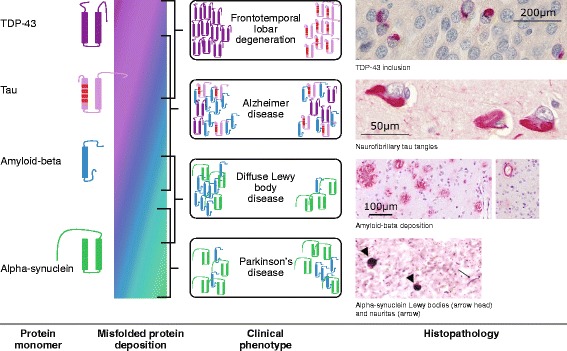
Traditional nuclear medicine ligands were designed to target cellular receptors or transporters with a binding pocket and a defined structure-activity relationship. More recently, tracers have been developed to target pathological protein aggregations, which have less well-defined structure-activity relationships. Aggregations of proteins such as tau, α-synuclein, and β-amyloid (Aβ) have been identified in neurodegenerative diseases, including Alzheimer's disease (AD) and other dementias, and Parkinson's disease (PD). Indeed, Aβ deposition is a hallmark of AD, and detection methods have evolved from coloured dyes to modern 18F-labelled positron emission tomography (PET) tracers. Such tracers are becoming increasingly established in routine clinical practice for evaluation of Aβ neuritic plaque density in the brains of adults who are being evaluated for AD and other causes of cognitive impairment. While similar in structure, there are key differences between the available compounds in terms of dosing/dosimetry, pharmacokinetics, and interpretation of visual reads. In the future, quantification of Aβ-PET may further improve its utility. Tracers are now being developed for evaluation of tau protein, which is associated with decreased cognitive function and neurodegenerative changes in AD, and is implicated in the pathogenesis of other neurodegenerative diseases. While no compound has yet been approved for tau imaging in clinical use, it is a very active area of research. Development of tau tracers comprises in-depth characterisation of existing radiotracers, clinical validation, a better understanding of uptake patterns, test-retest/dosimetry data, and neuropathological correlations with PET. Tau imaging may allow early, more accurate diagnosis, and monitoring of disease progression, in a range of conditions. Another marker for which imaging modalities are needed is α-synuclein, which has potential for conditions including PD and dementia with Lewy bodies. Efforts to develop a suitable tracer are ongoing, but are still in their infancy. In conclusion, several PET tracers for detection of pathological protein depositions are now available for clinical use, particularly PET tracers that bind to Aβ plaques. Tau-PET tracers are currently in clinical development, and α-synuclein protein deposition tracers are at early stage of research. These tracers will continue to change our understanding of complex disease processes.
Keywords: Alpha-synuclein; Beta-amyloid; Neurodegeneration; PET; Radiotracer; Tau.
Figures
References
-
- Bagchi DP, Yu L, Perlmutter JS, et al. Binding of the radioligand SIL23 to a-synuclein fibrils in Parkinson’s disease tissue establishes feasibility and screening approaches for developing a Parkinson disease imaging agent. PLoS One. 2013;8:e55031. doi: 10.1371/journal.pone.0055031. - DOI - PMC - PubMed
-
- Chien DT, Bahri S, Szardenings AK, et al. Early clinical PET imaging results with the novel PHF-tau radioligand [F-18]-T807. J Alzheimers Dis. 2013;34:457–468. - PubMed
-
- Chien DT, Szardenings AK, Bahri S, et al. Early clinical PET imaging results with the novel PHF-tau radioligand [F18]-T808. J Alzheimers Dis. 2014;38:171–184. - PubMed
Publication types
LinkOut - more resources
Full Text Sources
Other Literature Sources