


Childhood Obesity Declines Project: A Different Methodology
- PMID: 29565657
- PMCID: PMC5865615
- DOI: 10.1089/chi.2018.0019
Childhood Obesity Declines Project: A Different Methodology
Abstract
Background: The evidence for and our understanding of community-level strategies such as policies, system, and environmental changes that support healthy eating and active living is growing. However, researchers and evaluation scientists alike are still not confident in what to recommend for preventing or sustaining declines in the prevalence of obesity.
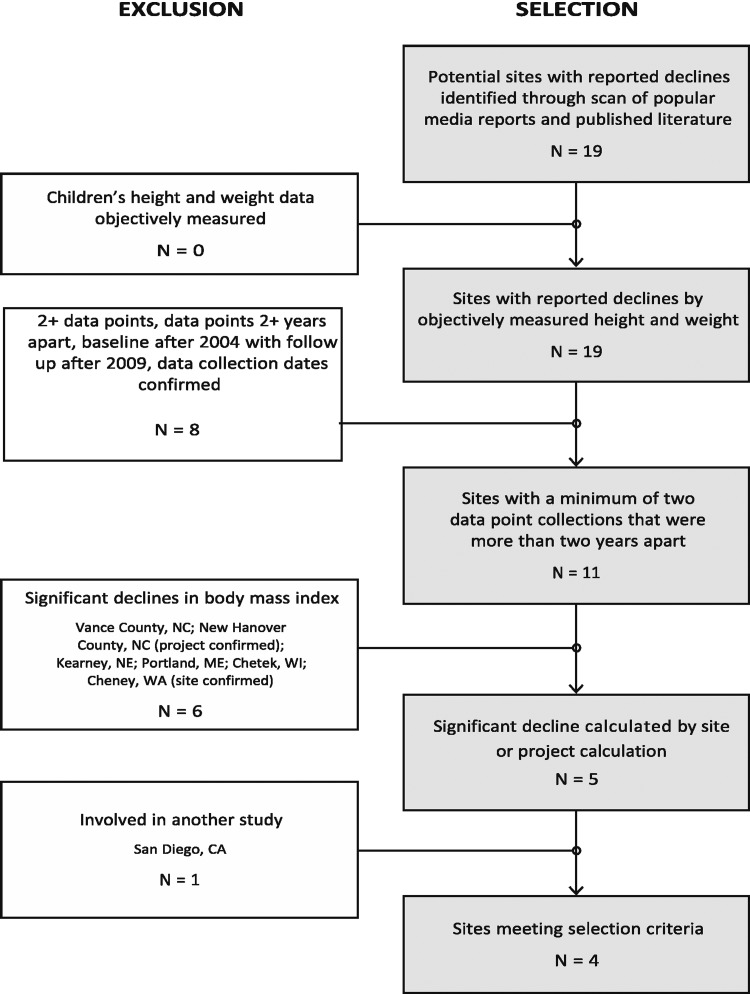
Methods: The Systematic Screening and Assessment (SSA) methodology was adapted as a retrospective process to confirm obesity declines and to better understand what and how policies and programs or interventions may contribute as drivers. The Childhood Obesity Declines (COBD) project's adaptation of the SSA methodology consisted of the following components: (1) establishing and convening an external expert advisory panel; (2) identification and selection of sites reporting obesity declines; (3) confirmation and review of what strategies occurred and contextual factors were present during the period of the obesity decline; and (4) reporting the findings to sites and the field.
Results/discussion: The primary result of the COBD project is an in-depth examination of the question, "What happened and how did it happen in communities where the prevalence of obesity declined?" The primary aim of this article is to describe the project's methodology and present its limitations and strengths.
Conclusions: Exploration of the natural experiments such that occurred in Anchorage, Granville County, New York City, and Philadelphia is the beginning of our understanding of the drivers and contextual factors that may affect childhood obesity. This retrospective examination allows us to: (1) describe targeted interventions; (2) examine the timeline and summarize intervention implementation; (3) document national, state, local, and institutional policies; and (4) examine the influence of the reach and potential multisector layering of interventions.
Keywords: community interventions; evaluation; methods; natural experiments; obesity; obesity prevention; policy.
Conflict of interest statement
No competing financial interests exist.
The authors did not report any conflicts of interest or financial disclosures. The findings and conclusions of this report are those of the authors and do not represent the official position of the Centers for Disease Control and Prevention, ICF, National Institutes of Health, or Robert Wood Johnson Foundation.
Figures
References
-
- Dietz WH, Economos CD. Progress in the control of childhood obesity. Pediatrics 2015;135:e559. - PubMed
-
- Institute of Medicine. Accelerating Progress in Obesity Prevention: Solving the Weight of the Nation. Washington, DC: The National Academies Press, 2012 - PubMed
-
- Institute of Medicine. Evaluating Obesity Prevention Efforts: A Plan for Measuring Progress. Washington, DC: The National Academies Press, 2013 - PubMed
-
- Leviton LC, Kettel Khan L, Dawkins N. (eds). The Systematic Screening and Assessment Method: Finding Innovations Worth Evaluating. New Directions for Evaluation No. 125. San Francisco, CA: Jossey-Bass, 2010
Publication types
MeSH terms
LinkOut - more resources
Full Text Sources
Other Literature Sources
Medical
Research Materials
