


Monounsaturated fats from plant and animal sources in relation to risk of coronary heart disease among US men and women
- PMID: 29566185
- PMCID: PMC5875103
- DOI: 10.1093/ajcn/nqx004
Monounsaturated fats from plant and animal sources in relation to risk of coronary heart disease among US men and women
Abstract
Background: Monounsaturated fatty acids (MUFAs) improve blood lipid profiles in intervention studies, but prospective evidence with regard to MUFA intake and coronary heart disease (CHD) risk is limited and controversial.
Objective: We investigated the associations of cis MUFA intake from plant (MUFA-P) and animal (MUFA-A) sources with CHD risk separately among 63,442 women from the Nurses' Health Study (1990-2012) and 29,942 men from the Health Professionals Follow-Up Study (1990-2012).
Design: Intakes of MUFA-Ps and MUFA-As were calculated by using validated food-frequency questionnaires collected every 4 y. Incident nonfatal myocardial infarction and fatal CHD cases (n = 4419) were confirmed by medical record review.
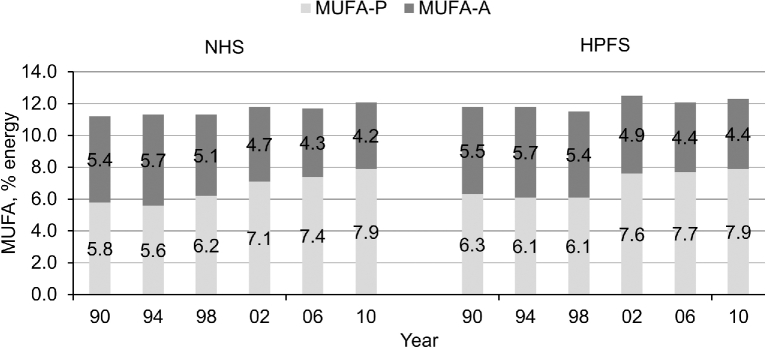
Results: During follow-up, MUFA-Ps and MUFA-As contributed 5.8-7.9% and 4.2-5.4% of energy on average, respectively. When MUFA-Ps were modeled to isocalorically replace other macronutrients, HRs (95% CIs) of CHD were 0.83 (0.68, 1.00) for saturated fatty acids (SFAs; 5% of energy), 0.86 (0.76, 0.97) for refined carbohydrates (5% of energy), and 0.80 (0.70, 0.91) for trans fats (2% of energy) (P = 0.05, 0.01, and 0.001, respectively). For MUFA-As, corresponding HRs (95% CIs) for the same isocaloric substitutions were 1.04 (0.79, 1.38) for SFAs, 1.11 (0.91, 1.35) for refined carbohydrates, and 0.88 (0.77, 1.01) for trans fats (P = 0.76, 0.31, and 0.08, respectively). Given the common food sources of SFAs and MUFA-As (Spearman correlation coefficients of 0.81-0.83 between these groups of fatty acids), we further estimated CHD risk when the sum of MUFA-As and SFAs (5% of energy) was replaced by MUFA-Ps, and found that the HR was 0.81 (95% CI: 0.73, 0.90; P < 0.001) for this replacement.
Conclusions: The largely different associations of MUFA-Ps and MUFA-As with CHD risk suggest that plant-based foods are the preferable sources of MUFAs for CHD prevention. These findings are observational and warrant confirmation in intervention settings. This study was registered at clinicaltrials.gov as NCT00005152 and NCT00005182.
Figures
References
-
- USDA, Agricultural Research Service; Beltsville Human Nutrition Research Center, Food Surveys Research Group; US Department of Health and Human Services, CDC, National Center for Health Statistics What we eat in America, NHANES 2013–2014 data: nutrient intakes: from food and beverages [Internet]. 2016[cited 2017 Jan 20]. Available from: https://www.ars.usda.gov/northeast-area/beltsville-md/beltsville-human-n....
-
- Mensink RP. Effects of saturated fatty acids on serum lipids and lipoproteins: a systematic review and regression analysis. Geneva (Switzerland): WHO; 2016.
-
- Imamura F, Micha R, Wu JH, de Oliveira Otto MC, Otite FO, Abioye AI, Mozaffarian D. Effects of saturated fat, polyunsaturated fat, monounsaturated fat, and carbohydrate on glucose-insulin homeostasis: a systematic review and meta-analysis of randomised controlled feeding trials. PLoS Med 2016;13:e1002087. - PMC - PubMed
-
- Gillingham LG, Harris-Janz S, Jones PJ. Dietary monounsaturated fatty acids are protective against metabolic syndrome and cardiovascular disease risk factors. Lipids 2011;46:209–28. - PubMed
Publication types
MeSH terms
Substances
Associated data
Grants and funding
LinkOut - more resources
Full Text Sources
Other Literature Sources
Medical
