


Affect, risk perception, and the use of cigarettes and e-cigarettes: a population study of U.S. adults
- PMID: 29566752
- PMCID: PMC5863900
- DOI: 10.1186/s12889-018-5306-z
Affect, risk perception, and the use of cigarettes and e-cigarettes: a population study of U.S. adults
Abstract
Background: Tobacco companies argue that the decision to smoke is made by well-informed rational adults who have considered all the risks and benefits of smoking. Yet in promoting their products, the tobacco industry frequently relies on affect, portraying their products as part of a desirable lifestyle. Research examining the roles of affect and perceived risks in smoking has been scant and non-existent for novel tobacco products, such as electronic cigarettes (e-cigarettes).
Methods: We examined the relationship between affect, perceived risk, and current use for cigarettes and e-cigarettes in 2015 in a nationally representative sample of 5398 U.S. adults who were aware of e-cigarettes.
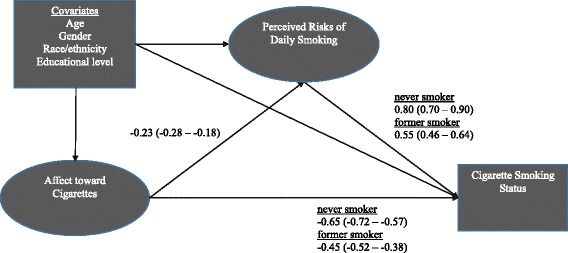
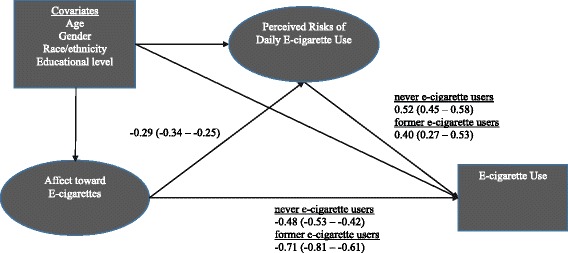
Results: Participants held various affective associations with tobacco products, and affect towards cigarettes was more negative than affect towards e-cigarettes. Using structural equation modeling (SEM), affect towards cigarettes and e-cigarettes was associated with cigarette smoking and e-cigarette use respectively, and these associations were both direct and partially mediated by risk perceptions towards smoking and e-cigarette use. More positive affect towards cigarettes or e-cigarettes was associated with lower perceived risks, which in turn was associated with higher odds of being a current cigarette or e-cigarette user.
Conclusions: In developing models explaining tobacco use behavior, or in creating public communication campaigns aimed at curbing tobacco use, it is useful to focus not only on the reason based predictors, such as perceptions of risks and benefits, but also on affective predictors. Educational efforts aimed at further smoking reductions should highlight and reinforce negative images and associations with cigarettes.
Keywords: Affect; Cigarettes; Electronic cigarettes; Risk perception; Smoking; Tobacco.
Conflict of interest statement
Authors’ information
LP, DO, SW, CK, and TP are with School of Public Health and Tobacco Center of Regulatory Science, Georgia State University, Atlanta, GA, USA. CM and PS are with Decision Research, Eugene, OR, USA. PS is also with Department of Psychology, University of Oregon, Eugene, OR, USA.
Ethics approval and consent to participate
The study on which these data analyses are based was approved by the Georgia State University Institutional Review Board (Reference number 341154). Participants were provided information about the study and consented by proceeding to take the survey; this implied consent was approved by the Georgia State University Institutional Review Board.
Consent for publication
Not applicable.
Competing interests
The authors have no conflicts of interest.
Publisher’s Note
Springer Nature remains neutral with regard to jurisdictional claims in published maps and institutional affiliations.
Figures
References
-
- United States Department of Health and Human Services . The health consequences of smoking—50 years of progress: a report of the surgeon General. Atlanta, GA: US Department of Health and Human Services, Center for Disease Control and Prevention, National Center for Chronic Disease Prevention and Health Promotion, Office of Smoking and Health; 2014.
-
- Jamal A. Current cigarette smoking among adults—United States, 2005–2015. MMWR Morb Mortal Wkly Rep. 2016;65(44):1205–11. - PubMed
-
- Slovic P. Smoking: risk, perception, and policy. Sage publications; 2001.
Publication types
MeSH terms
Grants and funding
LinkOut - more resources
Full Text Sources
Other Literature Sources
Medical
