Review
. 2018 Mar 8:9:441.
doi: 10.3389/fimmu.2018.00441. eCollection 2018.

NKG2D: A Master Regulator of Immune Cell Responsiveness

Affiliations
Review

NKG2D: A Master Regulator of Immune Cell Responsiveness

Felix M Wensveen et al. Front Immunol. .

Abstract

NKG2D is an activating receptor that is mostly expressed on cells of the cytotoxic arm of the immune system. Ligands of NKG2D are normally of low abundance, but can be induced in virtually any cell in response to stressors, such as infection and oncogenic transformation. Engagement of NKG2D stimulates the production of cytokines and cytotoxic molecules and traditionally this receptor is, therefore, viewed as a molecule that mediates direct responses against cellular threats. However, accumulating evidence indicates that this classical view is too narrow. During NK cell development, engagement of NKG2D has a long-term impact on the expression of NK cell receptors and their responsiveness to extracellular cues, suggesting a role in NK cell education. Upon chronic NKG2D engagement, both NK and T cells show reduced responsiveness of a number of activating receptors, demonstrating a role of NKG2D in induction of peripheral tolerance. The image that emerges is that NKG2D can mediate both inhibitory and activating signals, which depends on the intensity and duration of ligand engagement. In this review, we provide an overview of the impact of NKG2D stimulation during hematopoietic development and during acute and chronic stimulation in the periphery on responsiveness of other receptors than NKG2D. We propose that NKG2D interprets the context of the immunological environment through detection of cellular cues and in response sets the appropriate activation threshold for a large number of immune receptors. This perspective is of particular importance for future therapies that aim to exploit NKG2D signaling to fight tumors or infection.

Keywords: NK cells; NKG2D; T cells; activation; education; peripheral tolerance.


Figures
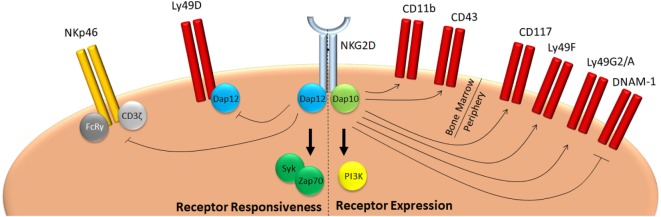
Figure 1
Figure 1
NKG2D mediates education of NK cells. NKG2D signaling during development negatively affects responsiveness of NK cells in two ways. On one hand, it promotes expression of inhibitory Ly49 molecules, such as Ly49F, G2, or A, whereas it inhibits expression of activating receptors, such as DNAM-1. On the other, it reduces responsiveness of activating receptors, such as NKp46 and Ly49D. As a consequence, mice deficient for NKG2D have a hyper-responsive phenotype and are better protected against infection with pathogens which are controlled by NK cells, such as cytomegalovirus (33, 34).
Figure 2
Figure 2
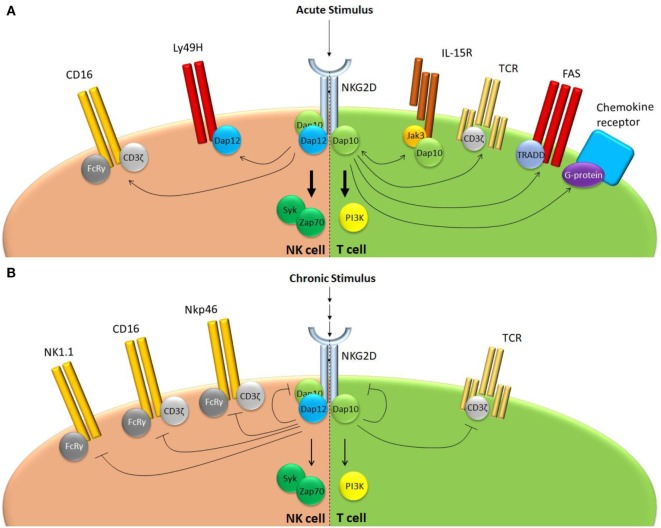
NKG2D regulates receptor responsiveness differently following acute or chronic stimulation. (A) Following acute stimulation, NKG2D promotes responsiveness of a range of structurally unrelated receptors that use largely distinct intracellular signaling modalities. (B) Chronic NKG2D engagement mediates its own downregulation and subsequent hypo-responsiveness to stimulation. In addition, chronic NKG2D stimulation impairs T cell receptor responsiveness in T cells. In NK cells, chronic NKG2D stimulation reduces missing self-signaling (not shown) as well as responsiveness of a number of receptors that share the FcεRIγ signal adaptor.

References

    1. Raulet DH. Roles of the NKG2D immunoreceptor and its ligands. Nat Rev Immunol (2003) 3:781–90.10.1038/nri1199 - DOI - PubMed
    1. Sáez-Borderías A, Gumá M, Angulo A, Bellosillo B, Pende D, López-Botet M. Expression and function of NKG2D in CD4+ T cells specific for human cytomegalovirus. Eur J Immunol (2006) 36:3198–206.10.1002/eji.200636682 - DOI - PubMed
    1. Allez M, Tieng V, Nakazawa A, Treton X, Pacault V, Dulphy N, et al. CD4+NKG2D+ T cells in Crohn’s disease mediate inflammatory and cyto-toxic responses through MICA interactions. Gastroenterology (2007) 132:2346–58.10.1053/j.gastro.2007.03.025 - DOI - PubMed
    1. Dai Z, Turtle CJ, Booth GC, Riddell SR, Gooley TA, Stevens AM, et al. Normally occurring NKG2D+CD4+ T cells are immunosuppressive and inversely correlated with disease activity in juvenile-onset lupus. J Exp Med (2009) 206:793–805.10.1084/jem.20081648 - DOI - PMC - PubMed
    1. Ito Y, Kanai T, Totsuka T, Okamoto R, Tsuchiya K, Nemoto Y, et al. Blockade of NKG2D signaling prevents the development of murine CD4+ T cell-mediated colitis. Am J Physiol Gastrointest Liver Physiol (2008) 294:G199–207.10.1152/ajpgi.00286.2007 - DOI - PubMed

Publication types

Substances