


Development of mucosal-associated invariant T cells
- PMID: 29569752
- PMCID: PMC6446805
- DOI: 10.1111/imcb.12039
Development of mucosal-associated invariant T cells
Abstract
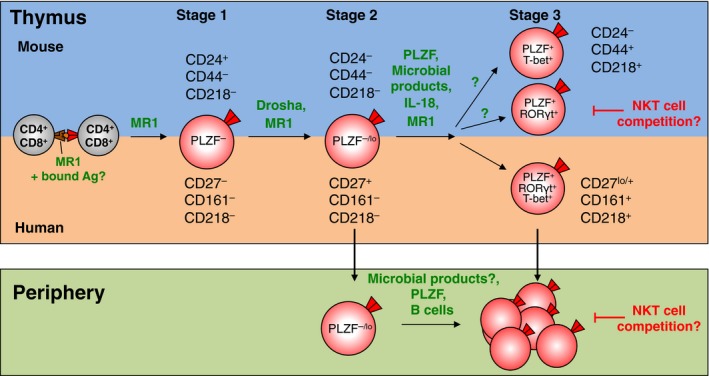
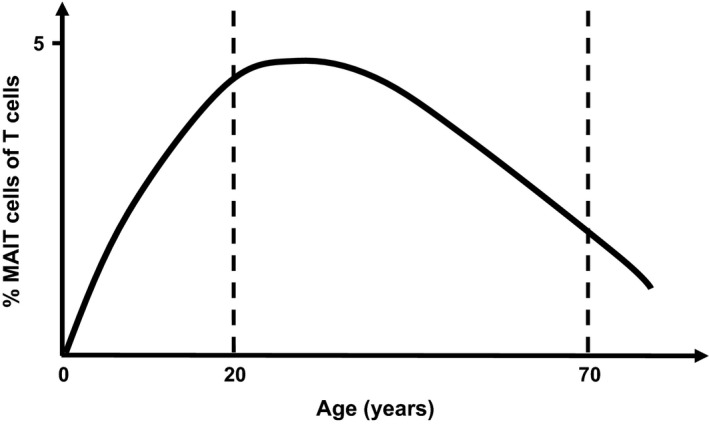
Mucosal-associated invariant T (MAIT) cells develop in the thymus and migrate into the periphery to become the largest antigen-specific αβ T-cell population in the human immune system. However, the frequency of MAIT cells varies widely between human individuals, and the basis for this is unclear. While MAIT cells are highly conserved through evolution and are phenotypically similar between humans and mice, they represent a much smaller proportion of total T cells in mice. In this review, we discuss how MAIT cells transition through a three-stage development pathway in both mouse and human thymus, and continue to mature and expand after they leave the thymus. Moreover, we will explore and speculate on how specific factors regulate different stages of this process.
Keywords: Development of MAIT cells; T-cell receptor; mucosal-associated invariant T cells.
© 2018 The Authors Immunology & Cell Biology published by John Wiley & Sons Australia, Ltd on behalf of Australasian Society for Immunology Inc.
Conflict of interest statement
The authors declare no conflict of interest.
Figures
References
-
- Bendelac A, Savage PB, Teyton L. The biology of NKT cells. Annu Rev Immunol 2007; 25: 297–336. - PubMed
-
- Treiner E, Duban L, Bahram S, et al Selection of evolutionarily conserved mucosal‐associated invariant T cells by MR1. Nature 2003; 422: 164–169. - PubMed
-
- Godfrey DI, Uldrich AP, McCluskey J, et al The burgeoning family of unconventional T cells. Nat Immunol 2015; 16: 1114–1123. - PubMed
Publication types
MeSH terms
LinkOut - more resources
Full Text Sources
Other Literature Sources
