


Neuroimmune Tau Mechanisms: Their Role in the Progression of Neuronal Degeneration
- PMID: 29570615
- PMCID: PMC5979395
- DOI: 10.3390/ijms19040956
Neuroimmune Tau Mechanisms: Their Role in the Progression of Neuronal Degeneration
Abstract
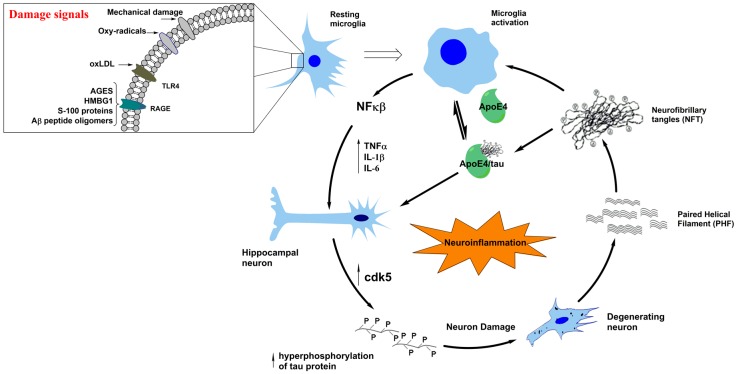
Progressive neurodegenerative pathologies in aged populations are an issue of major concern worldwide. The microtubule-associated protein tau is able to self-aggregate to form abnormal supramolecular structures that include small oligomers up to complex polymers. Tauopathies correspond to a group of diseases that share tau pathology as a common etiological agent. Since microglial cells play a preponderant role in innate immunity and are the main source of proinflammatory factors in the central nervous system (CNS), the alterations in the cross-talks between microglia and neuronal cells are the main focus of studies concerning the origins of tauopathies. According to evidence from a series of studies, these changes generate a feedback mechanism reactivating microglia and provoking constant cellular damage. Thus, the previously summarized mechanisms could explain the onset and progression of different tauopathies and their functional/behavioral effects, opening the window towards an understanding of the molecular basis of anomalous tau interactions. Despite clinical and pathological differences, increasing experimental evidence indicates an overlap between tauopathies and synucleinopathies, considering that neuroinflammatory events are involved and the existence of protein misfolding. Neurofibrillary tangles of pathological tau (NFT) and Lewy bodies appear to coexist in certain brain areas. Thus, the co-occurrence of synucleinopathies with tauopathies is evidenced by several investigations, in which NFT were found in the substantia nigra of patients with Parkinson's disease, suggesting that the pathologies share some common features at the level of neuroinflammatory events.
Keywords: Alzheimer’s disease; inflammation; molecular functions; molecular networks; neuroimmunomodulation; tau protein; tauopathies.
Conflict of interest statement
The authors declare no conflict of interest. The funding sponsors had no role in the design of the study and in the writing of the manuscript and no role at all in the decision to publish the results.
Figures
References
Publication types
MeSH terms
Substances
LinkOut - more resources
Full Text Sources
Other Literature Sources
Medical
