Review
. 2018 Mar 23;19(4):963.
doi: 10.3390/ijms19040963.

Roles of Chloroplast Retrograde Signals and Ion Transport in Plant Drought Tolerance

Affiliations
Review

Roles of Chloroplast Retrograde Signals and Ion Transport in Plant Drought Tolerance

Chenchen Zhao et al. Int J Mol Sci. .

Abstract

Worldwide, drought affects crop yields; therefore, understanding plants' strategies to adapt to drought is critical. Chloroplasts are key regulators of plant responses, and signals from chloroplasts also regulate nuclear gene expression during drought. However, the interactions between chloroplast-initiated retrograde signals and ion channels under stress are still not clear. In this review, we summarise the retrograde signals that participate in regulating plant stress tolerance. We compare chloroplastic transporters that modulate retrograde signalling through retrograde biosynthesis or as critical components in retrograde signalling. We also discuss the roles of important plasma membrane and tonoplast ion transporters that are involved in regulating stomatal movement. We propose how retrograde signals interact with ion transporters under stress.

Keywords: cotransporters; ion channels; pumps; retrograde signalling; stress responsive genes.


Conflict of interest statement

The authors declare no conflict of interest.

Figures

Figure 1
Figure 1
A schematic diagram of typical retrograde signalling pathways in plant cells. High-light stress could induce 1O2 accumulation which causes the accumulation of β-cyclocitral in the chloroplast. β-cyclocitral is exported to the nucleus to regulate expression of defense genes [43]. Elements in the tetrapyrrole pathways act as retrograde signals. Mg-ProtoIX and heme can both be regulated by FC1 and then transported from the chloroplasts to the nucleus to regulate photosynthesis-related genes [48,61]. Methylerythritol 4-phosphate (MEP) pathways also participate in retrograde signalling pathways, and high light could also induce methylerythritol cyclodiphosphate (MEcPP) production in chloroplasts and then regulate nuclear HPL gene expression [23]. PAP (3′-phosphoadnenosine 5′-phosphate), induced by drought and high light, could be transferred from the chloroplasts to the nucleus and regulate the expression of a set of genes [25]. Abbreviations: Protop IX, Protoporphyrin IX; FC1, ferrochelatase 1; TPK3, Tandem-pore K+ selective channel3; KEA 3, Cation/proton antiporter 3; CLC, anion channel of Cl channel (CLC) family; ROS, reactive oxygen species; PSI and PSII, Reaction centres of photosystem I and II; HMA, P-type ATPase of Arabidopsis/Heavy-metal-associated; bf6, cytochrome b6f complex; PC, plastocyanin; LHCII, Light harvesting complex; SULTR, phloem-localized sulphate transporter; ATPs, ATP sulphurylase; APS, Adenosine 5′-phosphosulfate; APK, APS kinase; PAPS, 3′phosphoadnosine 5′-phosphosulfate; SOT, Sulfotransferase; PAP, 3′-Phosphoadnenosine 5′phosphate; APX, Ascorbate peroxidase 2; DREB2A, Drought responsive element binding 2A; ZAT10, Salt tolerance Zinc Finger.
Figure 2
Figure 2
A schematic diagram of chloroplast-located ion transporters and retrograde signal molecule 3′-phosphoadnenosine 5′-phosphate (PAP), and their roles in stomatal regulation. PHOT1 and PHOT2 sense blue light, which activates plasma membrane proton pump AHAs, and this leads to the efflux of H+ from cytosol [119]. The accumulated electrons on the cytosolic side lead to activation of plasma membrane-located potassium inward-rectifying channels [120], leading to K+ influx. However, these potassium inward-rectifying channels can be inhibited by cytosolic Ca2+ accumulation [121]. CNGCs and CAXs are responsible for cytosolic Ca2+ accumulation [36], and CAX can be inactivated by ABA, which increases cytosolic Ca2+ accumulation [122]. ABA also inhibits blue light-induced H+-ATPase activation, which leads to stomatal closure [123]. Sulphate can be transported into chloroplasts by SULTR for the biosynthesis of PAP [117,118]. PAP is degraded by SAL1/ALX8 to AMP [25]. Under drought stress, ROS production in chloroplasts reduces SAL1 activity, which leads to PAP accumulation in the protoplast [25]. PAP is then transported into the cytosol by PAP transporter, PAPST1 [79], from where it moves to the nucleus to bind to the stress response genes XRNs, which potentially leads to CDPKs expression [26]. CDPKs activate SLAC1 channels, which leads to anion efflux [26]. Cytosolic Ca2+ also has a role in regulating CDPKs [124]. Besides, CDPKs and protein 14-3-3 have a role in regulating vacuole potassium channels activity [125,126]. ABA-induced stomatal closure depends on OST1 activity. OST1 has a role in activating anion efflux and inhibits water aquaporin channel PIP2;1 activity [127,128], which leads to stomatal closure. Abbreviations: PHOT, phototropins; AHA, Plasma membrane H+-ATPase; ATP, adenosine triphosphate; ADP, Adenosine diphosphate; KAT1, K+ channel 1 in Arabidopsis; KAT2, K+ channel in Arabidopsis 2; AKT, Arabidopsis Thaliana Rectifying channel ; ACA, Ca2+-ATPase; CNGC, Arabidopsis Cyclic nucleotide-gated ion channels; NRT1.1, Nitrate Transporter 1.1; STP1, Sugar Transporter 1; ABA, Abscisic acid; ALMT, Aluminium-activated malate transporter; VHA, vacuolar H+-ATPase; AVP, vacuolar H+/K+-PPase; TIPs, Tonoplast Intrinsic Proteins; CAX, Cation Exchanger; CLCa, Chloride Channel a; NHX, Na+,K+/H+ antiporters; AMP, Adenosine Monophosphate; SAL1, Altered expression of APX2; PAP, 3′-phosphoadnenosine 5′-phosphate; SULTR, phloem-localized sulphate transporter; PAPST1, 3′-Phosphoadenosine 5′-Phosphosulfate Transporter 1;ABI, ABA Insensitive; OST1, Open Stomata 1; TPC, Two-pore Ca2+ channel; TPK, Two-pore K+ channel; CDPKs, Ca2+ dependent protein kinases; SLAC1, Slow Anion channel-associated 1; PIP2;1, Plasma Membrane Intrinsic Protein 2; GORK, Guard Cell Outwardly Rectifying K+ channel.
Figure 3
Figure 3
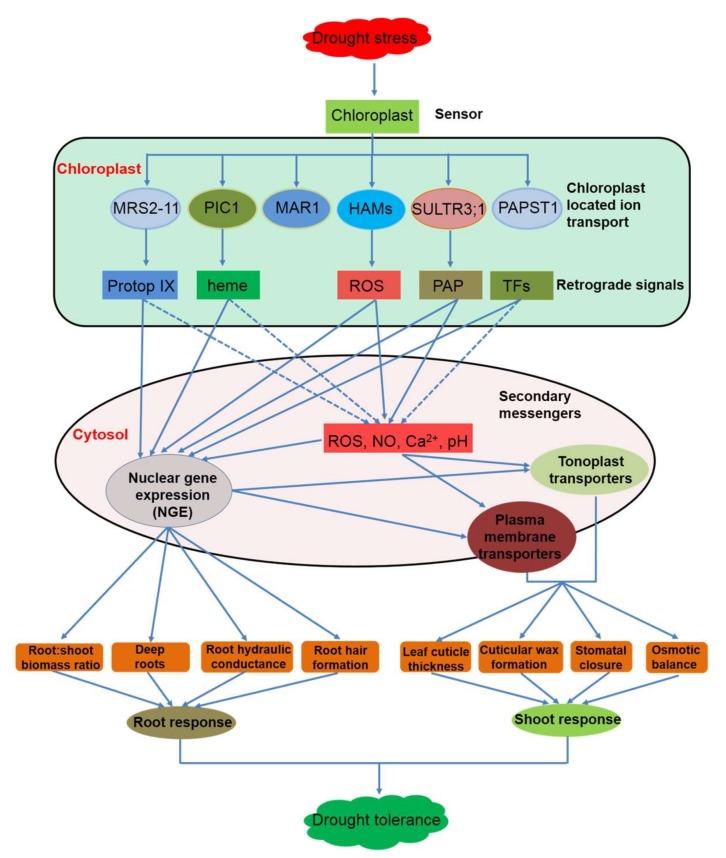
A schematic diagram of retrograde signals and potential mechanisms in regulating plant drought tolerance. Drought can be perceived by chloroplasts. Chloroplast-located ion channels participate in biosynthetic processes of retrograde signals, such as Mg-Protop IX [45], heme [48], ROS [100], and PAP [117], which target either nuclear genes expression (NGE) [48,54,116] or secondary messengers [55]. Secondary messengers and NGE regulate plasma membrane or tonoplast ion transporters [171], triggering the root and shoot responses to drought. Dotted blue arrows: potential interactions. Abbreviations: see legends of Figure 1 and Figure 2.

References

    1. Evans A. The Feeding of the Nine Billion. [(accessed on 15 March 2018)]; Available online: http://www.wfp.org/stories/feeding-ten-billion-global-food-security-21st....
    1. FAO How to Feed the World in 2050. [(accessed on 15 March 2018)]; Available online: http://www.fao.org/fileadmin/templates/wsfs/docs/expert_paper/How_to_Fee....
    1. Zhang X., Cai X. Climate change impacts on global agricultural land availability. Environ. Res. Lett. 2011;6:014014. doi: 10.1088/1748-9326/6/1/014014. - DOI
    1. Kogan F.N. Global drought watch from space. Bull. Am. Meteorol. Soc. 1997;78:621–636. doi: 10.1175/1520-0477(1997)078<0621:GDWFS>2.0.CO;2. - DOI
    1. Schmidhuber J., Tubiello F.N. Global food security under climate change. Proc. Natl. Acad. Sci. USA. 2007;104:19703–19708. doi: 10.1073/pnas.0701976104. - DOI - PMC - PubMed

MeSH terms

LinkOut - more resources