. 2018 Mar 23;13(3):e0194825.
doi: 10.1371/journal.pone.0194825. eCollection 2018.

At-hatch administration of probiotic to chickens can introduce beneficial changes in gut microbiota

Affiliations

At-hatch administration of probiotic to chickens can introduce beneficial changes in gut microbiota

Stephen Baldwin et al. PLoS One. .

Abstract

Recent advances in culture-free microbiological techniques bring new understanding of the role of intestinal microbiota in heath and performance. Intestinal microbial communities in chickens assume a near-stable state within the week which leaves a very small window for permanent microbiota remodelling. It is the first colonisers that determine the fate of microbial community in humans and birds alike, and after the microbiota has matured there are very small odds for permanent modification as stable community resists change. In this study we inoculated broiler chicks immediately post hatch, with 3 species of Lactobacillus, identified by sequencing of 16S rRNA and pheS genes as L. ingluviei, L. agilis and L. reuteri. The strains were isolated from the gut of healthy chickens as reproducibly persistent Lactobacillus strains among multiple flocks. Birds inoculated with the probiotic mix reached significantly higher weight by 28 days of age. Although each strain was able to colonise when administered alone, administering the probiotic mix at-hatch resulted in colonisation by only L. ingluviei. High initial abundance of L. ingluviei was slowly reducing, however, the effects of at-hatch administration of the Lactobacillus mix on modifying microbiota development and structure remained persistent. There was a tendency of promotion of beneficial and reduction in pathogenic taxa in the probiotic administered group.


Conflict of interest statement

Competing Interests: The authors have declared that no competing interests exist.

Figures

Fig 1
Fig 1
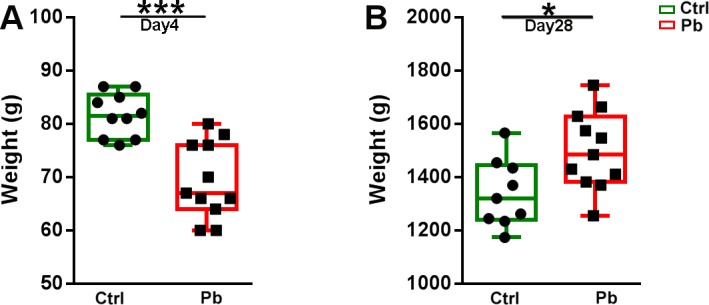
Weights of the birds at 4 (A) and 28 days (B). Control PBS inoculated birds were significantly heavier between the days 2 and 6 post hatch. Between day 6 and 24 there were no significant differences, however, probiotic inoculated group became significantly heavier starting from day 24 to the end of the trail.
Fig 2
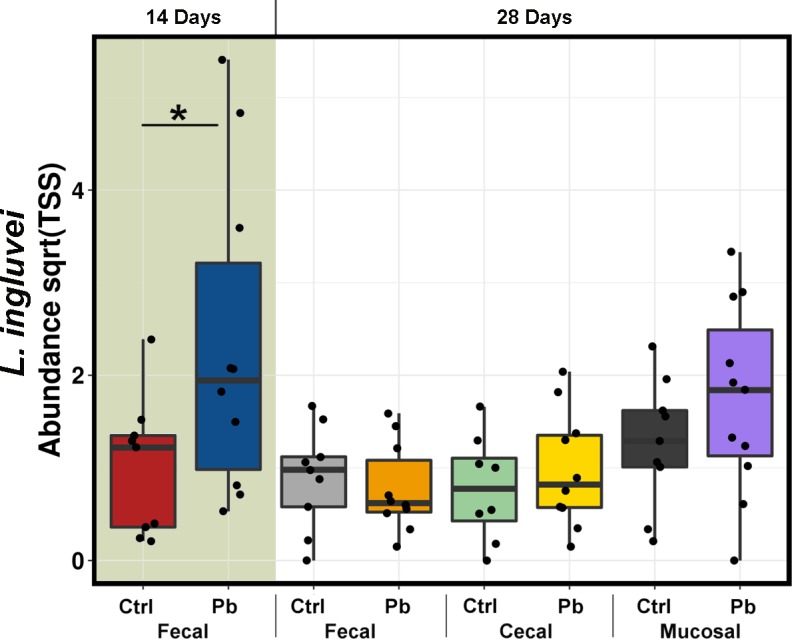
Fig 2. TSS normalised, square root transformed abundance of inoculated L. ingluviei.
Out of the 3 OTUs detected in inoculum, only one, identical to L. ingluviei was detected in birds using sequencing methodology and was present in all birds across all sampling points. Legend: Pb = probiotic, Ctrl = PBS control.
Fig 3
Fig 3. Redundancy analysis (RDA) plot showing group to group microbial community differences between the treatments, timepoints and sampling origins.
Legend: D14 = 14 days, D28 = 28 days, Pb = probiotic, Ctr = PBS control, C = caecal, M = ileal mucosa.
Fig 4
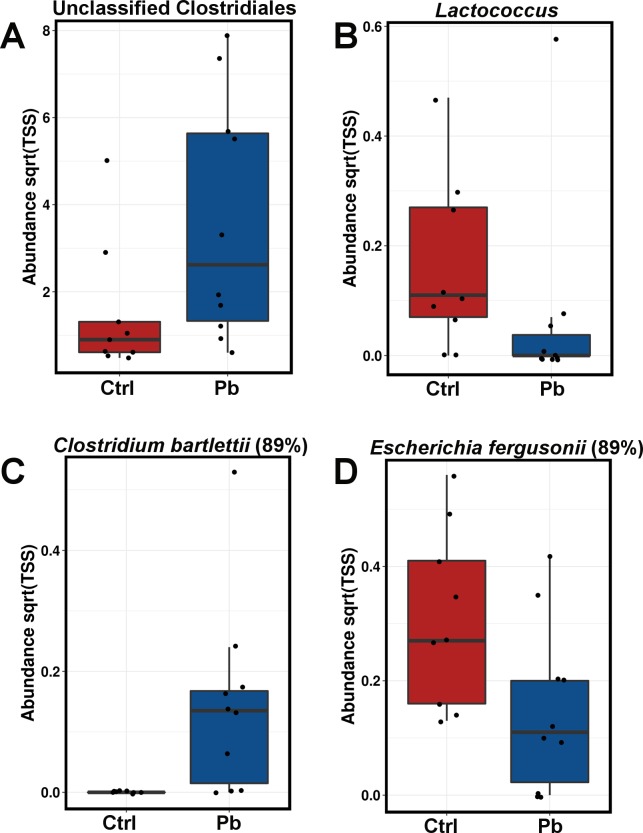
Fig 4. Phylotypes significantly altered by probiotic administration 14 days post hatch.
Complete data with significance values is provided in Tables A and B in S1 File. Blastn best hits against 16S Microbial database and % ID are given as a guide.
Fig 5
Fig 5. Boxplots showing some of the excreta phylotypes altered in abundance by at-hatch probiotic administration 28 days post hatch.
Complete data with significance values is provided in Tables C and D in S1 File. Blastn best hits against 16S Microbial database and % ID are given as a guide.
Fig 6
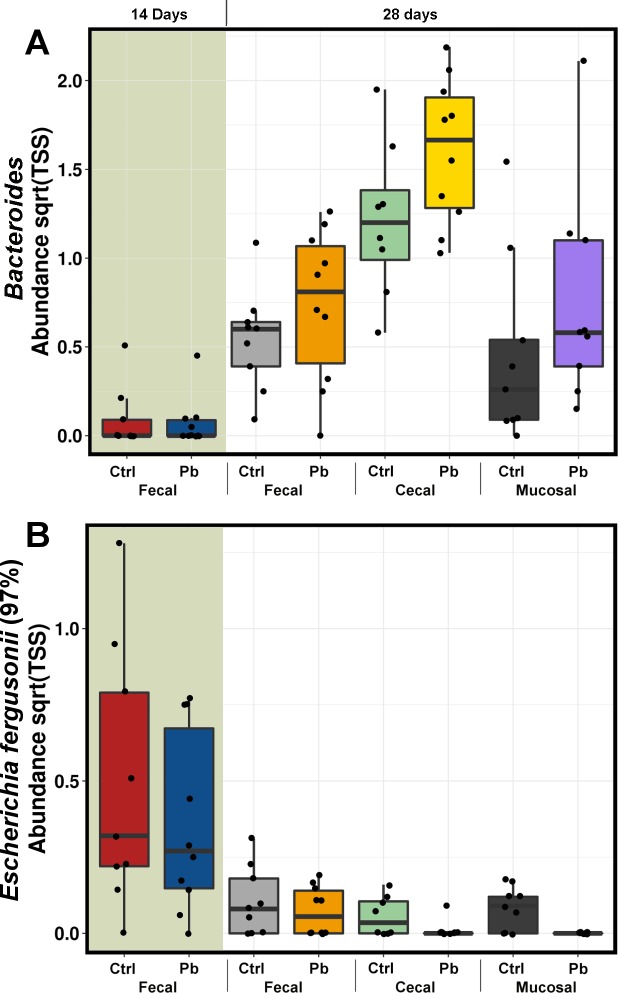
Fig 6. TSS normalised, square root transformed abundance of genus Bacteroides and an OTU most similar (blastn on 16S Microbial database) to Escherichia fergusonii.

References

    1. Stanley D, Hughes R, Moore R. Microbiota of the chicken gastrointestinal tract: influence on health, productivity and disease. Applied Microbiology and Biotechnology. 2014;98(10):4301–10. 10.1007/s00253-014-5646-2 - DOI - PubMed
    1. Stanley D, Keyburn AL, Denman SE, Moore RJ. Changes in the caecal microflora of chickens following Clostridium perfringens challenge to induce necrotic enteritis. Veterinary Microbiology. 2012;159(1–2):155–62. 10.1016/j.vetmic.2012.03.032. - DOI - PubMed
    1. Bailey R. Gut Health in Poultry—The World Within. Aviagen, editor. Huntsville USA: Aviagen; 2013.
    1. Stanley D, Denman SE, Hughes RJ, Geier MS, Crowley TM, Chen H. Intestinal microbiota associated with differential feed conversion efficiency in chickens. Appl Microbiol Biotechnol. 2012;96 10.1007/s00253-011-3847-5. - DOI - PubMed
    1. Mohan B, Kadirvel R, Natarajan A, Bhaskaran M. Effect of probiotic supplementation on growth, nitrogen utilisation and serum cholesterol in broilers. British poultry science. 1996;37(2):395–401. 10.1080/00071669608417870 - DOI - PubMed

Publication types

MeSH terms

Substances