. 2018 Mar 23;8(1):5095.
doi: 10.1038/s41598-018-23486-0.

Non-invasive quantification of human swallowing using a simple motion tracking system

Affiliations

Non-invasive quantification of human swallowing using a simple motion tracking system

Hiroaki Hashimoto et al. Sci Rep. .

Abstract

The number of patients with dysphagia is rapidly increasing due to the ageing of the population. Therefore, the importance of objectively assessing swallowing function has received increasing attention. Videofluoroscopy and videoendoscopy are the standard clinical examinations for dysphagia, but these techniques are not suitable for daily use because of their invasiveness. Here, we aimed to develop a novel, non-invasive method for measuring swallowing function using a motion tracking system, the Kinect v2 sensor. Five males and five females with normal swallowing function participated in this study. We defined three mouth-related parameters and two larynx-related parameters and recorded data from 2.5 seconds before to 2.5 seconds after swallowing onset. Changes in mouth-related parameters were observed before swallowing and reached peak values at the time of swallowing. In contrast, larynx-related parameters showed little change before swallowing and reached peak values immediately after swallowing. This simple swallow tracking system (SSTS) successfully quantified the swallowing process from the oral phase to the laryngeal phase. This SSTS is non-invasive, wireless, easy to set up, and simultaneously measures the dynamics of swallowing from the mouth to the larynx. We propose the SSTS for use as a novel and non-invasive swallowing assessment tool in the clinic.


Conflict of interest statement

The authors declare no competing interests.

Figures
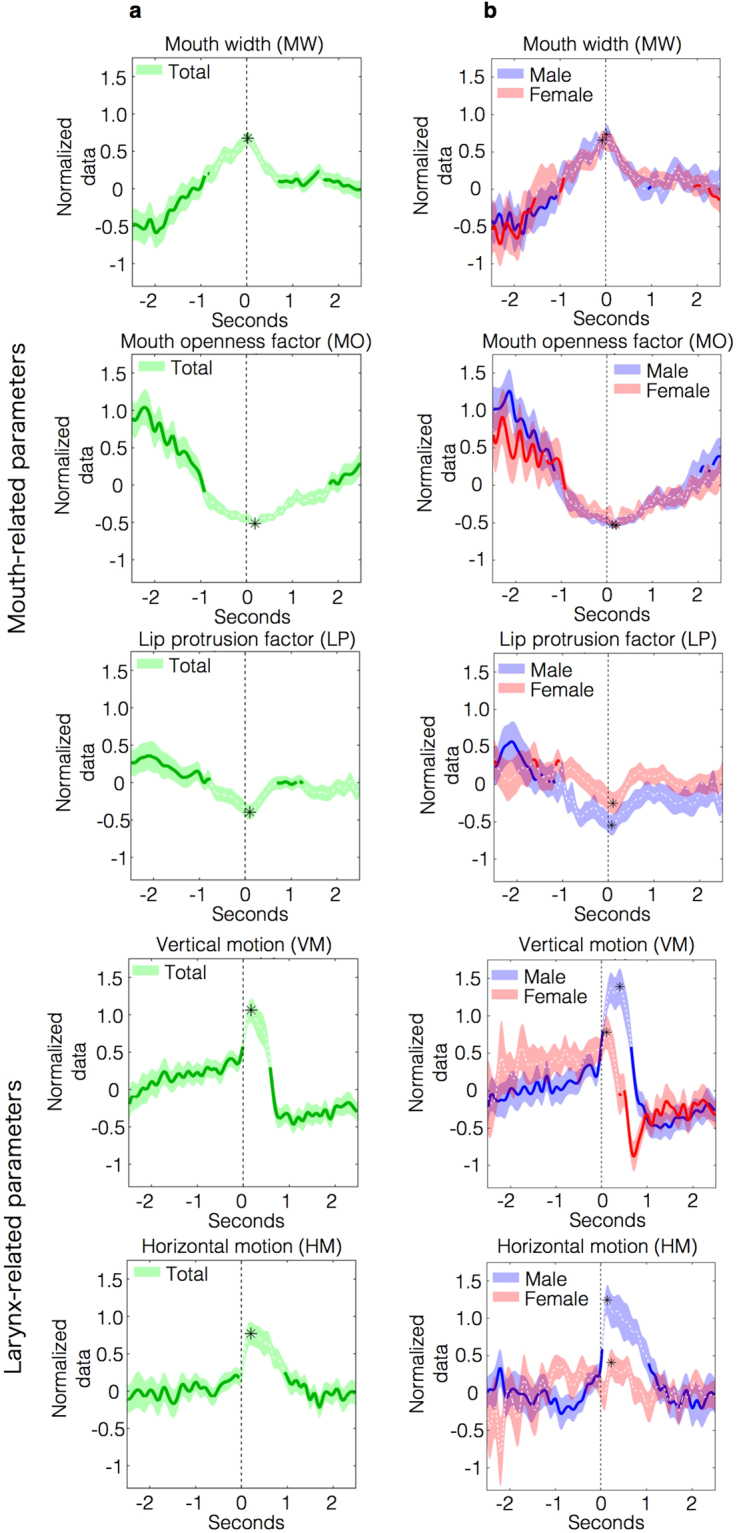
Figure 1
Figure 1
Graphs of mouth-related parameters (MW, MO, and LP) and larynx-related parameters (VM and HM) from 2.5 s before to 2.5 s after swallowing onset. MW, MO, and LP were the mouth-related parameters. VM and HM were the larynx-related parameters. Error bars indicate 95% CIs. Zero seconds corresponds to the onset of swallowing. The positive peak values for MW, VM, and HM and the negative peak values for MO and LP are indicated with asterisks. Peak values were compared with other data points using one-way ANOVA and a multiple comparisons test. Significantly different data points (corrected p < 0.01) are shown as solid lines. (a) Results from the total group are shown. The mouth movement parameters started to change before swallowing and reached positive peak values or negative peak values at the time of swallowing. In contrast, the larynx-related parameters showed little change before swallowing but reached positive peak values immediately after swallowing. Peak values were significantly different from the data points collected before or after swallowing. (b) Results from both the male and female groups are displayed. For MW, MO, and LP, the graphs displayed similar trends for males and females; however, for VM and HM, differences were observed between males and females from 0 to 1.0 s. The changes in VM after swallowing were more notable in males than in females. In females, the peak values for HM were not significantly different from the other data points.
Figure 2
Figure 2
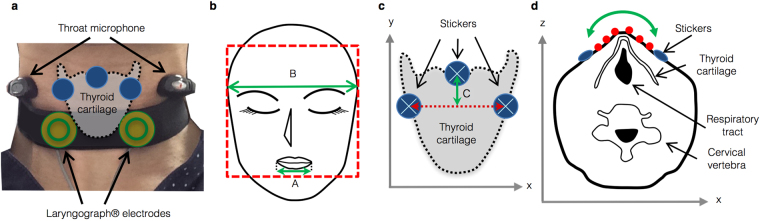
Schematic of non-invasive swallowing measurements and parameters recorded by the SSTS. (a) We monitored swallowing with electroglottography (EGG, laryngograph) and a throat microphone. A pair of laryngograph electrodes was placed below the thyroid cartilage. The microphone was placed around a participant’s neck. Three blue stickers were attached to the thyroid cartilage for recognition by the Kinect v2 sensor to monitor laryngeal movements. (b) MW is the parameter involved in mouth movement and is defined as the ratio of the width between the corner edges of the mouth (A) to the width of the face (B). MW = A/B. (c) VM is the difference in y coordinates between the median stickers and the averaged outside stickers in the xy plane. VM = C. VM indirectly represented vertical laryngeal motion. (d) Schematic of an axial laryngeal slice. The surface between the outside stickers was approximated to a convex quadratic function in the xz plane (green curved line), and the associated quadratic coefficient was HM. HM represented the degree to which a participant’s larynx projects forward. HM indirectly indicated horizontal laryngeal motion. Red circles indicate pixels available for the calculation of HM in the xz plane.
Figure 3
Figure 3
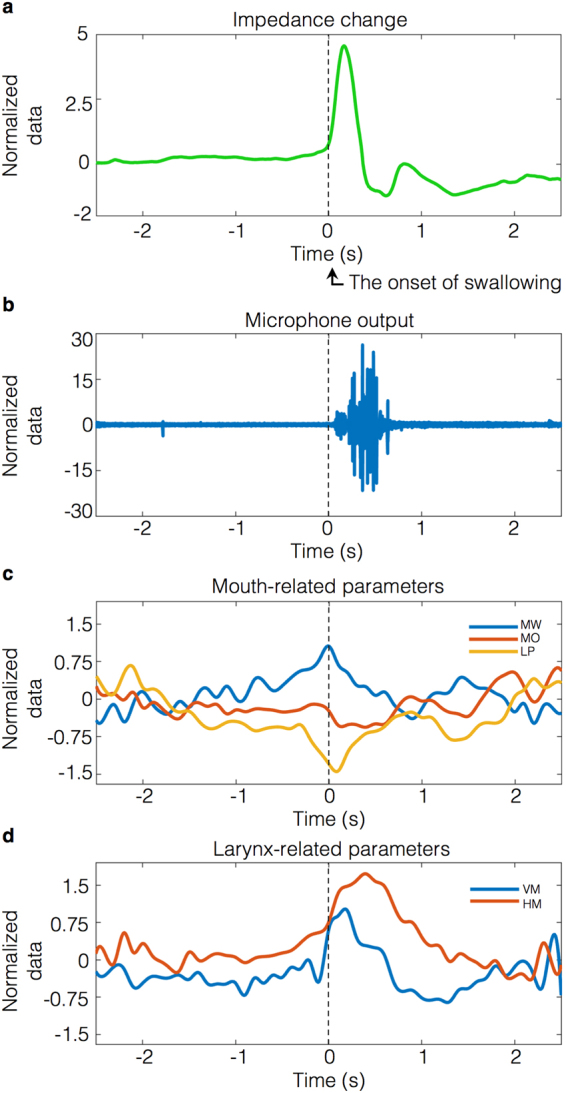
Representative waveforms of Participant 1. These waveforms were traced from a 30-year-old male participant (Participant 1) and were calculated by the additional averaging of signals that were time-locked to the onset of swallowing. (a) Signals recorded by the laryngograph (EGG) changed upon swallowing. The onset of swallowing was detected at the initial rise of the waveform. (b) The waveforms were recorded by a throat microphone. The sounds of swallowing were caused by a food bolus passing through the pharynx. (c) The mouth-related parameters MW, MO, and LP changed during swallowing. These parameters began to change before swallowing and exhibited positive or negative peaks at the onset of swallowing. (d) The larynx-related parameters VM (vertical motion) and HM (horizontal motion) did not exhibit appreciable changes before swallowing, but these parameters suddenly exhibited a positive peak immediately after swallowing.

References

    1. Firmin H, Reilly S, Fourcin A. Non-invasive monitoring of reflexive swallowing. Speech Hearing and Language. 1997;10:171–184.
    1. Sazonov E, et al. Non-invasive monitoring of chewing and swallowing for objective quantification of ingestive behavior. Physiol Meas. 2008;29:525–541. doi: 10.1088/0967-3334/29/5/001. - DOI - PMC - PubMed
    1. Dudik JM, Jestrovic I, Luan B, Coyle JL, Sejdic E. A comparative analysis of swallowing accelerometry and sounds during saliva swallows. Biomed Eng Online. 2015;14:3. doi: 10.1186/1475-925X-14-3. - DOI - PMC - PubMed
    1. Yagi N, et al. A noninvasive swallowing measurement system using a combination of respiratory flow, swallowing sound, and laryngeal motion. Medical & biological engineering & computing. 2017;55:1001–1017. doi: 10.1007/s11517-016-1561-2. - DOI - PMC - PubMed
    1. Nederkoorn C, Smulders FT, Jansen A. Recording of swallowing events using electromyography as a non-invasive measurement of salivation. Appetite. 1999;33:361–369. doi: 10.1006/appe.1999.0268. - DOI - PubMed

Publication types

LinkOut - more resources