


Associations Between Polypharmacy and Cognitive and Physical Capability: A British Birth Cohort Study
- PMID: 29574684
- PMCID: PMC6001617
- DOI: 10.1111/jgs.15317
Associations Between Polypharmacy and Cognitive and Physical Capability: A British Birth Cohort Study
Abstract
Objectives: To investigate longitudinal associations between polypharmacy and cognitive and physical capability and to determine whether these associations differ with cumulative exposure to polypharmacy.
Design: Prospective birth cohort study.
Setting: England, Scotland, and Wales.
Participants: An eligible sample of men and women from the Medical Research Council National Survey of Health and Development with medication data at age 69 (N=2,122, 79%).
Measurements: Cognitive capability was assessed using a word learning test, visual search speed task, and the Addenbrooke's Cognitive Examination, Third Edition (ACE-III). Physical capability was measured using chair rise speed, standing balance time, walking speed, and grip strength.
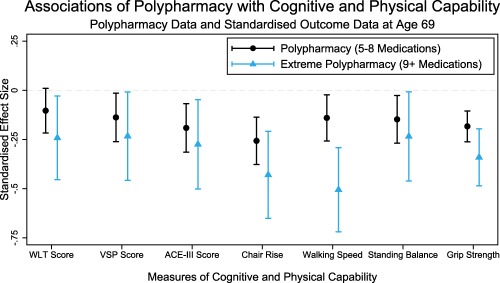
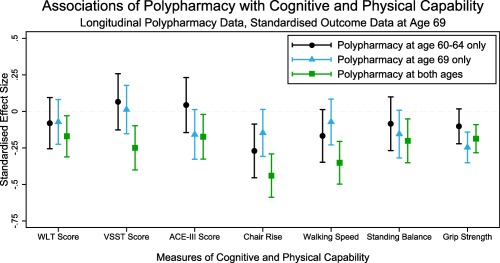
Results: Polypharmacy (5-8 prescribed medications) was present in 18.2% of participants at age 69 and excessive polypharmacy (≥9 prescribed medications) in 4.7%. Both were associated with poorer cognitive and physical capability in models adjusted for sex, education, and disease burden. Stronger associations were found for excessive polypharmacy (e.g., difference in mean ACE-III scores comparing polypharmacy=-2.0, 95% CI=-2.8 to -1.1 and excessive polypharmacy=-2.9, 95% CI=-4.4 to -1.4 with no polypharmacy). Participants with polypharmacy at age 60 to 64 and at age 69 showed stronger Negative associations with cognitive and physical capability were stronger still in participants with polypharmacy at both age 60 to 64 and at age 69 (e.g. difference in mean chair rise speed, comparing polypharmacy with no polypharmacy at both ages=-3.9, 95% CI=-5.2 to -2.6 and at age 60-64 only=-2.5, 95% CI=-4.1 to -0.9).
Conclusion: Polypharmacy at age 60 to 64 and age 69 was associated with poorer physical and cognitive capability, even after adjusting for disease burden. Stronger negative associations were seen in participants with longstanding polypharmacy, suggesting a cumulative, dose-dependent relationship (where dose is the number of prescribed medications). Future research aiming to improve cognitive and physical capability should consider interventions to reduce the duration and level of polypharmacy at younger ages, in addition to optimizing disease control with appropriate medications.
Keywords: cognition; life-course; longitudinal; physical capability; polypharmacy.
© 2018 The Authors. The Journal of the American Geriatrics Society published by Wiley Periodicals, Inc. on behalf of The American Geriatrics Society.
Figures
References
-
- Haider SI, Johnell K, Weitoft GR, Thorslund M, Fastbom J. The influence of educational level on polypharmacy and inappropriate drug use: A register‐based study of more than 600,000 older people. J Am Geriatr Soc 2009;57:62–69. - PubMed
-
- Pugh MJ, Palmer RF, Parchman ML, Mortensen E, Markides K, Espino DV. Association of suboptimal prescribing and change in lower extremity physical function over time. Gerontology 2007;53:445–453. - PubMed
Publication types
MeSH terms
Grants and funding
LinkOut - more resources
Full Text Sources
Other Literature Sources
Medical
Miscellaneous
