


Our Buddies, Ourselves: The Role of Sexual Homophily in Adolescent Friendship Networks
- PMID: 29574690
- PMCID: PMC6157003
- DOI: 10.1111/cdev.13052
Our Buddies, Ourselves: The Role of Sexual Homophily in Adolescent Friendship Networks
Abstract
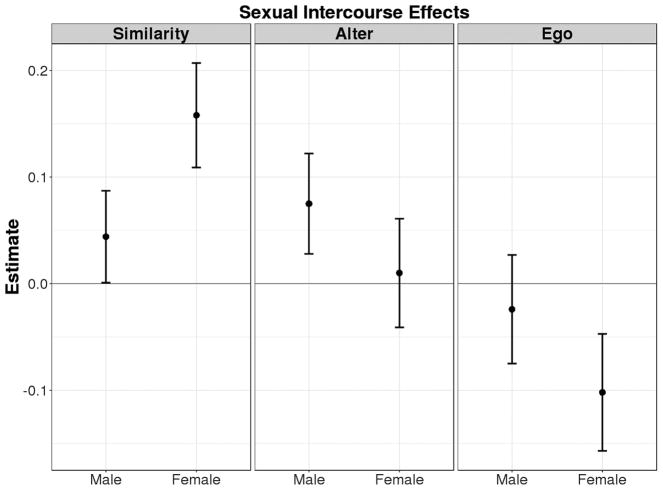
The present study tests the assumption that peers wield sufficient influence to induce sexual homophily (i.e., similarities in sexual experiences). Because girls face greater stigma for their sexual experiences than do boys, sexual homophily may be greater in girls' friendship networks than in boys'. Stochastic actor-based models were used to analyze network data (n = 2,566; ages 14-18) from two high schools in the National Longitudinal Study of Adolescent to Adult Health. Sexual homophily was present in friendship networks. Girls and boys were equally susceptible to their friends' influence, but the former exhibited a stronger preference for befriending same sexual debut status peers than the latter. The findings suggest that adolescents-particularly girls-"curate" their networks to minimize peer ostracism.
© 2018 Society for Research in Child Development.
Figures
References
-
- Bamberg M. Forms and functions of “slut bashing” in male identity constructions in 15-year-olds. Human Development. 2004;47:331–353. doi: 10.1159/000081036. - DOI
-
- Bay-Cheng LY, Livingston JA, Fava NM. “Not always a clear path”: Making space for peers, adults, and complexity in adolescent girls’ sexual development. In: Zurbriggen EL, Roberts T, editors. The sexualization of girls and girlhood: Causes, consequences, & resistance. New York, NY: Oxford University Press; 2013. pp. 257–277.
-
- Bearman PS, Brückner H. Promising the future: Virginity pledges and first intercourse. American Journal of Sociology. 2001;106:859–912. doi: 10.1086/320295. - DOI
Publication types
MeSH terms
Grants and funding
LinkOut - more resources
Full Text Sources
Other Literature Sources
Medical
