


Degrees of functional connectome abnormality in disorders of consciousness
- PMID: 29575425
- PMCID: PMC6866294
- DOI: 10.1002/hbm.24050
Degrees of functional connectome abnormality in disorders of consciousness
Abstract
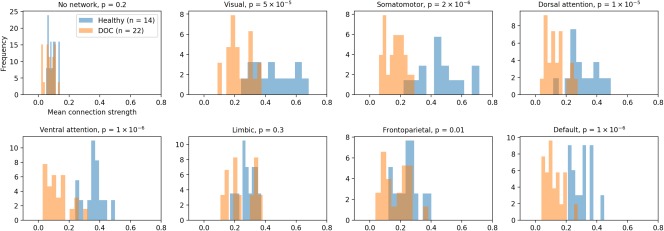
Understanding the neuronal basis of disorders of consciousness can help improve the accuracy of their diagnosis, indicate potential targets for therapeutic interventions, and provide insights into the organization of normal conscious information processing. Measurements of brain activity have been used to find associations of the levels of consciousness with brain complexity, topological features of functional connectomes, and disruption of resting-state networks. However, obtainment of a detailed picture of activity patterns underlying the vegetative state/unresponsive wakefulness syndrome and the minimally conscious state remains a work in progress. We here aimed at finding the aspects of fMRI-based functional connectivity that differentiate these states from each other and from the normal condition. A group of 22 patients was studied (9 minimally conscious state and 13 vegetative state/unresponsive wakefulness syndrome). Patients were shown to have reduced connectivity in most resting-state networks and disrupted patterns of relative connection strengths as compared to healthy subjects. Differences between the unresponsive wakefulness syndrome and the minimally conscious state were found in the patterns formed by a relatively small number of strongest positive correlations selected by thresholding. These differences were captured by measures of functional connectivity disruption that integrate area-specific abnormalities over the whole brain. The results suggest that the strong positive correlations between the functional activities of specific brain areas observed in healthy individuals may be critical for consciousness and be an important target of disruption in disorders of consciousness.
Keywords: consciousness; functional connectivity; magnetic resonance imaging; minimally conscious state; unresponsive wakefulness syndrome.
© 2018 Wiley Periodicals, Inc.
Figures


References
-
- Achard, S. , Delon‐Martin, C. , Vértes, P. E. , Renard, F. , Schenck, M. , Schneider, F. , … Bullmore, E. T. (2012). Hubs of brain functional networks are radically reorganized in comatose patients. Proceedings of the National Academy of Sciences of the United States of America, 109(50), 20608–20613. - PMC - PubMed
-
- Amico, E. , Marinazzo, D. , Di Perri, C. , Heine, L. , Annen, J. , Martial, C. , … Goñi, J. (2017). Mapping the functional connectome traits of levels of consciousness. NeuroImage, 148, 201–211. - PubMed
-
- Andronache, A. , Rosazza, C. P. , Sattin, D. P. , Leonardi, M. M. , D'incerti, L. M. , Minati, L. , & Coma Research Centre (CRC) – Besta Institute . (2013). Impact of functional MRI data preprocessing pipeline on default‐mode network detectability in patients with disorders of consciousness. Frontiers in Neuroinformatics, 7, 16. - PMC - PubMed
-
- Casali, A. G. , Gosseries, O. , Rosanova, M. , Boly, M. , Sarasso, S. , Casali, K. R. , … Massimini, M. (2013). A theoretically based index of consciousness independent of sensory processing and behavior. Science Translational Medicine, 5(198), 198ra105–198ra105. - PubMed
Publication types
MeSH terms
LinkOut - more resources
Full Text Sources
Other Literature Sources
