


Assessment of bulbar function in amyotrophic lateral sclerosis: validation of a self-report scale (Center for Neurologic Study Bulbar Function Scale)
- PMID: 29577526
- PMCID: PMC6005752
- DOI: 10.1111/ene.13638
Assessment of bulbar function in amyotrophic lateral sclerosis: validation of a self-report scale (Center for Neurologic Study Bulbar Function Scale)
Erratum in
-
Erratum.Eur J Neurol. 2018 Oct;25(10):1303. doi: 10.1111/ene.13802. Eur J Neurol. 2018. PMID: 30192063 Free PMC article. No abstract available.
Abstract
Background and purpose: Impaired bulbar functions of speech and swallowing are among the most serious consequences of amyotrophic lateral sclerosis (ALS). Despite this, clinical trials in ALS have rarely emphasized bulbar function as an endpoint. The rater-administered Amyotrophic Lateral Sclerosis Functional Rating Scale-Revised (ALSFRS-R) or various quality-of-life measures are commonly used to measure symptomatic benefit. Accordingly, we sought to evaluate the utility of measures specific to bulbar function in ALS.
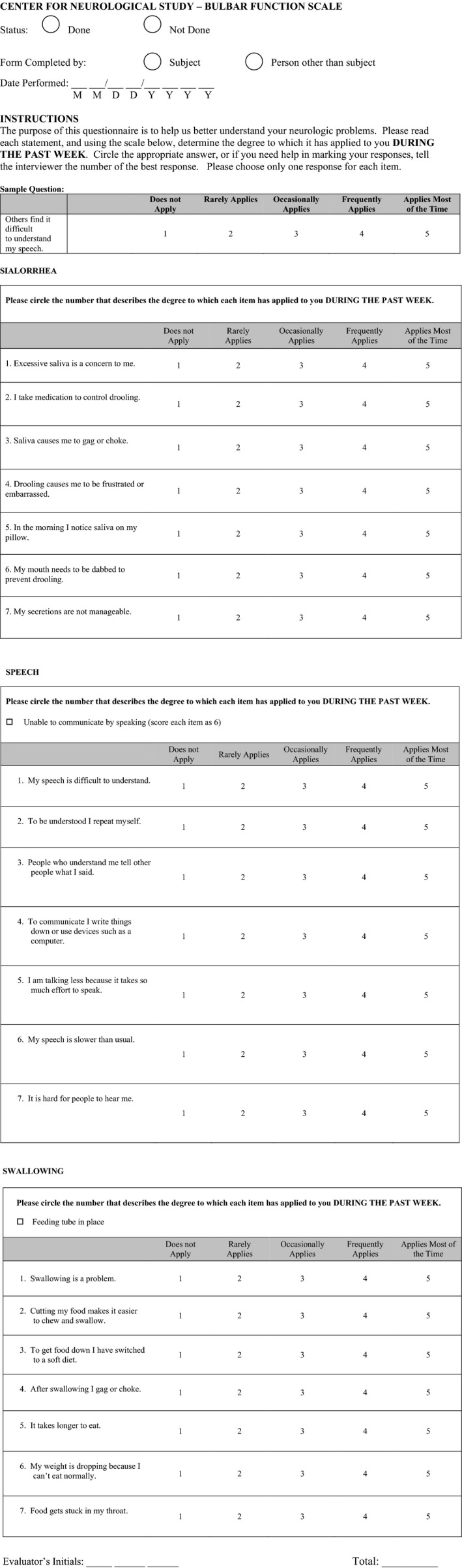
Methods: We assessed bulbar functions in 120 patients with ALS, with clinicians first making direct observations of the degree of speech, swallowing and salivation impairment in these subjects. Clinical diagnosis of bulbar impairment was then compared with ALSFRS-R scores, speech rate, time to swallow liquids and solids, and scores obtained when patients completed visual analog scales (VASs) and the newly-developed 21-question self-administered Center for Neurologic Study Bulbar Function Scale (CNS-BFS).
Results: The CNS-BFS, ALSFRS-R, VAS and timed speech and swallowing were all concordant with clinician diagnosis. The self-report CNS-BFS and ALSFRS-R bulbar subscale best predicted clinician diagnosis with misclassification rates of 8% and 14% at the optimal cut-offs, respectively. In addition, the CNS-BFS speech and swallowing subscales outperformed both the bulbar component of the ALSFRS-R and speech and swallowing VASs when correlations were made between these scales and objective measures of timed reading and swallowing.
Conclusions: Based on these findings and its relative ease of administration, we conclude that the CNS-BFS is a useful metric for assessing bulbar function in patients with ALS.
Keywords: Amyotrophic Lateral Sclerosis Functional Rating Scale Revised (ALSFRS-R), bulbar function; Center for Neurologic Study Bulbar Function Scale; amyotrophic lateral sclerosis; patient-reported outcome.
© 2018 The Authors. European Journal of Neurology published by John Wiley & Sons Ltd on behalf of European Academy of Neurology.
Figures
References
-
- del Aguila MA, Longstreth WT Jr, McGuire V, Koepsell TD, van Belle G. Prognosis in amyotrophic lateral sclerosis: a population‐based study. Neurology 2003; 60: 813–819. - PubMed
-
- Stambler N, Charatan M, Cedarbaum JM. Prognostic indicators of survival in ALS. ALS CNTF Treatment Study Group. Neurology 1998; 50: 66–72. - PubMed
-
- Armon C, Moses D. Linear estimates of rates of disease progression as predictors of survival in patients with ALS entering clinical trials. J Neurol Sci 1998; 160 (Suppl. 1): S37–S41. - PubMed
-
- Shimizu T, Nagaoka U, Nakayama Y, et al Reduction rate of body mass index predicts prognosis for survival in amyotrophic lateral sclerosis: a multicenter study in Japan. Amyotrophic Lateral Scler 2012; 13: 363–366. - PubMed
-
- Cedarbaum JM, Stambler N, Malta E, et al The ALSFRS‐R: a revised ALS functional rating scale that incorporates assessments of respiratory function. BDNF ALS Study Group (Phase III). J Neurol Sci 1999; 169: 13–21. - PubMed
Publication types
MeSH terms
Grants and funding
LinkOut - more resources
Full Text Sources
Other Literature Sources
Medical
Miscellaneous
