


Adaptive reduction of human myometrium contractile activity in response to prolonged uterine stretch during term and twin pregnancy. Role of TREK-1 channel
- PMID: 29577872
- PMCID: PMC5960639
- DOI: 10.1016/j.bcp.2018.03.021
Adaptive reduction of human myometrium contractile activity in response to prolonged uterine stretch during term and twin pregnancy. Role of TREK-1 channel
Abstract
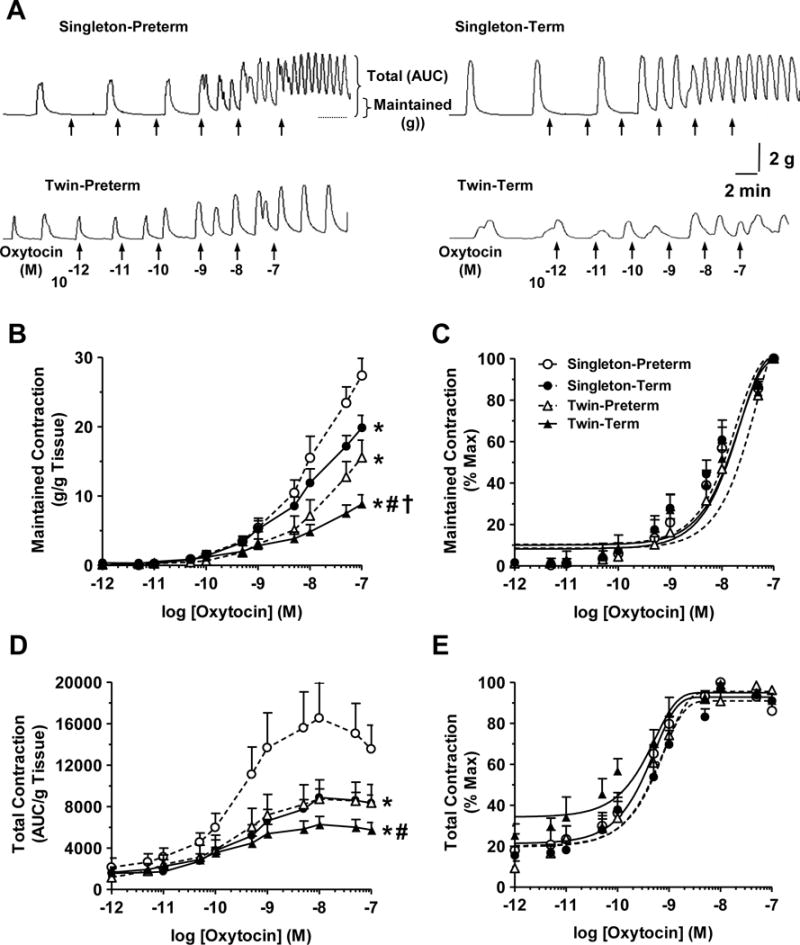
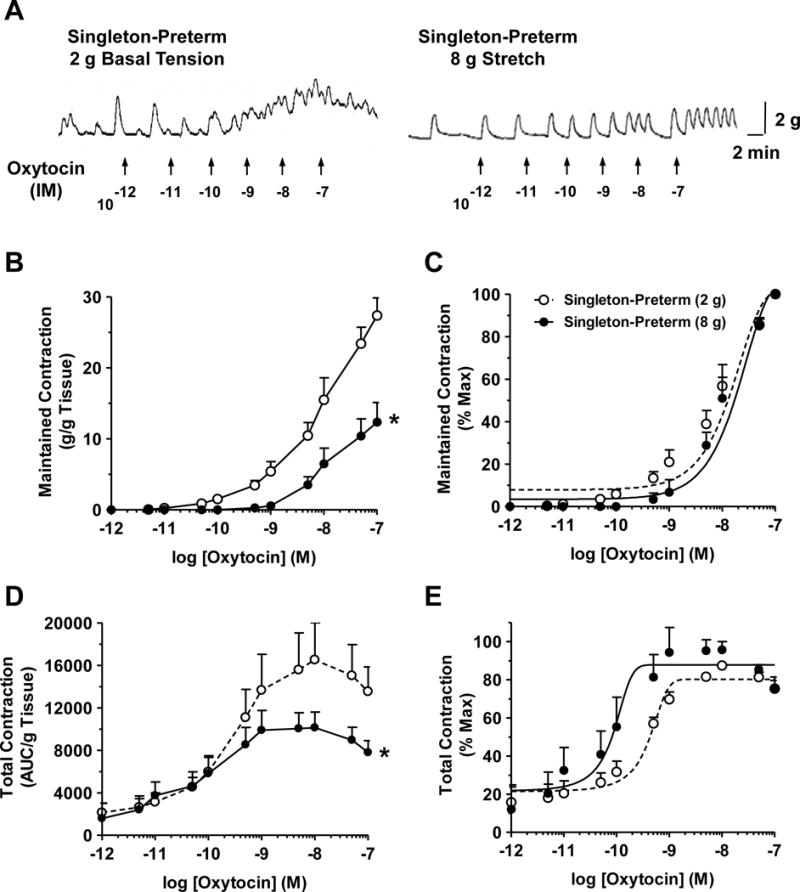
Quiescence of myometrium contractile activity allows uterine expansion to accommodate the growing fetus and prevents preterm labor particularly during excessive uterine stretch in multiple pregnancy. However, the mechanisms regulating uterine response to stretch are unclear. We tested the hypothesis that prolonged uterine stretch is associated with decreased myometrium contractile activity via activation of TWIK-related K+ channel (TREK-1). Pregnant women at different gestational age (preterm and term) and uterine stretch (singleton and twin pregnancy) were studied, and uterine strips were isolated for measurement of contractile activity and TREK-1 channel expression/activity. Both oxytocin- and KCl-induced contraction were reduced in term vs preterm pregnancy and in twin vs singleton pregnancy. Oxytocin contraction was reduced in uterine segments exposed to 8 g stretch compared to control tissues under 2 g basal tension. TREK-1 mRNA expression and protein levels were augmented in Singleton-Term vs Singleton-Preterm, and in uterine strips exposed to 8 g stretch. The TREK-1 activator arachidonic acid reduced oxytocin contraction in preterm and term, singleton and twin pregnant uterus. The TREK-1 blocker l-methionine enhanced oxytocin contraction in Singleton-Term and twin pregnant uterus, and reversed the decreases in contraction in uterine strips exposed to prolonged stretch. Carboprost-induced uterine contraction was also reduced by arachidonic acid and enhanced by l-methionine. Thus, myometrium contraction decreases with gestational age and uterine expansion in twin pregnancy. The results suggest that prolonged stretch enhances the expression/activity of TREK-1 channel, leading to decreased myometrium contractile activity and maintained healthy term pregnancy particularly in multiple pregnancy.
Keywords: Contraction; Potassium channel; Pregnancy; Stretch; Uterus.
Copyright © 2018 Elsevier Inc. All rights reserved.
Conflict of interest statement
None
Figures



References
-
- Arrowsmith S, Kendrick A, Hanley JA, Noble K, Wray S. Myometrial physiology–time to translate? Exp Physiol. 2014;99:495–502. - PubMed
-
- de Ziegler D, Bulletti C, Fanchin R, Epiney M, Brioschi PA. Contractility of the nonpregnant uterus: the follicular phase. Annals of the New York Academy of Sciences. 2001;943:172–84. - PubMed
-
- Kunz G, Beil D, Deiniger H, Einspanier A, Mall G, Leyendecker G. The uterine peristaltic pump. Normal and impeded sperm transport within the female genital tract. Adv Exp Med Biol. 1997;424:267–77. - PubMed
-
- Parkington HC, Coleman HA. Ionic mechanisms underlying action potentials in myometrium. Clin Exp Pharmacol Physiol. 1988;15:657–65. - PubMed
-
- Fortunato SJ, Menon R. Distinct molecular events suggest different pathways for preterm labor and premature rupture of membranes. Am J Obstet Gynecol. 2001;184:1399–405. discussion 405-6. - PubMed
Publication types
MeSH terms
Substances
Grants and funding
LinkOut - more resources
Full Text Sources
Other Literature Sources
Medical
