


Need for Permanent Pacemaker After Surgical Aortic Valve Replacement Reduces Long-Term Survival
- PMID: 29577930
- PMCID: PMC6057813
- DOI: 10.1016/j.athoracsur.2018.02.041
Need for Permanent Pacemaker After Surgical Aortic Valve Replacement Reduces Long-Term Survival
Abstract
Background: Permanent pacemaker (PPM) implantation has been touted as an inconsequential complication after transcatheter aortic valve replacement. As transcatheter aortic valve replacement moves to lower risk patients, the long-term implications remain poorly understood; therefore, we evaluated the long-term outcomes of pacemaker for surgical aortic valve replacement patients.
Methods: A total of 2,600 consecutive patients undergoing surgical aortic valve replacement over the past 15 years were reviewed using The Society of Thoracic Surgeons (STS) institutional database and Social Security death records. Patients were stratified by placement of a PPM within 30 days of surgery. The impact of PPM placement on long-term survival was assessed by Kaplan-Meier analysis and risk-adjusted survival by Cox proportional hazards modeling.
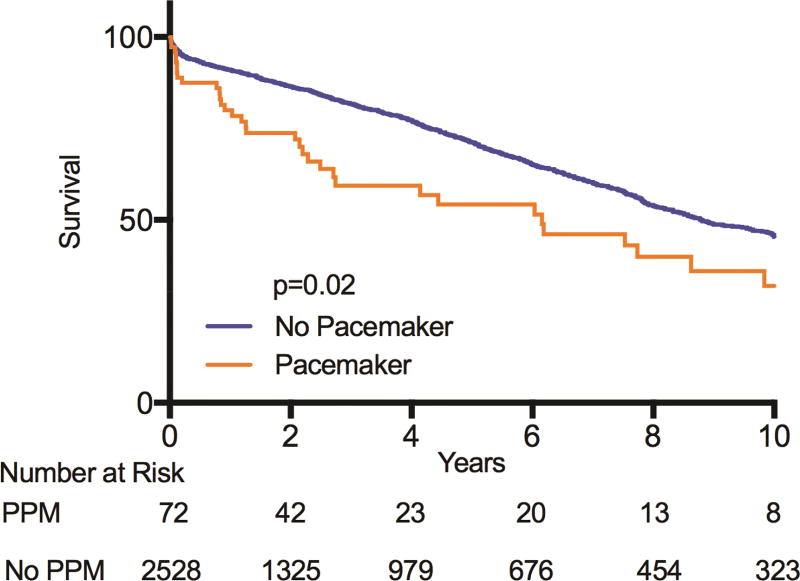
Results: A total of 72 patients (2.7%) required PPM placement postoperatively. Patients requiring PPM had more postoperative complications, including atrial fibrillation (43.1% versus 27.0%, p = 0.003), prolonged ventilation (16.7% versus 5.7%, p < 0.0001), and renal failure (12.5% versus 4.6%, p = 0.002). These led to greater resource utilization including longer intensive care unit stay (89 versus 44 hours, p < 0.0001) and hospital length of stay (9 versus 6 days, p < 0.0001), and higher inflation-adjusted hospital cost ($81,000 versus $47,000, p < 0.0001). Median follow-up was 7.5 years, and patients requiring PPM had significantly worse long-term survival (p = 0.02), even after risk adjustment with STS predicted risk of mortality (hazard ratio 1.48, p = 0.02).
Conclusions: The need for PPM after aortic valve replacement independently reduces long-term survival. The rate of PPM placement after surgical aortic valve replacement remains very low but dramatically increases resource utilization. As transcatheter aortic valve replacement expands to low-risk patients, the impact of PPM placement on long-term survival warrants close monitoring.
Copyright © 2018 The Society of Thoracic Surgeons. Published by Elsevier Inc. All rights reserved.
Figures
Comment in
-
Permanent pacemaker implantation is never a benign complication after aortic valve replacement.J Thorac Dis. 2018 Nov;10(Suppl 33):S4080-S4081. doi: 10.21037/jtd.2018.09.107. J Thorac Dis. 2018. PMID: 30631560 Free PMC article. No abstract available.
References
-
- Leon MB, Smith CR, Mack M, et al. Transcatheter aortic-valve implantation for aortic stenosis in patients who cannot undergo surgery. The New England journal of medicine. 2010;363(17):1597–1607. - PubMed
-
- Smith CR, Leon MB, Mack MJ, et al. Transcatheter versus surgical aortic-valve replacement in high-risk patients. New England Journal of Medicine. 2011;364(23):2187–2198. - PubMed
-
- Iung B, Cachier A, Baron G, et al. Decision-making in elderly patients with severe aortic stenosis: Why are so many denied surgery? Eur Heart J. 2005;26(24):2714–2720. - PubMed
-
- Daubert MA, Weissman NJ, Hahn RT, et al. Long-term valve performance of tavr and savr: A report from the partner i trial. JACC Cardiovascular imaging 2016 - PubMed
-
- Cribier A, Eltchaninoff H, Bash A, et al. Percutaneous transcatheter implantation of an aortic valve prosthesis for calcific aortic stenosis: First human case description. Circulation. 2002;106(24):3006–3008. - PubMed
MeSH terms
Grants and funding
LinkOut - more resources
Full Text Sources
Other Literature Sources
Medical
Miscellaneous
