


doi: 10.1038/nmeth.4637.
Epub 2018 Mar 26.
Photoactivatable drugs for nicotinic optopharmacology
Affiliations
- PMID: 29578537
- PMCID: PMC5923430
- DOI: 10.1038/nmeth.4637
Item in Clipboard
Photoactivatable drugs for nicotinic optopharmacology
Nat Methods.
2018 May.
Abstract
Photoactivatable pharmacological agents have revolutionized neuroscience, but the palette of available compounds is limited. We describe a general method for caging tertiary amines by using a stable quaternary ammonium linkage that elicits a red shift in the activation wavelength. We prepared a photoactivatable nicotine (PA-Nic), uncageable via one- or two-photon excitation, that is useful to study nicotinic acetylcholine receptors (nAChRs) in different experimental preparations and spatiotemporal scales.
Conflict of interest statement
The authors declare no competing financial interests.
Figures
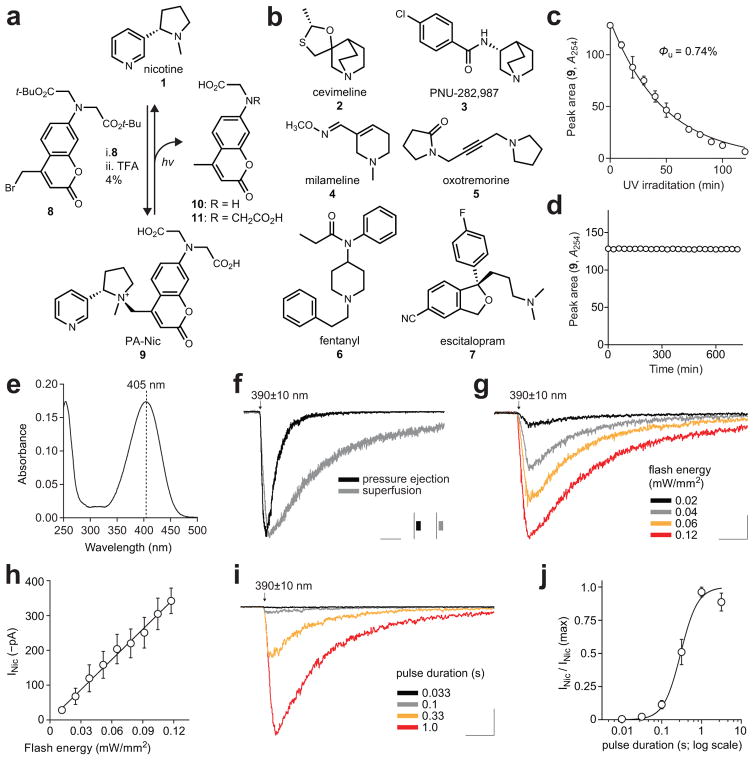
(a) Chemical structure of nicotine (1) and the
synthesis and photolysis of PA-Nic (9). (b) Chemical
structures of ‘uncageable’ drugs
2–7. (c) Plot of mean HPLC
chromatogram peak area vs. irradiation time (365 nm) provides
the uncaging quantum yield (Φu); solid line
is exponential fit; error bars indicate ±SD; n=2 independent
samples. (d) Representative dark stability experiment of PA-Nic
(9); n=3 independent samples. (e)
Representative absolute absorption spectrum of PA-Nic (9, 10
μM); n=3 independent samples. (f) Light-evoked
currents following PA-Nic epi-illumination photolysis. Voltage clamp traces from
individual MHb neurons are shown for different methods of PA-Nic application
(similar for >10 independent experiments). Photolysis: 1 s pulse, 0.12
mW/mm2. Scale: 2.5 s, 100 pA (grey), 150 pA (black)
(g–j) Controllable nicotine uncaging via
PA-Nic epi-illumination photolysis. (g) Representative voltage
clamp traces from a MHb neuron for light pulses (1 s) of varying intensity.
Scale: 2.5 s, 75 pA (h) Resulting photochemical dose-response
relation for peak currents (y=2.876x+2.1,
R2=0.9921). Mean (n=9/6) peak of light-activated
currents plotted vs. input flash intensity. (i)
Representative voltage clamp traces during light pulses (0.12 mW/mm2)
of varying duration applied to a MHb neuron. Scale: 2.5 s, 250 pA
(j) Graphical analysis of summary pulse duration data in
i. The Hill equation was fitted to the mean data
(nH (Hill slope)=2.0, duration at
½ max=0.3 s, R2=0.928) from n=5/3.
All error bars indicate ±SEM.
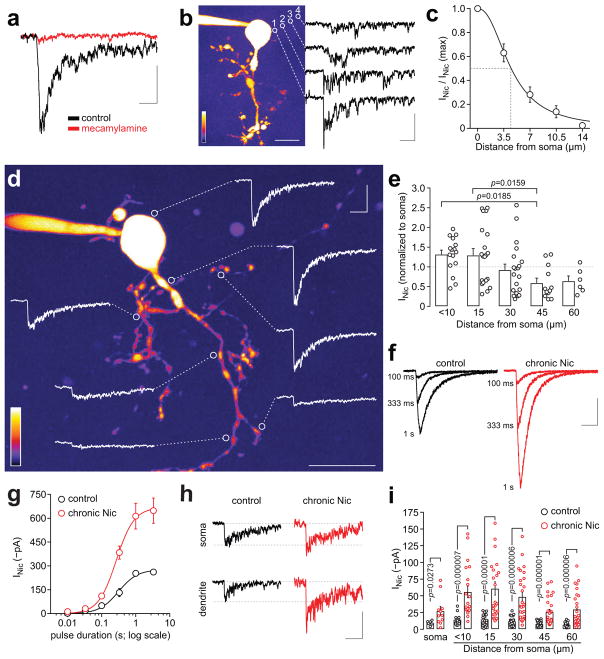
(a) PA-Nic uncaging and mecamylamine antagonism. Nicotine was
uncaged in a ~1 μm peri-somatic spot with a 405 nm laser pulse (10 ms,
2.9 mW). Voltage-clamp currents are shown before (black trace, similar for
>10 independent experiments) and 10 min after (red trace, single experiment)
mecamylamine (10 μM) superfusion. Scale: 50 ms, 100 pA
(b–c) Lateral spread of uncaged nicotine, estimated
electrophysiologically. (b) A representative 2PLSM image of a MHb
neuron is shown. Nicotine was uncaged (white circles; 10 ms, 1.5 mW) at the
surface (1; 0 μm), and at 3.5 (2), 7.0 (3), and 10.5 (4) μm from
the cell surface. Representative traces from a single neuron are shown. Scales
on image: (lower left = relative intensity; lower right = 20
μm). Scale (current): 500 ms, 30 pA (c) The Hill equation
was fitted to the mean (±SEM) data (n (Hill
slope)=2.293, R2=0.9074) (n=6/5), resulting
in an estimate of 4.5 μm for the lateral distance at ½ max
amplitude. (d–e) Subcellular mapping of nAChRs
in MHb neurons. (d) Representative 2PLSM image of a ChAT(+)
MHb neuron, marked with uncaging positions (white circles; 50 ms, 2 mW) and the
evoked response at that location. Scales: (lower left = relative
intensity; lower right = 20 μm, upper right = 1 s, 60
pA) (e) Summary of position-dependent uncaging data for
ChAT(+) MHb neurons (n=8/5) using PA-Nic (80 μM).
Nicotine uncaging responses were recorded at the soma and at dendritic locations
at the indicated linear distance from the soma surface. The mean (+SEM)
and individual responses are shown. P values: Tukey post-hoc
after 1-way ANOVA (F(4,69)=4.3,
p=0.0036). (f–i)
Interrogating chronic nicotine-mediated nAChR up-regulation with PA-Nic.
(f) Representative traces are shown from a control and chronic
nicotine-treated ChAT(+) MHb neuron stimulated via epi-illumination
photolysis (0.12 mW/mm2) for the indicated durations. Scale: 200 pA,
2 s (g) The Hill equation was fitted to photochemical dose response
mean (±SEM) data from control (n=7/2) or chronic
nicotine-treated neurons (n=11/3) (control:
n=1.7, duration at ½ max=0.3 s,
R2=0.732; chronic nicotine:
n=1.6, duration at ½ max=0.3 s,
R2=0.89). (h–i) Chronic
nicotine up-regulates nAChRs at all cellular locations tested. (h)
Representative uncaging responses are shown from a control and chronic
nicotine-treated neuron stimulated at the soma and at a dendrite ~30 μm
from the soma using 405 nm laser photolysis (50 ms, 2 mW) of PA-Nic. Scale: 20
pA, 2 s (i) Scatter plots (mean ±SEM) of nicotine uncaging
amplitudes at the indicated cellular location are shown for ChAT(+)
control (n=6/3) and chronic nicotine-treated (n=14/4) neurons.
P values: two-sided Mann-Whitney test.
References
-
- Hagen V, Dekowski B, Nache V, et al. Angew Chem Int Ed. 2005;44:7887–7891. - PubMed
Publication types
MeSH terms
Substances
Grants and funding
LinkOut - more resources
Full Text Sources
Other Literature Sources
Molecular Biology Databases
