Review
. 2019 Jul 19;20(4):1492-1501.
doi: 10.1093/bib/bby018.

Comprehensive analysis of Helicobacter pylori infection-associated diseases based on miRNA-mRNA interaction network

Affiliations
Review

Comprehensive analysis of Helicobacter pylori infection-associated diseases based on miRNA-mRNA interaction network

Jue Yang et al. Brief Bioinform. .

Abstract

Helicobacter pylori (H. pylori) infection remains a cause of significant morbidity and mortality worldwide. Comprehensive understanding of the pathogenic mechanism of H. pylori and its interaction with host will contribute to developing novel prophylactical and therapeutical strategies. Here, we first determined microRNA (miRNA) levels in H. pylori-infected patients with gastritis, duodenal ulcer, gastric cancer or mucosa-associated lymphoid tissue lymphoma using miRNA data sets. Thirty-four differentially expressed miRNAs were identified and functional enrichment analysis of those miRNA target genes revealed that H. pylori infection were strongly associated with pathway in cancer and regulation of mRNA synthesis. Using disease connectivity analysis of 28 hub genes, we found that H. pylori may increase the risk of many extragastric diseases (e.g. cardiovascular disease, hemic and lymphatic diseases and nervous system disease). Altogether, our integrated analysis provided a new method to predict pathogen-human disease connectivity based on miRNA-mRNA interaction network and indicated anti-H. pylori therapy as an effective means of human diseases prevention.

Keywords: Helicobacter pylori; cardiovascular disease; gastric cancer; miRNA.


Figures

Figure 1
Figure 1
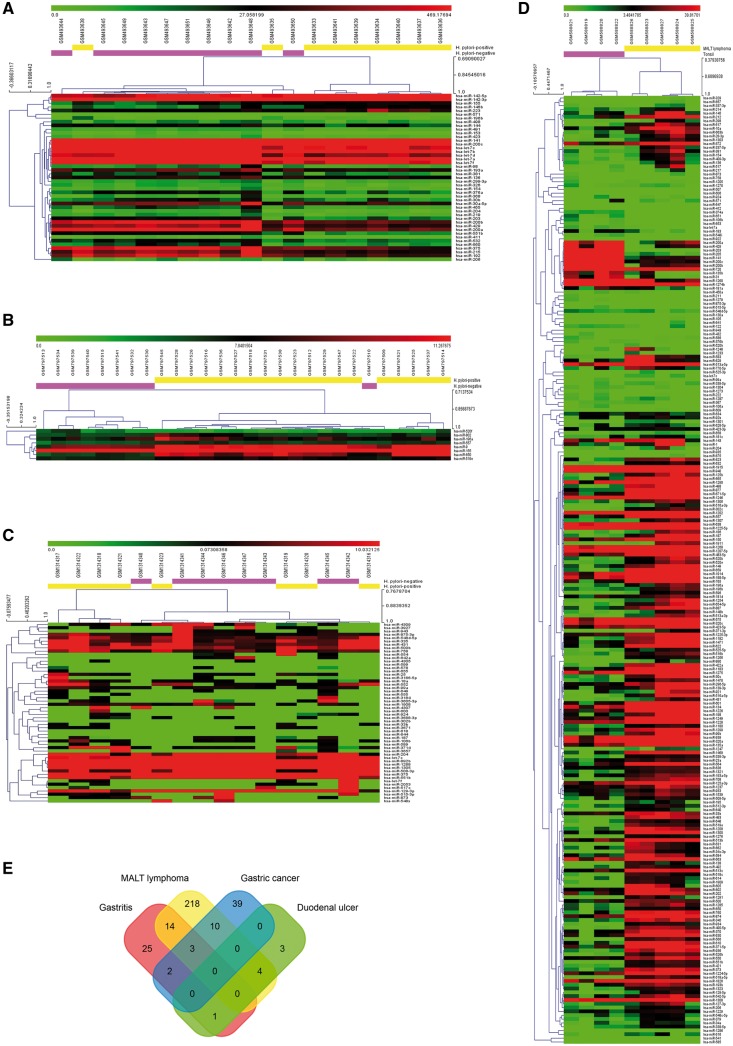
Identification of differentially expressed miRNAs associated with H. pylori infection. (A-D) Heat maps of miRNA microarray analysis. Each column contains the data from a specific gene and each row contains data from single sample. Upregulated expression levels are in red and downregulated in green. The fold-changes (log2 transformed) of miRNA expression in H. pylori-negative samples versus H. pylori-positive samples from GSE19769 (A; gastritis), GSE32174 (B; duodenal ulcer), GSE54397 (C; gastric cancer), GSE23877 (D; MALT lymphoma). In total, 45 249 8 and 54 differentially expressed miRNAs were identified from GSE19769, GSE23877, GSE32174 and GSE54397, respectively. (E) Venn diagram of overlap of differentially expressed miRNAs. We filtered out 34 differentially expressed miRNAs that at least occurred in two datasets. Among these 34 miRNAs, hsa-let-7c, hsa-miR-204 and hsa-miR-551 b were overlapped in three data sets.
Figure 2
Figure 2
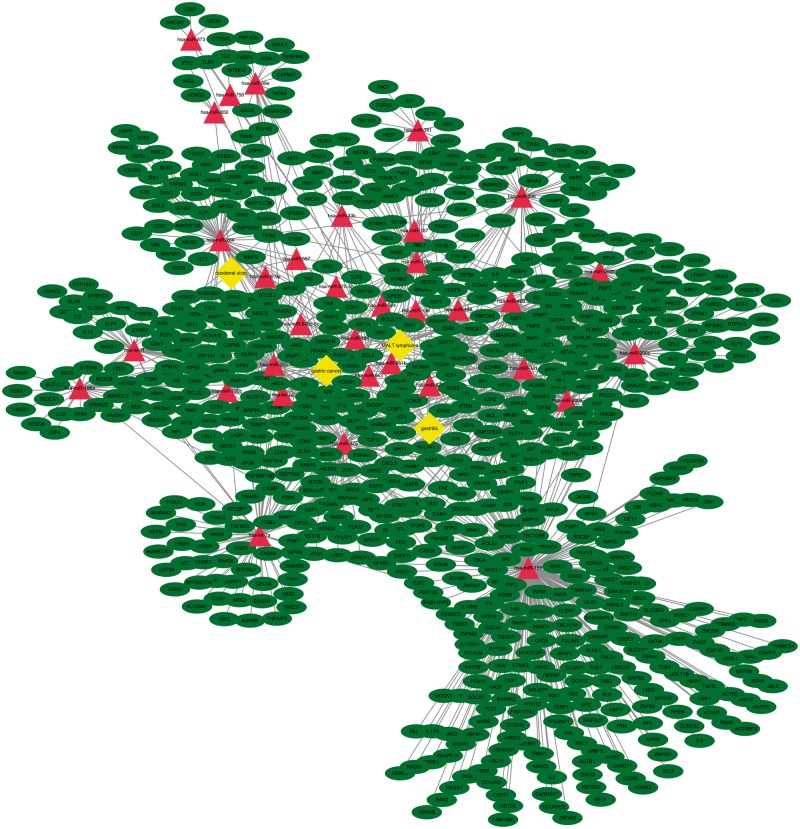
Regulatory network between miRNA and their target genes. Target genes for differentially expressed miRNAs were retrieved from the miRTarBase. These target genes were validated by at least one of strongly experimental methods (reporter assay, Western blot or quantitative real-time polymerase chain reaction). We also linked these differentially expressed miRNAs to the diseases that were diagnosed in the patients. This network was generated using Cytoscape 3.4.0 and consisted of 4 H. pylori infection-related diseases, 28 miRNAs and 765 genes. Rectangle (yellow) represents diseases, ellipses (green) represents genes and triangle represents miRNAs.
Figure 3
Figure 3
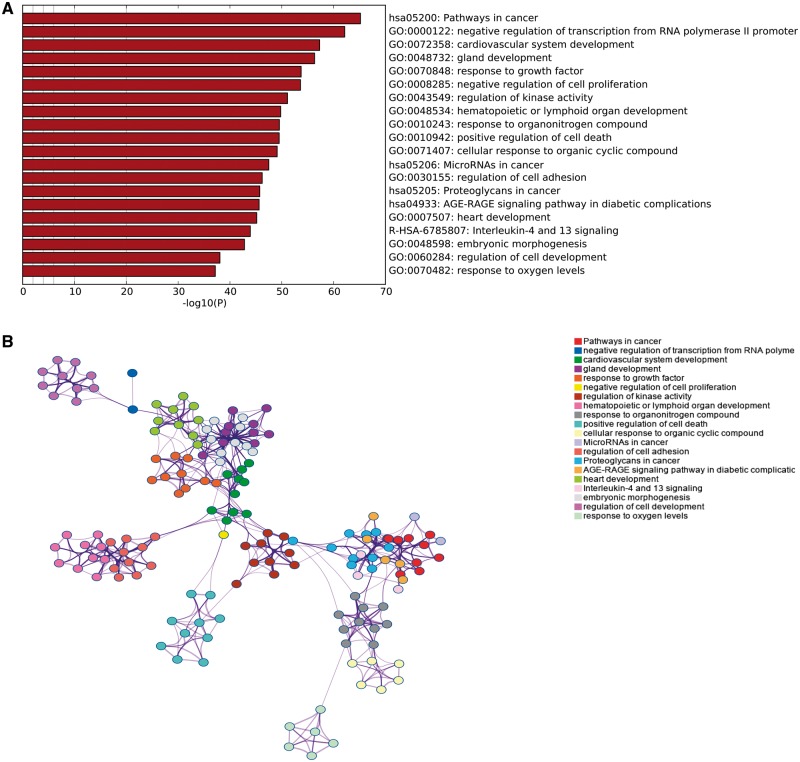
Functional enrichment analysis of miRNA target genes. (A) Top 20 clusters from Metascape pathway enrichment analysis of the 765 H. pylori infection-associated genes. Length of bars represent log10 (P value) based on the best-scoring term within each cluster. (B) Relationships among these top 20 clusters enrichment terms displayed as a network analyzed by Metascape. Nodes of the same color belonged to the same cluster. Terms with a similarity score > 0.3 were linked by an edge. The network was visualized with Cytoscape with ‘force-directed’ layout and with edge bundled for clarity.
Figure 4
Figure 4
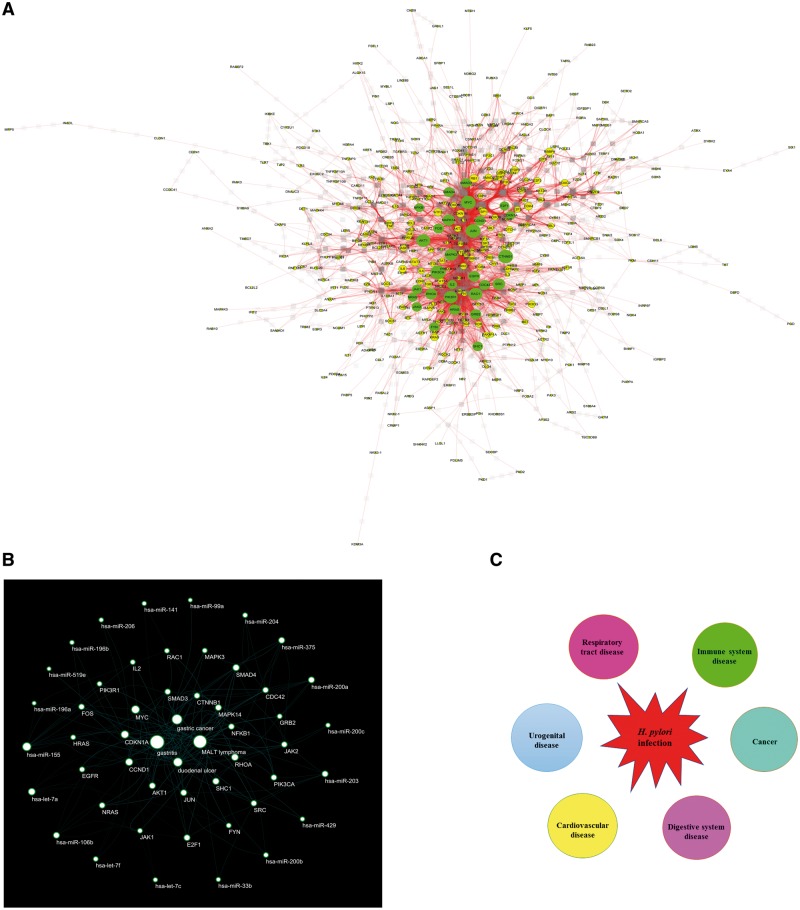
Hub genes and disease connectivity analysis. (A) The protein–protein interaction network of 765 genes was generated using STRING (confidence score ≥ 0.9) and visualized with Cytoscape 3.4.0. The node properties, such as degree, were calculated using Centiscape 2.2. In total, 28 hub genes were identified according to degree > 40 threshold. (B) STRING-generated interaction network among the 28 hub genes and miRNA-mRNA interaction predicted with miRTarBase were described in ‘Materials and methods’ section. Then miRNA–hub gene–disease network was visualized with Cytoscape 3.4.0. This network consists of 4 H. pylori infection-related diseases, 21 miRNAs and 28 genes. (C) Diseases or conditions enriched with H. pylori infection associated genes were identified using the ‘set analyzer’ tool of the Comparative Toxicogenomic Database with Bonferoni-corrected P value < 0.05. The corrected P value is calculated by the hypergeometric distribution and adjusted for multiple testing using the Bonferroni method. Diseases with the smallest P values mean the most reliable connectivity between a disease and genes analyzed.

References

    1. The EUROGAST Study Group. An international association between Helicobacter pylori infection and gastric cancer. Lancet 1993;341:1668. - PubMed
    1. Tjandra JJ. Helicobacter pylori in peptic ulcer disease. Del Med J 1994;66:557–8. - PubMed
    1. Parsonnet J, Friedman GD, Vandersteen DP, et al. Helicobacter pylori infection and the risk of gastric carcinoma. N Engl J Med 1991;325(16):1127–31. - PubMed
    1. Warren JR, Marshall B.. Unidentified curved bacilli on gastric epithelium in active chronic gastritis. Lancet 1983;1:1273–5. - PubMed
    1. Lai CY, Yang TY, Lin CL, et al. Helicobacter pylori infection and the risk of acute coronary syndrome: a nationwide retrospective cohort study. Eur J Clin Microbiol Infect Dis 2015;34(1):69–74. - PubMed

Publication types