


Functional Connectivity Between Anterior Insula and Key Nodes of Frontoparietal Executive Control and Salience Networks Distinguish Bipolar Depression From Unipolar Depression and Healthy Control Subjects
- PMID: 29580768
- PMCID: PMC6467478
- DOI: 10.1016/j.bpsc.2018.01.013
Functional Connectivity Between Anterior Insula and Key Nodes of Frontoparietal Executive Control and Salience Networks Distinguish Bipolar Depression From Unipolar Depression and Healthy Control Subjects
Abstract
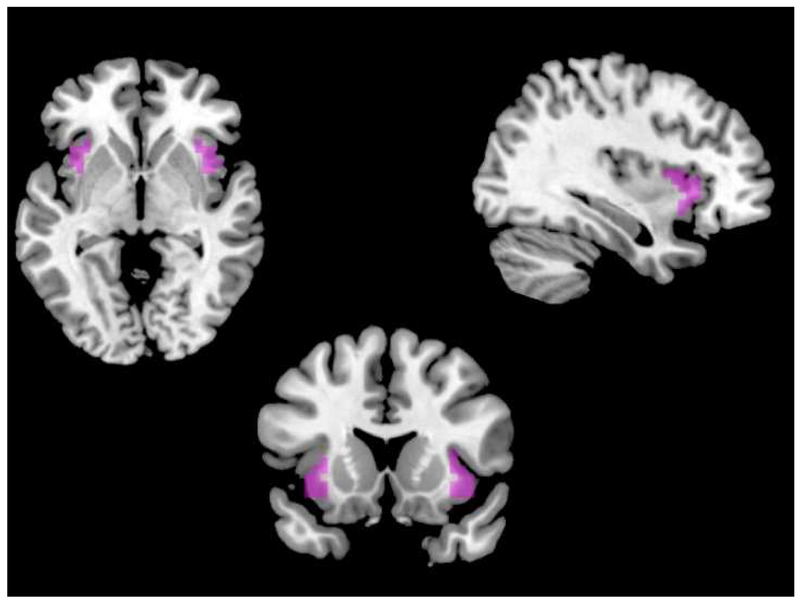
Background: Patients with bipolar depression are characterized by dysregulation across the full spectrum of mood, differentiating them from patients with unipolar depression. The ability to switch neural resources among the default mode network, salience network, and executive control network (ECN) has been proposed as a key mechanism for adaptive mood regulation. The anterior insula is implicated in the modulation of functional network switching. Differential connectivity between anterior insula and functional networks may provide insights into pathophysiological differences between bipolar and unipolar mood disorders, with implications for diagnosis and treatment.
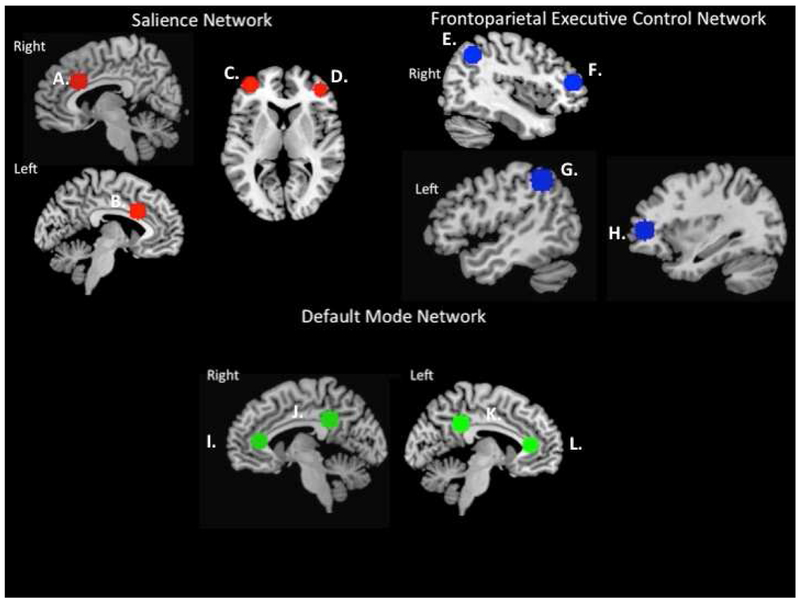
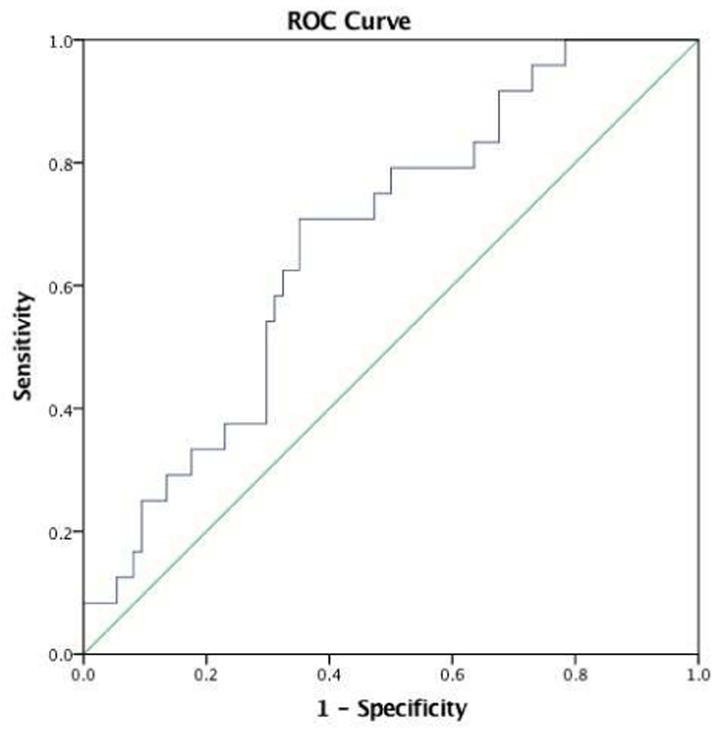
Methods: Resting-state functional magnetic resonance imaging data were collected from 98 subjects (35 unipolar, 24 bipolar, and 39 healthy control subjects). Pearson correlations were computed between bilateral insula seed regions and a priori defined target regions from the default mode network, salience network, and ECN. After r-to-z transformation, a one-way multivariate analysis of covariance was conducted to identify significant differences in connectivity between groups. Post hoc pairwise comparisons were conducted and Bonferroni corrections were applied. Receiver-operating characteristics were computed to assess diagnostic sensitivity.
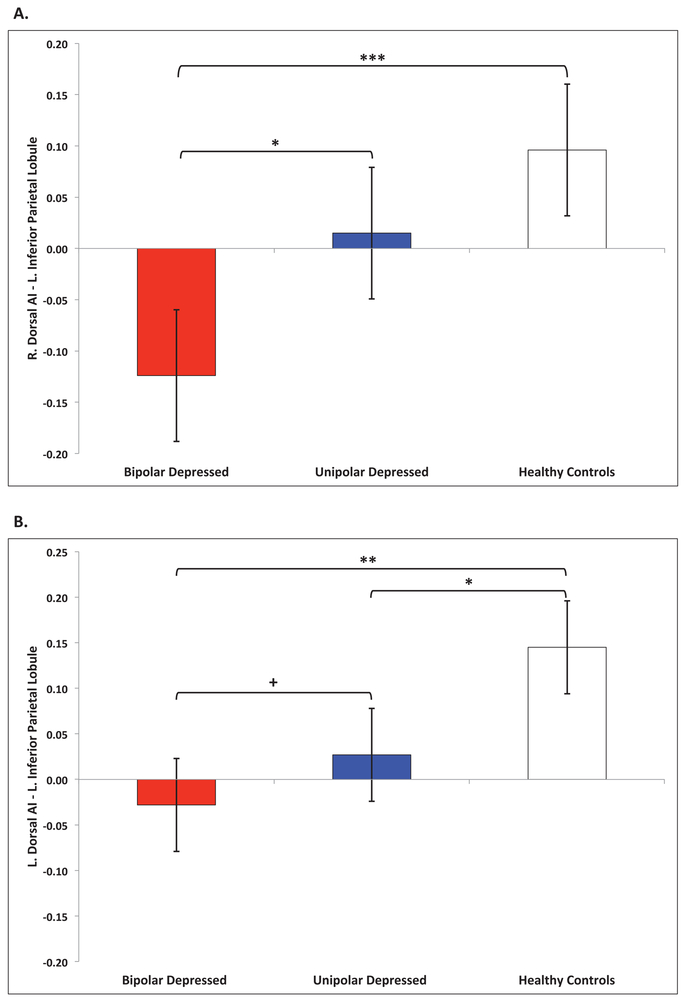
Results: Patients with bipolar depression evidenced significantly altered right anterior insula functional connectivity with the inferior parietal lobule of the ECN relative to patients with unipolar depression and control subjects. Right anterior insula-inferior parietal lobule connectivity significantly discriminated patients with bipolar depression.
Conclusions: Impaired functional connectivity between the anterior insula and the inferior parietal lobule of the ECN distinguishes patients with bipolar depression from those with unipolar depression and healthy control subjects. This finding highlights a pathophysiological mechanism with potential as a therapeutic target and a clinical biomarker for bipolar disorder, exhibiting reasonable sensitivity and specificity.
Keywords: Bipolar depression; Frontoparietal; Functional network connectivity; Insula; Salience; Unipolar depression.
Copyright © 2018 Society of Biological Psychiatry. Published by Elsevier Inc. All rights reserved.
Conflict of interest statement
Financial Disclosures
No commercial funding to any contributing authors directly supported the preparation of this work. Additional funding disclosures: Dr. Nierenberg reports grants and personal fees from Takeda/Lundbeck and AlfaSigma (formerly known as PamLabs). He has received research funding from GlaxoSmithKlein, NeuroRx Pharma, Marriott Foundation, National Institute of Health, Brain & Behavior Research Foundation, Janssen, Intracellular Therapies, and Patient Centered Outcomes Research Institute (PCORI). Dr. Nierenberg also receives personal or consulting fees from Alkermes, PAREXEL, Sunovian, Naurex, Hoffman La Roche/Genentech, Eli Lilly & Company, Pfizer, SLACK Publishing, and Physician's Postgraduate Press, Inc. Dr. Van Dijk is currently employed by Pfizer Inc. Pfizer Inc. had no input or influence on the study design, data collection, data analyses, or interpretation of results. Dr. Dougherty receives device donations and has received consulting income from Medtronic. Dr Dougherty has pending patent applications related to deep brain stimulation for mental illness. Dr. Dougherty further reports consulting income from Insys, speaking fees from Johnson & Johnson, and research support from Cyberonics and Roche. Dr. Deckersbach reports research support from Agency for Healthcare Research and Quality, National Institutes of Health, Defense Advanced Research Projects Agency, Patient Centered Outcomes Research Institute, Depression and Bipolar Alternative Treatment Foundation, International OCD Foundation, Otsuka Pharmaceuticals, Brain & Behavior Research Foundation, Tourette Syndrome Association, National Institute on Aging, Janssen Pharmaceuticals, the Forest Research Institute, Shire Development, Inc., Medtronic, Cyberonics, Northstar, and Takeda. He has received personal/consulting fees from BrainCells, Inc., Clintara, Inc., Systems Research and Applications Corporation, Catalan Agency for Health Technology Assessment and Research, National Association of Social Workers Massachusetts, Massachusetts Medical Society, National Institute on Drug Abuse, and Oxford University Press. He has received both grants and personal fees from Sunovion Pharmaceuticals, Inc., Tufts University, National Institute of Mental Health, and Cogito, Inc. All other authors report no biomedical financial interests or potential conflicts of interest.
Figures
Comment in
-
Using Neuroimaging to Develop Mood Disorder Diagnostic Biomarkers: A Good Forward Step and Some Considerations.Biol Psychiatry Cogn Neurosci Neuroimaging. 2018 May;3(5):411-413. doi: 10.1016/j.bpsc.2018.03.008. Biol Psychiatry Cogn Neurosci Neuroimaging. 2018. PMID: 29735151 No abstract available.
References
-
- Murray CJ, Vos T, Lozano R, Naghavi M, Flaxman AD, Michaud C, et al. (2012): Disability-adjusted life years (DALYs) for 291 diseases and injuries in 21 regions, 1990–2010: a systematic analysis for the Global Burden of Disease Study 2010. Lancet. 380:2197–2223. - PubMed
-
- Fava M (2003): Diagnosis and definition of treatment-resistant depression. Biological psychiatry. 53:649–659. - PubMed
-
- Gitlin M (2006): Treatment-resistant bipolar disorder. Mol Psychiatry. 11:227–240. - PubMed
Publication types
MeSH terms
Grants and funding
LinkOut - more resources
Full Text Sources
Other Literature Sources
Medical
