


Relationships Among Perceived Functional Capacity, Self-Efficacy, and Disability After Dysvascular Amputation
- PMID: 29580940
- PMCID: PMC6153084
- DOI: 10.1016/j.pmrj.2018.03.014
Relationships Among Perceived Functional Capacity, Self-Efficacy, and Disability After Dysvascular Amputation
Abstract
Background: Prosthesis rehabilitation after dysvascular transtibial amputation (TTA) is focused on optimizing functional capacity with limited emphasis on promoting health self-efficacy. Self-efficacy interventions decrease disability for people living with chronic disease, but the influence of self-efficacy on disability is unknown for people with dysvascular TTA.
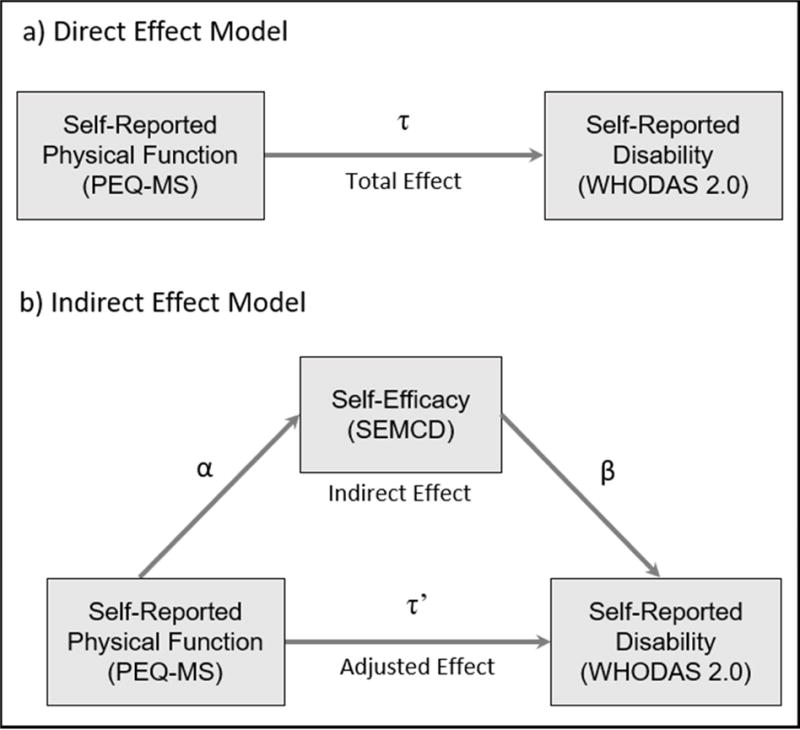
Objectives: To identify if self-efficacy mediates the relationship between self-reported functional capacity and disability after dysvascular TTA.
Design: Cross-sectional, secondary data analysis.
Setting: Outpatient rehabilitation facilities.
Participants: Thirty-eight men (63.6 ± 9.1 years old) with dysvascular TTA.
Methods: Participants had been living with an amputation for less than 6 months and using walking as their primary form of locomotion using a prosthesis. The independent variable, functional capacity, was measured using the Prosthesis Evaluation Questionnaire-Mobility Scale (PEQ-MS). The proposed mediator, self-efficacy, was measured with the Self-Efficacy of Managing Chronic Disease questionnaire (SEMCD).
Main outcome measure: Disability was measured using the World Health Organization Disability Assessment Schedule 2.0 (WHODAS 2.0) questionnaire.
Results: The relationship between self-reported functional capacity and disability is partially mediated by self-efficacy. Relationships between WHODAS 2.0 and PEQ-MS (r = -0.61), WHODAS 2.0 and SEMCD (r = -0.51), and PEQ-MS and SEMCD (r = 0.44) were significant (P < .01). Controlling for SEMCD (P = .04), the relationship between PEQ-MS and WHODAS 2.0 remained significant (P < .01). Statistically significant mediation was determined by a bootstrap method for the product of coefficients (95% confidence interval: -2.23, -7.39).
Conclusions: This study provides initial evidence that the relationship between self-reported functional capacity and disability is partially mediated by self-efficacy after dysvascular TTA. The longitudinal effect of self-efficacy should be further examined to identify causal pathways of disability after dysvascular amputation. Furthermore, additional factors contributing to the relationship between self-reported functional capacity and disability need to be identified.
Level of evidence: III.
Copyright © 2018 American Academy of Physical Medicine and Rehabilitation. Published by Elsevier Inc. All rights reserved.
Conflict of interest statement
Figures
References
-
- Ziegler-Graham K, MacKenzie EJ, Ephraim PL, Travison TG, Brookmeyer R. Estimating the prevalence of limb loss in the United States: 2005 to 2050. Arch Phys Med Rehabil. 2008;89(3):422–429. - PubMed
-
- Coffey L, Gallagher P, Desmond D. Goal pursuit and goal adjustment as predictors of disability and quality of life among individuals with a lower limb amputation: a prospective study. Arch Phys Med Rehabil. 2014;95(2):244–252. - PubMed
-
- Dillingham TR, Pezzin LE, MacKenzie EJ. Limb amputation and limb deficiency: epidemiology and recent trends in the United States. South Med J. 2002;95(8):875–883. - PubMed
-
- VA/DoD Clinical Practice Guideline for Rehabilitation of Lower Limb Amputation. Department of Veterans Affairs & Department of Defense; 2008.
MeSH terms
Grants and funding
LinkOut - more resources
Full Text Sources
Other Literature Sources
Medical
Research Materials
