Review
. 2018 May 19;373(1746):20170006.
doi: 10.1098/rstb.2017.0006.

Inferring influence and leadership in moving animal groups

Affiliations
Review

Inferring influence and leadership in moving animal groups

Ariana Strandburg-Peshkin et al. Philos Trans R Soc Lond B Biol Sci. .

Abstract

Collective decision-making is a daily occurrence in the lives of many group-living animals, and can have critical consequences for the fitness of individuals. Understanding how decisions are reached, including who has influence and the mechanisms by which information and preferences are integrated, has posed a fundamental challenge. Here, we provide a methodological framework for studying influence and leadership in groups. We propose that individuals have influence if their actions result in some behavioural change among their group-mates, and are leaders if they consistently influence others. We highlight three components of influence (influence instances, total influence and consistency of influence), which can be assessed at two levels (individual-to-individual and individual-to-group). We then review different methods, ranging from individual positioning within groups to information-theoretic approaches, by which influence has been operationally defined in empirical studies, as well as how such observations can be aggregated to give insight into the underlying decision-making process. We focus on the domain of collective movement, with a particular emphasis on methods that have recently been, or are being, developed to take advantage of simultaneous tracking data. We aim to provide a resource bringing together methodological tools currently available for studying leadership in moving animal groups, as well as to discuss the limitations of current methodologies and suggest productive avenues for future research.This article is part of the theme issue 'Collective movement ecology'.

Keywords: collective movement; decision-making; leadership; methods; social behaviour.


Conflict of interest statement

We have no competing interests.

Figures
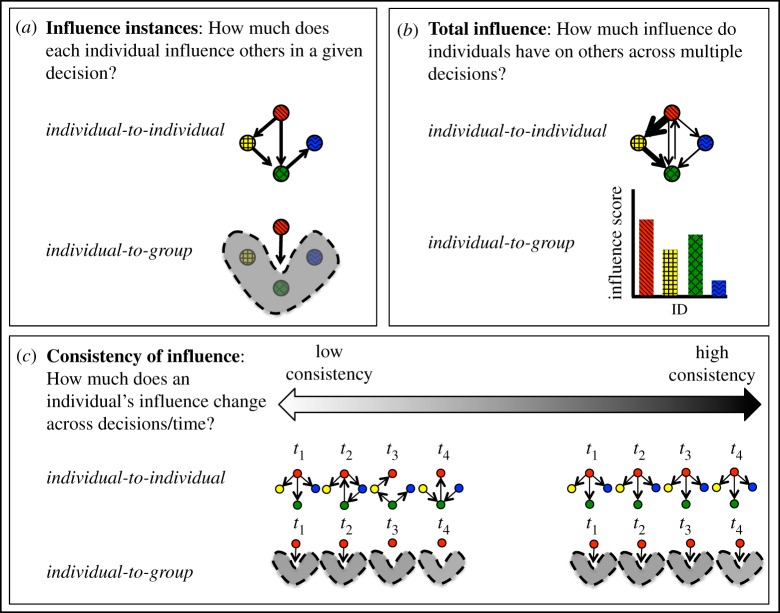
Figure 1.
Figure 1.
A conceptual framework for studying leadership in animal groups. Studies typically observe influence instances (a), instances in which a given individual influences the group (in the case of individual-to-group observations) or another individual (in the case of individual-to-individual observations) during a given decision, or at a particular moment in time. Coloured dots indicate individuals, with arrows representing influences between them. (b) Influence instances are then aggregated over multiple decisions, or across time, to estimate an individual's total influence over other individuals in its group (individual-to-individual level), or over the group as a whole (individual-to-group level). Such estimates often take the form of weighted network edges in the case of dyadic influence relationships (top of panel) or an aggregate influence ‘score’ or ‘rank’ in the case of the individual-to-group level (bottom of panel). (c) Finally, it is important to assess the consistency of influence across multiple events (here shown labelled as t1t4) to determine the extent to which individuals influence one another (or the group) the same amount during each group decision, or across time.
Figure 2.
Figure 2.
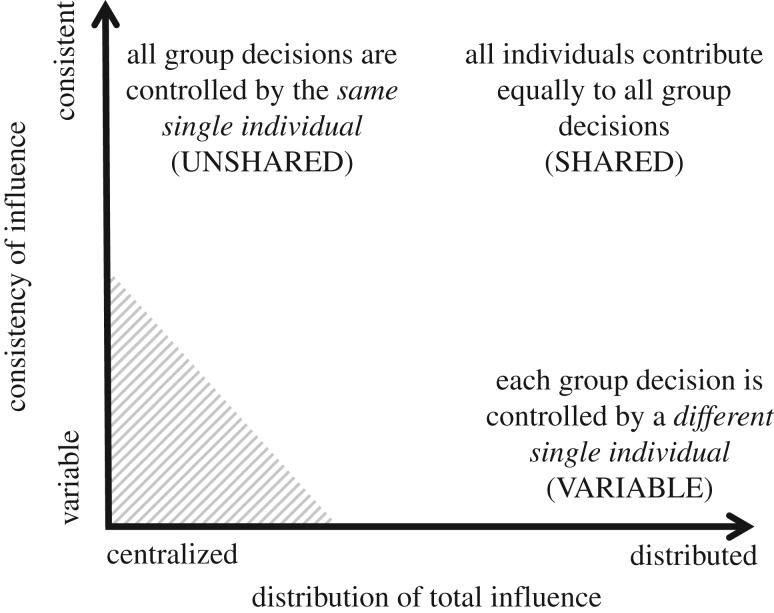
Assessing overall decision-making patterns based on the distribution and consistency of influence. We suggest that decision-making systems can be usefully categorized along two axes: the distribution of total influence and the consistency of influence. The distribution of total influence (x-axis) can range from centralized (one individual has high total influence, and the rest have little or none) to distributed (all individuals have approximately equal total influence). The consistency (y-axis) can range from variable (individuals are not consistent in their influence across multiple events) to consistent (individuals have the same influence across all events). Placing decision-making systems along these two axes clearly divides the space into sections corresponding to different decision-making types that have previously been discussed in the literature, including despotic/unshared decision-making (centralized, consistent), shared decision-making (distributed, consistent) and variable influence (distributed, variable). The bottom left corner is shaded because it is not possible to have a completely centralized distribution of total influence that is also highly variable. This visualization also highlights the importance of considering consistency of influence in addition to total influence, as it is only along this dimension that variable influence and shared decision-making can be distinguished.

References

    1. Krebs JR, Davies NB. 1987. An introduction to behavioural ecology. New York, NY: Wiley-Blackwell.
    1. Conradt L, List C. 2009. Group decisions in humans and animals: a survey. Phil. Trans. R. Soc. B 364, 719–742. (10.1098/rstb.2008.0276) - DOI - PMC - PubMed
    1. Conradt L, Roper TJ. 2005. Consensus decision making in animals. Trends Ecol. Evol. 20, 449–456. (10.1016/j.tree.2005.05.008) - DOI - PubMed
    1. Conradt L. 2012. Models in animal collective decision-making: information uncertainty and conflicting preferences. Interface Focus 2, 226–240. (10.1098/rsfs.2011.0090) - DOI - PMC - PubMed
    1. Conradt L, Roper TJ. 2003. Group decision-making in animals. Nature 421, 155–158. (10.1038/nature01294) - DOI - PubMed

Publication types

LinkOut - more resources