


Sexual Probability Discounting: A Mechanism for Sexually Transmitted Infection Among Undergraduate Students
- PMID: 29582269
- PMCID: PMC6365211
- DOI: 10.1007/s10508-018-1155-1
Sexual Probability Discounting: A Mechanism for Sexually Transmitted Infection Among Undergraduate Students
Abstract
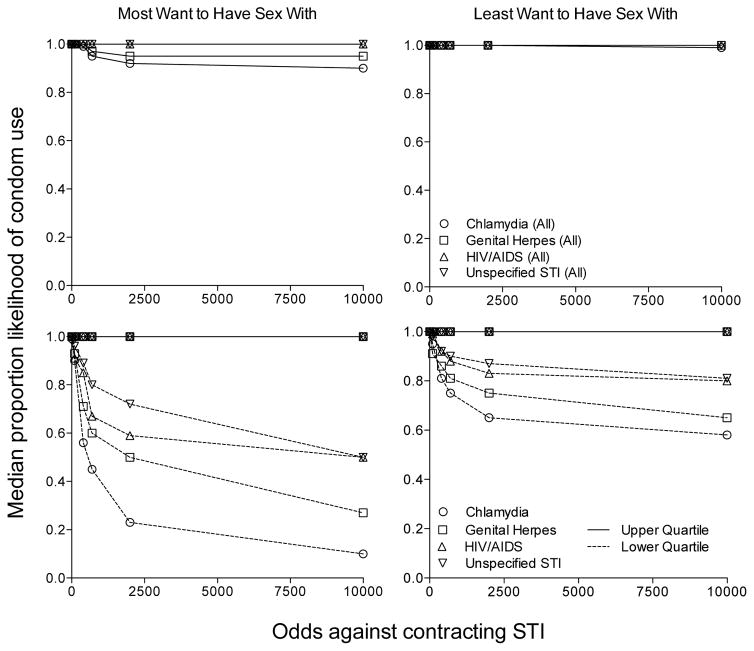
Lack of condom use among youth is a major contributor to the spread of sexually transmitted infections (STIs) including HIV/AIDS, which has lifelong deleterious health consequences. College students (N = 262) completed the Sexual Probability Discounting Task in which participants reported their likelihood of condom use under various probabilities of contracting an STI. Each participant completed the task in regard to different STIs including HIV/AIDS and different partners. Results showed that the likelihood of condom-protected sex generally decreased as HIV/AIDS and other STI contraction became less probable. Moreover, condom-protected sex likelihood was related to STI type (e.g., decreased condom-protected sex in chlamydia relative to HIV/AIDS condition) and partner desirability (decreased condom-protected sex with more desirable partners). Results are the first to show that compared to other STIs, HIV/AIDS had the most influence on condom-protected sex. Results showed probability discounting contributed to lack of condom-protected sex and offers a novel framework for examining determinants of within-subject variability in condom use.
Keywords: Condom use; HIV/AIDS; Sexual Probability Discounting Task; Sexual health; Sexually transmitted infections.
Figures
References
-
- Bontempi JB, Mugno R, Bulmer SM, Danvers K, Vancour ML. Exploring gender differences in the relationship between HIV/STD testing and condom use among undergraduate college students. American Journal of Health Education. 2009;40(2):97–105.
-
- Centers for Disease Control and Prevention. Control HIV/STD behavioral surveillance working group. CDC Sexual behavior questions (CSBQ) 2011 Retrieved from http://chipts.ucla.edu/wp-content/uploads/downloads/2012/01/CDC-Sexual-B....
-
- Centers for Disease Control and Prevention. Trends in HIV-Related Risk Behaviors Among High School Students – United States, 1991–2011. Retrieved from http://www.cdc.gov/mmwr/preview/mmwrhtml/mm6129a4.htm?s_cid=mm6129a4_w.
-
- Centers for Disease Control and Prevention. Incidence, prevalence, and cost of sexually transmitted infections in the united states. 2013 Retrieved from Http://www.Cdc.gov/std/stats/sti-Estimates-Fact-Sheet-Feb-2013.Pdf.
Publication types
MeSH terms
Grants and funding
LinkOut - more resources
Full Text Sources
Other Literature Sources
Medical
