. 2018 Mar 27;10(4):149.
doi: 10.3390/v10040149.

Inhibition of Zika Virus Replication by Silvestrol

Affiliations

Inhibition of Zika Virus Replication by Silvestrol

Fabian Elgner et al. Viruses. .

Abstract

The Zika virus (ZIKV) outbreak in 2016 in South America with specific pathogenic outcomes highlighted the need for new antiviral substances with broad-spectrum activities to react quickly to unexpected outbreaks of emerging viral pathogens. Very recently, the natural compound silvestrol isolated from the plant Aglaia foveolata was found to have very potent antiviral effects against the (-)-strand RNA-virus Ebola virus as well as against Corona- and Picornaviruses with a (+)-strand RNA-genome. This antiviral activity is based on the impaired translation of viral RNA by the inhibition of the DEAD-box RNA helicase eukaryotic initiation factor-4A (eIF4A) which is required to unwind structured 5´-untranslated regions (5'-UTRs) of several proto-oncogenes and thereby facilitate their translation. Zika virus is a flavivirus with a positive-stranded RNA-genome harboring a 5'-capped UTR with distinct secondary structure elements. Therefore, we investigated the effects of silvestrol on ZIKV replication in A549 cells and primary human hepatocytes. Two different ZIKV strains were used. In both infected A549 cells and primary human hepatocytes, silvestrol has the potential to exert a significant inhibition of ZIKV replication for both analyzed strains, even though the ancestor strain from Uganda is less sensitive to silvestrol. Our data might contribute to identify host factors involved in the control of ZIKV infection and help to develop antiviral concepts that can be used to treat a variety of viral infections without the risk of resistances because a host protein is targeted.

Keywords: Ziks virus; antiviral; eIF4A; hepatocytes; silvestrol.


Conflict of interest statement

The authors declare no conflict of interest.

Figures
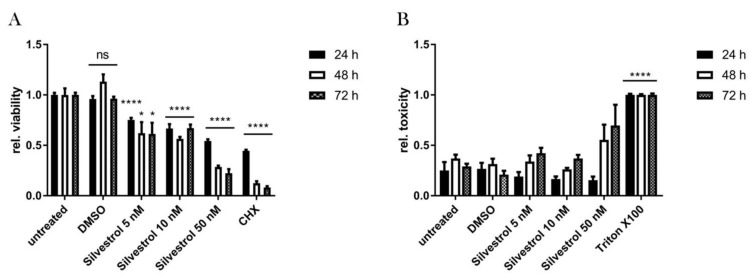
Figure 1
Figure 1
Cytostatic effect of silvestrol in A549 cells. (A) Time- and concentration-dependent decrease of cellular metabolic activity after silvestrol treatment in A549 cells determined by the PrestoBlue assay. Cycloheximid (CHX) served as positive control in a concentration of 35 µM to inhibit cell proliferation; (B) Lactate dehydrogenase (LDH) release assay with the supernatants of silvestrol treated A549 cells did not show an increased cell death. Treatment with 1% Triton X-100 served as positive control for complete cell death. LDH activity in the samples was normalized to the LDH activity in the supernatant of Triton X-100 treated cells. ns = not significant = p > 0.05; * = p ≤ 0.05; **** = p ≤ 0.0001.
Figure 2
Figure 2
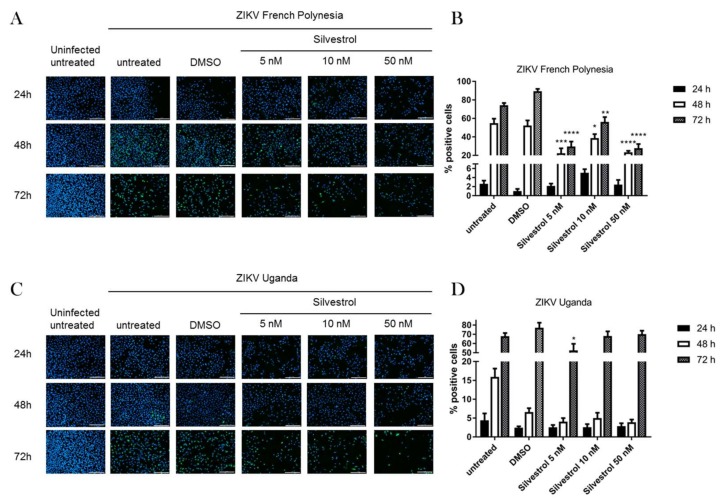
Silvestrol treatment reduces the number of Zika virus (ZIKV) positive cells. (A) A549 cells were infected with ZIKV French Polynesia isolate (FP) and treated with the indicated amount of silvestrol. Cells were fixed on the indicated time points and nuclei were stained with DAPI (blue) and NS1 was stained with a specific antibody in green, scale bar = 200 µm; (B) Ratio of NS1-positive cells in at least four fields of view of the respective samples exemplary shown in (A); (C) A549 cells were infected with ZIKV Uganda isolate (U) and treated with the indicated amount of silvestrol. Cells were fixed on the indicated time points and nuclei were stained with DAPI (blue) and NS1 was stained with a specific antibody in green, scale bar = 200 µm; (D) Ratio of NS1-positive cells in at least four fields of view of the respective samples exemplary shown in (C). * = p ≤ 0.05; ** = p ≤ 0.01; *** = p ≤ 0.001; **** = p ≤ 0.0001.
Figure 3
Figure 3
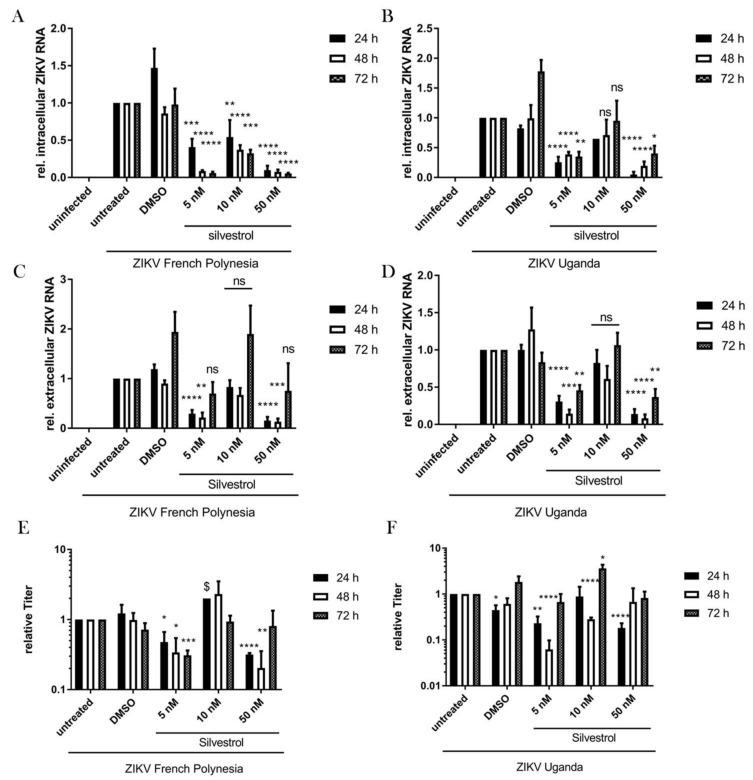
Significant reduction of intra- and extracellular ZIKV RNA levels and released virions. (A) Quantification of intracellular ZIKV RNA of A549 cells infected with ZIKV FP and treated with the indicated concentrations of silvestrol. ZIKV RNA was quantified by RT-qPCR and normalized to the amount of RPL27 transcripts; (B) Quantification of intracellular ZIKV RNA of A549 cells infected with ZIKV U and treated with the indicated concentrations of silvestrol. ZIKV RNA was quantified by RT-qPCR and normalized to the amount of RPL27 transcripts; (C) RT-qPCR quantification of extracellular ZIKV RNA of A549 cells infected with ZIKV FP and treated with the indicated concentrations of silvestrol; (D) RT-qPCR quantification of extracellular ZIKV RNA of A549 cells infected with ZIKV U and treated with the indicated concentrations of silvestrol; (E) Relative extracellular titers of A549 cells infected with ZIKV FP and treated with the indicated concentrations of silvestrol. Titers were quantified by plaque assay in Vero cells; (F) Relative extracellular titers of A549 cells infected with ZIKV U and treated with the indicated concentrations of silvestrol. Titers were quantified by plaque assay in Vero cells. $: only two experiments were performed. ns = not significant = p > 0.05; * = p ≤ 0.05; ** = p ≤ 0.01; *** = p ≤ 0.001; **** = p ≤ 0.0001.
Figure 4
Figure 4
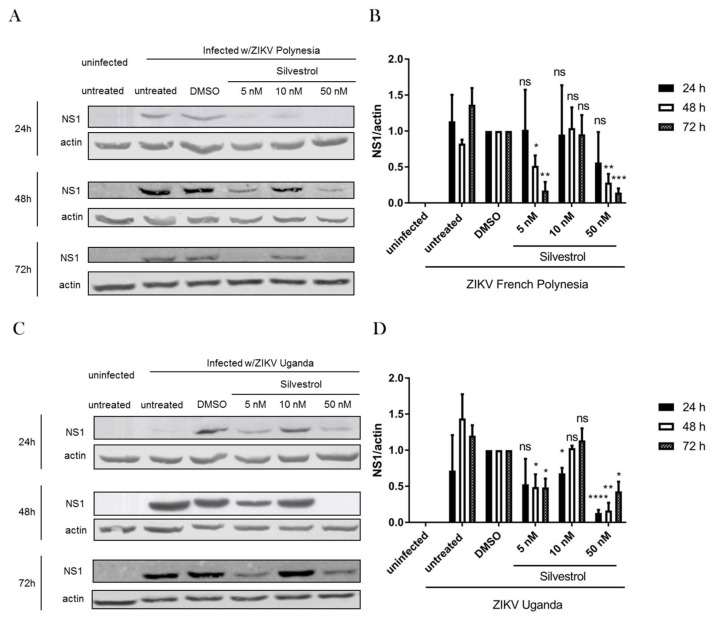
Silvestrol treatment reduces the amount of intracellular NS1 protein. (A) A549 cells were infected with ZIKV U and treated with the indicated amount of silvestrol. Cell lysates of the indicated time points were analyzed by Western blot with specific antibodies against NS1 and β-actin; (B) Quantification of densitometry scans examples are shown in (A); (C) A549 cells were infected with ZIKV FP and treated with the indicated amount of silvestrol. Cell lysates of the indicated time points were analyzed by Western blot with specific antibodies against NS1 and β-actin; (D) Quantification of densitometry scans examples are shown in (C). ns = not significant = p > 0.05; * = p ≤ 0.05; ** = p ≤ 0.01; *** = p ≤ 0.001; **** = p ≤ 0.0001.
Figure 5
Figure 5
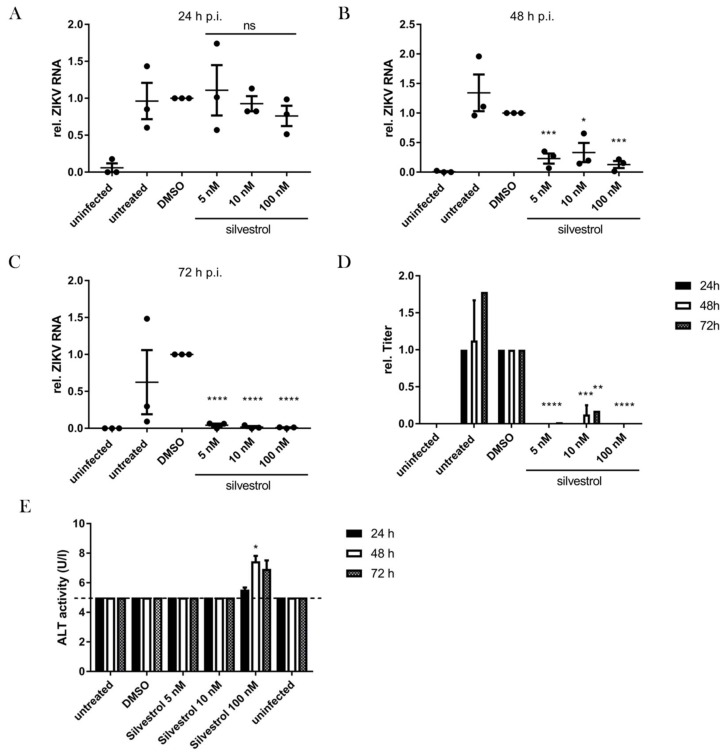
Silvestrol exerts an anti-ZIKV effect also in primary cells. Primary human hepatocytes were infected with ZIKV FP and treated with the indicated concentrations of silvestrol. The extracellular ZIKV RNA was quantified by RT-qPCR after 24 (A), 48 (B), and 72 h (C); (D) Extracellular titers of infected and treated primary human hepatocytes (PHHs) after 48 and 72 h. Shown are titers from just one PHH donor quantified by plaque assay in Vero cells; (E) ALT activity in PHH supernatants. ns = not significant = p > 0.05; * = p ≤ 0.05; ** = p ≤ 0.01; *** = p ≤ 0.001; **** = p ≤ 0.0001.

References

    1. Göertz G.P., Abbo S.R., Fros J.J., Pijlman G.P. Functional RNA during Zika virus infection. Virus Res. :2017. doi: 10.1016/j.virusres.2017.08.015. - DOI - PubMed
    1. Heinz F.X., Stiasny K. The Antigenic Structure of Zika Virus and Its Relation to Other Flaviviruses: Implications for Infection and Immunoprophylaxis. Microbiol. Mol. Biol. Rev. 2017;81 doi: 10.1128/MMBR.00055-16. - DOI - PMC - PubMed
    1. Zhu Z., Chan J.F.-W., Tee K.-M., Choi G.K.-Y., Lau S.K.-P., Woo P.C.-Y., Tse H., Yuen K.-Y. Comparative genomic analysis of pre-epidemic and epidemic Zika virus strains for virological factors potentially associated with the rapidly expanding epidemic. Emerg. Microbes Infect. 2016;5:e22. doi: 10.1038/emi.2016.48. - DOI - PMC - PubMed
    1. Kuno G., Chang G.-J.J. Full-length sequencing and genomic characterization of Bagaza, Kedougou, and Zika viruses. Arch. Virol. 2007;152:687–696. doi: 10.1007/s00705-006-0903-z. - DOI - PubMed
    1. Baronti C., Piorkowski G., Charrel R.N., Boubis L., Leparc-Goffart I., de Lamballerie X. Complete coding sequence of zika virus from a French polynesia outbreak in 2013. Genome Announc. 2014;2 doi: 10.1128/genomeA.00500-14. - DOI - PMC - PubMed

Publication types

MeSH terms

LinkOut - more resources