Review
. 2018 Mar 27;19(4):1005.
doi: 10.3390/ijms19041005.

Role of Macrophages in Brain Tumor Growth and Progression

Affiliations
Review

Role of Macrophages in Brain Tumor Growth and Progression

Elia Guadagno et al. Int J Mol Sci. .

Abstract

The role of macrophages in the growth and the progression of tumors has been extensively studied in recent years. A large body of data demonstrates that macrophage polarization plays an essential role in the growth and progression of brain tumors, such as gliomas, meningiomas, and medulloblastomas. The brain neoplasm cells have the ability to influence the polarization state of the tumor associated macrophages. In turn, innate immunity cells have a decisive role through regulation of the acquired immune response, but also through humoral cross-talking with cancer cells in the tumor microenvironment. Neoangiogenesis, which is an essential element in glial tumor progression, is even regulated by the tumor associated macrophages, whose activity is linked to other factors, such as hypoxia. In addition, macrophages play a decisive role in establishing the entry into the bloodstream of cancer cells. As is well known, the latter phenomenon is also present in brain tumors, even if they only rarely metastasize. Looking ahead in the future, we can imagine that characterizing the relationships between tumor and tumor associated macrophage, as well as the study of circulating tumor cells, could give us useful tools in prognostic evaluation and therapy. More generally, the study of innate immunity in brain tumors can boost the development of new forms of immunotherapy.

Keywords: cancer; glioma; innate immunity; macrophage polarization; medulloblastoma; meningioma.


Conflict of interest statement

The authors declare no conflict of interest.

Figures
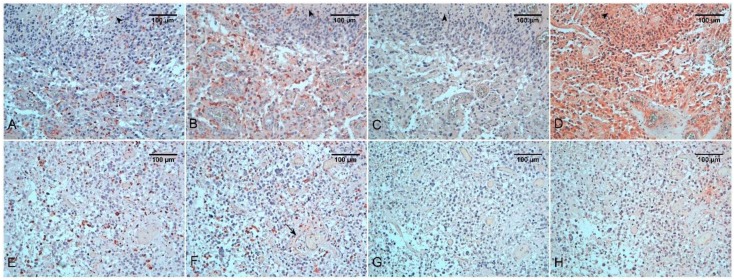
Figure 1
Figure 1
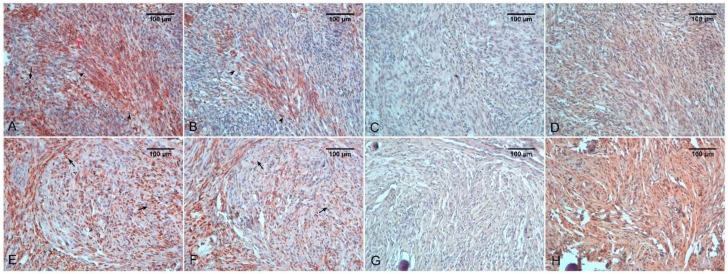
Glioblastoma isocitrate dehydrogenases (IDH)-wild type (AD). Immunostaining for CD68 (A), CD163 (B), inducible nitric oxide synthase (iNOS) (C), and hypoxia-inducible factors (HIF-1α) (D). Tumor tissue is near a zone of necrosis (arrowhead). Note the strongly positive immunostaining for HIF-1α. Glioblastoma IDH-mutant (EH). Immunostaining for CD68 (E), CD163 (F), iNOS (G), and HIF-1α (H). In a vessels-rich area macrophages polarization in CD163 positive M2 elements is less evident than in the IDH-wild type case shown above. Elongated, CD163+ element, similar to normal perivascular microglia, are present around the vessels (arrow).
Figure 2
Figure 2
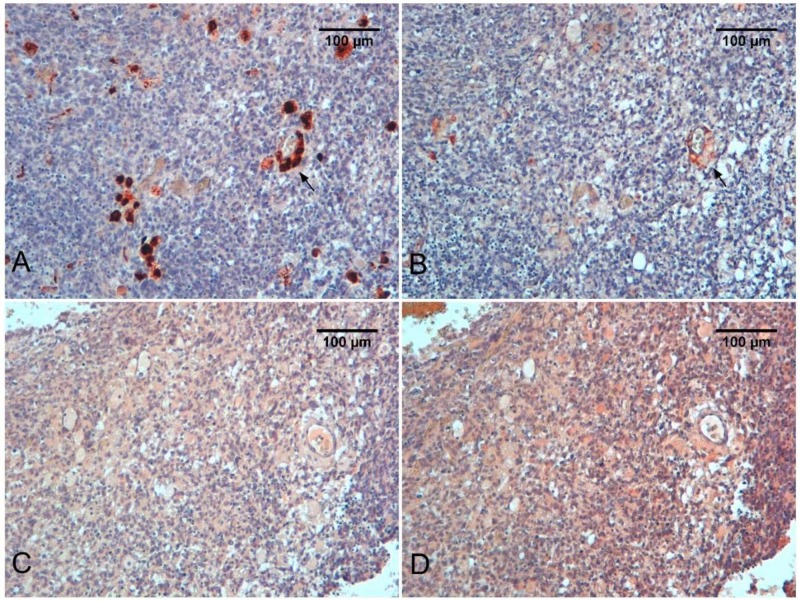
Atypical meningioma (AD). Immunostaining for CD68 (A), CD163 (B), iNOS (C), and HIF-1α (D). Note a CD68 positive signal in sheet-like growth areas (arrowheads) and in scattered macrophages (arrow). CD163 positivity is lower and immunoreactivity for HIF-1α is very low. Meningothelial meningioma (EH). Immunostaining for CD68 (E), CD163 (F), iNOS (G), and HIF-1α (H). A more marked positivity for CD163 is evident. Note that CD68 positivity into the whorl is more marked than CD163 staining (Arrows) and strong positivity for HIF-1α.
Figure 3
Figure 3
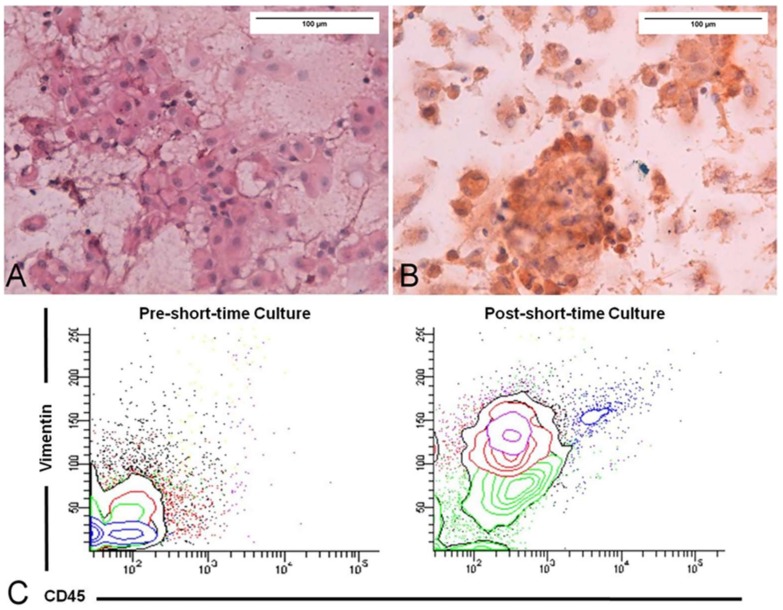
Medulloblastoma. Immunostaining for CD68 (A), CD163 (B), iNOS (C), and HIF-1α (D). Note perivascular CD68 positive elements (arrow), probably just recruited from the bloodstream. CD163 is much less expressed in the same elements (arrow).
Figure 4
Figure 4
Liquid Biopsy primary short-time culture of a Glioblastoma case: (A) Hematossilin/Eosin staining of circulating tumor cells, isolated and cultured in chamber slide for 14 days; (B) Immunocytochemical staining using antibody anti-GFAP (Glial Fibrillary Acidic Protein); and, (C) Cytometric analysis for vimentinand CD45 antigens expression on circulating cells at time 0 and at day 14 of culture. Scale bar = 100 μm

References

    1. Engelhardt B., Vajkoczy P., Weller R.O. The movers and shapers in immune privilege of the CNS. Nat. Immunol. 2017;18:123–131. doi: 10.1038/ni.3666. - DOI - PubMed
    1. Carson M.J., Doose J.M., Melchior B., Schmid C.D., Ploix C.C. CNS immune privilege: Hiding in plain sight. Immunol. Rev. 2006;213:48–65. doi: 10.1111/j.1600-065X.2006.00441.x. - DOI - PMC - PubMed
    1. Chow B.W., Gu C. The molecular constituents of the blood-brain barrier. Trends Neurosci. 2015;38:598–608. doi: 10.1016/j.tins.2015.08.003. - DOI - PMC - PubMed
    1. Engelhardt B., Ransohoff R.M. Capture, crawl, cross: The T cell code to breach the blood-brain barriers. Trends Immunol. 2012;33:579–589. doi: 10.1016/j.it.2012.07.004. - DOI - PubMed
    1. Ransohoff R.M., Engelhardt B. The anatomical and cellular basis of immune surveillance in the central nervous system. Nat. Rev. Immunol. 2012;12:623–635. doi: 10.1038/nri3265. - DOI - PubMed