


The Effects of Nicotine and Tobacco Use on Brain Reward Function: Interaction With Nicotine Dependence Severity
- PMID: 29584917
- PMCID: PMC6784410
- DOI: 10.1093/ntr/nty059
The Effects of Nicotine and Tobacco Use on Brain Reward Function: Interaction With Nicotine Dependence Severity
Abstract
Introduction: This study investigated the effects of nicotine/tobacco on neural activation during performance of a monetary incentive delay task.
Aims and methods: Prior to each scan, nonsmokers received nicotine or placebo nasal spray, and smokers were smoking satiated or 24-hour withdrawn. During the scan, participants made timed responses to reward-related cues and received feedback. Parameter estimates from cue- and feedback-related activation in medial prefrontal regions and the nucleus accumbens were extracted and underwent within- and between-group analyses. Smokers' nicotine dependence severity was included as a continuous predictor variable for neural activation.
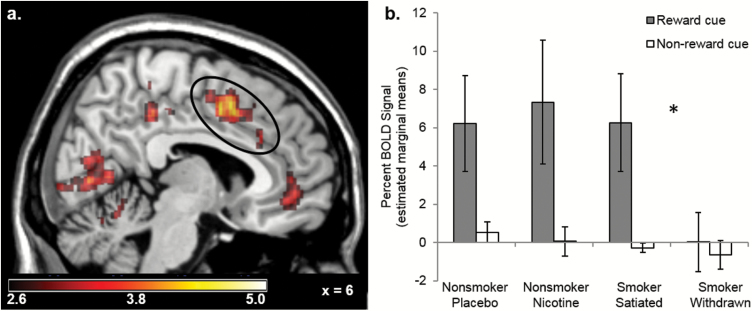
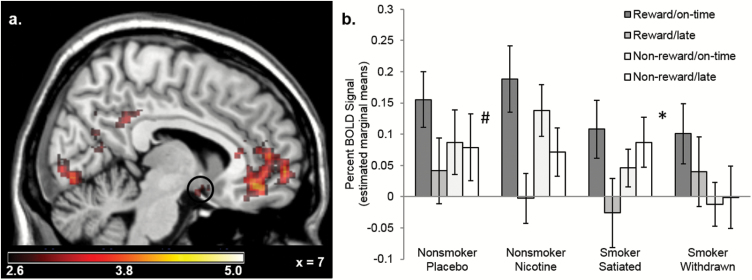
Results: Among smokers (n = 21), withdrawal decreased cue-related activation in the supplementary motor area and ventromedial prefrontal cortex, and the difference in activation (satiety > withdrawal) in these regions negatively correlated with nicotine dependence severity (Fagerström Test for Nicotine Dependence). Among nonsmokers (n = 22), nicotine increased the difference in nucleus accumbens activation between rewarded and nonrewarded feedback phases. Tobacco withdrawal and acute nicotine also had widespread effects on activation throughout the brain during the feedback phase.
Conclusions: Acute nicotine in nonsmokers may have increased the salience of feedback information, but produced few effects on reward-related activation overall, perhaps reflecting nicotine's modest, indirect effects on reward processing. Conversely, tobacco withdrawal decreased activation compared with satiety, and this difference between conditions correlated with nicotine dependence severity. This suggests that as smokers become more dependent on nicotine, tobacco withdrawal has a more pronounced effect on reward processing.
Implications: Relative to the acute effects of nicotine in nonsmokers, withdrawal from daily tobacco use had more significant effects on reward-related brain activation. This study suggests that the effects of tobacco withdrawal on reward-related brain function interact with subjects' level of nicotine dependence severity. These are potentially important sources of variability that could contribute to smoking cessation outcomes.
© The Author(s) 2018. Published by Oxford University Press on behalf of the Society for Research on Nicotine and Tobacco. All rights reserved. For permissions, please e-mail: journals.permissions@oup.com.
Figures
References
-
- US Department of Health and Human Services. Preventing tobacco use among youth and young adults: a report of the surgeon general 2012. https://www.surgeongeneral.gov/library/reports/preventing-youth-tobacco-.... Accessed June 14, 2017.
-
- Lopez-Quintero C, Pérez de los Cobos J, Hasin DS, et al. . Probability and predictors of transition from first use to dependence on nicotine, alcohol, cannabis, and cocaine: results of the National Epidemiologic Survey on Alcohol and Related Conditions (NESARC). Drug Alcohol Depend. 2011;115(1–2):120–130. - PMC - PubMed
-
- Bevins RA, Palmatier MI. Extending the role of associative learning processes in nicotine addiction. Behav Cogn Neurosci Rev. 2004;3(3):143–158. - PubMed
Publication types
MeSH terms
Substances
Grants and funding
LinkOut - more resources
Full Text Sources
Other Literature Sources
Medical
