


Comparative analysis of FKBP family protein: evaluation, structure, and function in mammals and Drosophila melanogaster
- PMID: 29587629
- PMCID: PMC5870485
- DOI: 10.1186/s12861-018-0167-3
Comparative analysis of FKBP family protein: evaluation, structure, and function in mammals and Drosophila melanogaster
Abstract
Background: FK506-binding proteins (FKBPs) have become the subject of considerable interest in several fields, leading to the identification of several cellular and molecular pathways in which FKBPs impact prenatal development and pathogenesis of many human diseases.
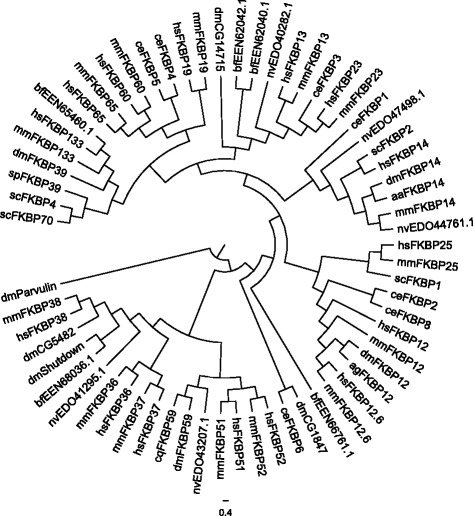
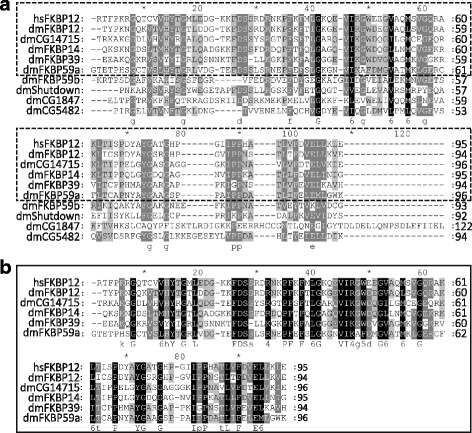
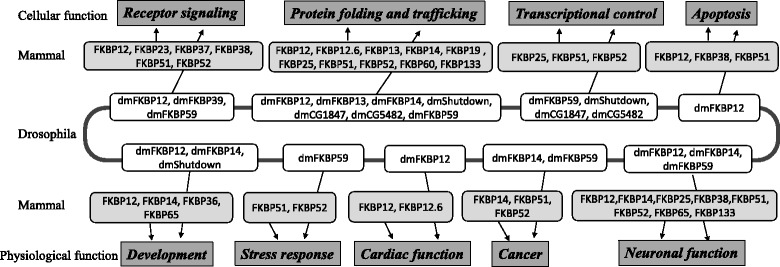
Main body: This analysis revealed differences between how mammalian and Drosophila FKBPs mechanisms function in relation to the immunosuppressant drugs, FK506 and rapamycin. Differences that could be used to design insect-specific pesticides. (1) Molecular phylogenetic analysis of FKBP family proteins revealed that the eight known Drosophila FKBPs share homology with the human FKBP12. This indicates a close evolutionary relationship, and possible origination from a common ancestor. (2) The known FKBPs contain FK domains, that is, a prolyl cis/trans isomerase (PPIase) domain that mediates immune suppression through inhibition of calcineurin. The dFKBP59, CG4735/Shutdown, CG1847, and CG5482 have a Tetratricopeptide receptor domain at the C-terminus, which regulates transcription and protein transportation. (3) FKBP51 and FKBP52 (dFKBP59), along with Cyclophilin 40 and protein phosphatase 5, function as Hsp90 immunophilin co-chaperones within steroid receptor-Hsp90 heterocomplexes. These immunophilins are potential drug targets in pathways associated with normal physiology and may be used to treat a variety of steroid-based diseases by targeting exocytic/endocytic cycling and vesicular trafficking. (4) By associating with presinilin, a critical component of the Notch signaling pathway, FKBP14 is a downstream effector of Notch activation at the membrane. Meanwhile, Shutdown associates with transposons in the PIWI-interacting RNA pathway, playing a crucial role in both germ cells and ovarian somas. Mutations in or silencing of dFKBPs lead to early embryonic lethality in Drosophila. Therefore, further understanding the mechanisms of FK506 and rapamycin binding to immunophilin FKBPs in endocrine, cardiovascular, and neurological function in both mammals and Drosophila would provide prospects in generating unique, insect specific therapeutics targeting the above cellular signaling pathways.
Conclusion: This review will evaluate the functional roles of FKBP family proteins, and systematically summarize the similarities and differences between FKBP proteins in Drosophila and Mammals. Specific therapeutics targeting cellular signaling pathways will also be discussed.
Keywords: FK506-binding protein; Hsp90; Inositol 1, 4, 5-trisphosphate; Notch; Peptidyl-prolyl isomerase; Phospholipase C; Ryanodine receptor; Tetratricopetide receptor; Transient receptor potential.
Conflict of interest statement
Ethics approval and consent to participate
Not applicable.
Consent for publication
Not applicable.
Competing interests
The authors declare that they have no competing interests.
Publisher’s Note
Springer Nature remains neutral with regard to jurisdictional claims in published maps and institutional affiliations.
Figures
References
Publication types
MeSH terms
Substances
Grants and funding
- 31371256/31571273/31771277/by the National Natural Science Foundation of China/International
- MS2014SXSF038/the Foreign Distinguished Scientist Program from the National Department of Education/International
- GK20130100/201701005/GERP-17-45/the National Department of Education Central Universities Research Fund/International
- 2015CB943100/Ministry of Science and Technology of the People's Republic of China/International
- 2009MSCRFE008300/US Maryland Stem Cell Research Fund/International
LinkOut - more resources
Full Text Sources
Other Literature Sources
Molecular Biology Databases
Miscellaneous
