


Evaluation of an interaction-skills training for reducing the burden of family caregivers of patients with severe mental illness: a pre-posttest design
- PMID: 29587690
- PMCID: PMC5870172
- DOI: 10.1186/s12888-018-1669-z
Evaluation of an interaction-skills training for reducing the burden of family caregivers of patients with severe mental illness: a pre-posttest design
Abstract
Background: Family members who care for patients with severe mental illness experience emotional distress and report a higher incidence of mental illness than those in the general population. They report feeling inadequately prepared to provide the necessary practical and emotional support for these patients. The MAT training, an Interaction-Skills Training program (IST) for caregivers, was developed to meet those needs. This study used a single-arm pretest-posttest design to examine the impact of the training on caregivers' sense of competence (self-efficacy) and burden.
Methods: One hundred family caregivers recruited from three mental health institutions participated in the training. Burden was assessed using the Involvement Evaluation Questionnaire, and self-efficacy using the Self-Efficacy Questionnaire. Analysis of variance with repeated measures was used to investigate whether participation in the training changed the level of family caregivers' burden and self-efficacy. Pearson's correlation was used to examine the relationships between self-efficacy and burden.
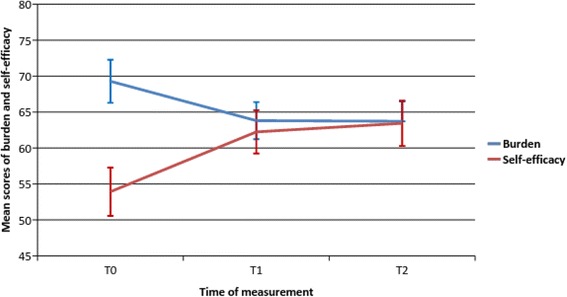
Results: Our results indicate that, after the training, self-efficacy increased significantly over time (p < 0.001) and that burden decreased significantly (p < 0.001). However, the results could not demonstrate the expected association between an increase of self-efficacy and decrease of burden. Caregivers expressed high appreciation for the training.
Conclusions: After following the IST program, family caregivers of patients with severe mental illness experienced a greater sense of competence and a significant decrease in burden. The training was greatly appreciated and satisfied caregivers' need to acquire the skills required in complex caregiving situations.
Trial registration: This study was retrospectively registered (14/01/2018) in the ISRCTN registry with study ID ISRCTN44495131 .
Keywords: Burden; Family caregivers; IST; Interaction-skills training; Psycho-education; Self-efficacy; Severe mental disorders.
Conflict of interest statement
Ethics approval and consent to participate
Under Dutch law, no medical ethical approval was needed for our study, see CCMO [24]. According to the Medical Research Involving Human Subjects Act (WMO), research falls under the scope of the WMO if:
It concerns medical-scientific research and;
Participants are subject to procedures or are required to follow rules of behavior.
Our study does not concern medical-scientific research, since it is an evaluation study among family members (non-patients) following a training program that is offered as care as usual in several Dutch mental health institutions over the past years.
This was confirmed by the Pro Persona Research Department (February 2016).
After receiving verbal and written information on the study, all participants / family members signed for informed consent.
Consent for publication
Not applicable.
Competing interests
The authors declare that they have no competing interests.
Publisher’s Note
Springer Nature remains neutral with regard to jurisdictional claims in published maps and institutional affiliations.
Figures
References
-
- Bentur N, Moualem A. The effect on family members of treating home hospitalized patients. Harefuah. 2001;140(5):386–391. - PubMed
-
- Ostman M, Hansson L. Family burden and care participation: a test-retest reliability study of an interview instrument concerning families with a severely mentally ill family member. Nordic Journal of Psychiatry. 2000;54:327–332. doi: 10.1080/080394800457156. - DOI
-
- Shah AJ, Wadoo O, Latoo J. Psychological distress in carers of people with mental disorders. British Journal of Medical Practitioners. 2010;3(3):18.
Publication types
MeSH terms
Associated data
LinkOut - more resources
Full Text Sources
Other Literature Sources
Medical
